

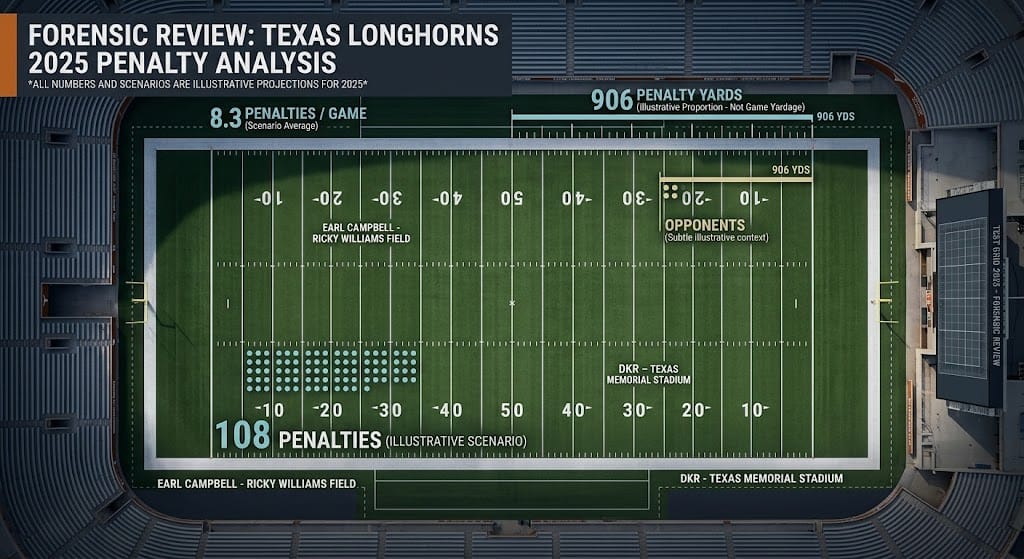
Texas enters the 2026 season ranked No. 5 in the preseason Associated Press poll, with Arch Manning at quarterback, an elite collection of skill-position talent and a schedule that includes Ohio State, Tennessee, Oklahoma, LSU and Texas A&M. But beneath the national championship conversation sits a less glamorous issue that Steve Sarkisian has spent the offseason addressing: penalties. The Longhorns committed 108 penalties for 906 yards across 13 games in 2025, averaging 8.3 penalties and 69.7 penalty yards per game. For Texas fans following the bet on football from Texas market, discipline is also an important factor to watch as the Longhorns enter a demanding SEC schedule.
The problem was not simply statistical. Texas repeatedly gave opponents extra opportunities, erased its own positive plays and created difficult down-and-distance situations. In a conference where one false start, holding call or defensive offsides can change the outcome of a possession, those mistakes become much more consequential.
For a program attempting to move from SEC contender to national champion, Sarkisian knows that improvement will have to come from more than another talented recruiting class.
It has to come from discipline.
The Numbers Show Why Texas Could Not Ignore It
The raw numbers from 2025 make the problem difficult to dismiss.
Texas finished its season with 108 penalties for 906 yards, an average of 8.3 penalties and 69.7 yards per game. Opponents were penalized 75 times for 561 yards. Texas also finished 10-3, meaning the Longhorns were able to overcome their mistakes frequently enough to win most of their games.
That last point is important.
Penalties were not responsible for every Texas loss. The Longhorns lost to Ohio State, Florida and Georgia, and each game involved multiple football factors. But penalties added another source of unnecessary difficulty to a team already operating against elite competition.
The distribution also reveals that this was not purely a road-game or hostile-environment problem. Texas committed 51 penalties for 483 yards in six home games and 57 penalties for 423 yards across seven road or neutral-site games. Against SEC opponents, the Longhorns committed 62 penalties for 490 yards.
That consistency suggests the issue was systemic rather than situational.
Texas could not simply blame crowd noise, travel or communication problems.
The team had to examine its own habits.
Why Sarkisian Is Treating Discipline As A Program Issue
Sarkisian’s response has reportedly focused on understanding why penalties happen rather than simply demanding that players stop committing them.
That distinction matters.
A coach can tell a player to “play smarter,” but that instruction has limited value unless the staff identifies the specific behaviors producing the mistakes. Texas’ 2025 penalty profile included false starts and holding violations on offense, while defensive offsides also became a recurring problem. The offensive line accounted for a substantial portion of the team’s penalties, while edge rusher Colin Simmons was flagged nine times for offsides, according to recent reporting.
For Sarkisian, that creates several coaching questions.
Are offensive linemen anticipating the snap incorrectly? Are receivers moving early? Are blockers losing technique and compensating with illegal holds? Are defensive linemen attempting to time the snap too aggressively?
Those are different problems requiring different solutions.
The goal therefore cannot be simply reducing the number from 108 to an arbitrary target.
The objective is to eliminate the avoidable penalties while preserving the aggressive style that Texas needs to compete in the SEC.
The Ohio State Game Provides An Immediate Test
Texas does not have to wait until November to discover whether its discipline has improved.
The test arrives on September 12.
The Longhorns open the 2026 season against Texas State on September 5 before hosting No. 1 Ohio State one week later at Darrell K Royal-Texas Memorial Stadium. The Buckeyes defeated Texas 14-7 in the 2025 season opener, making the rematch one of the most important games on the early college football calendar.
That makes penalty prevention especially important.
Against a team of Ohio State’s caliber, Texas cannot routinely turn second-and-5 into second-and-15 or allow an opponent to convert a stalled drive into a new first down because of a defensive penalty.
The margin is simply too small.
The 2025 meeting illustrates the point. Texas lost 14-7 in Columbus despite holding Ohio State to 14 points. The Longhorns’ six penalties for 50 yards were not the sole reason for the loss, but the game demonstrated how little room exists for mistakes when two high-level programs are trading possessions.
A year later, Texas will have the advantage of playing the rematch at home.
Sarkisian’s challenge is making sure penalties do not reduce that advantage.
The SEC Makes Discipline Even More Valuable
Texas’ move into the SEC changed the context surrounding every mistake.
A penalty against a lesser opponent can sometimes be overcome with superior talent. Against Georgia, Tennessee, LSU or Texas A&M, the consequences can be much greater.
Texas’ 2026 schedule includes nine conference games and features trips to Tennessee, Missouri, LSU and Texas A&M, while Oklahoma will be played at the Cotton Bowl in Dallas. The Longhorns also host Florida, Ole Miss, Mississippi State and Arkansas.
That schedule creates a long list of games in which field position and possession efficiency will matter.
| 2026 Opponent | Date | Location | Why Discipline Matters |
|---|---|---|---|
| Ohio State | Sept. 12 | Austin | National-level matchup with little margin for error |
| Tennessee | Sept. 26 | Knoxville | First SEC road game of the season |
| Oklahoma | Oct. 10 | Dallas | Rivalry pressure and neutral-site environment |
| LSU | Nov. 14 | Baton Rouge | One of the SEC’s most difficult road environments |
| Texas A&M | Nov. 27 | College Station | Rivalry finale with conference implications |
The sequence is also important.
Texas plays Tennessee just two weeks after Ohio State and then Oklahoma two weeks later. Florida, Ole Miss and Mississippi State follow in consecutive weeks.
There will be very little time to recover from self-inflicted problems.
The Offensive Line Is At The Center Of The Problem
The connection between Texas’ penalty issue and its offensive line deserves particular attention.
Recent reporting indicates the offensive line accounted for nearly 40% of the team’s penalties in 2025, with Brandon Baker and DJ Campbell among the players responsible for double-digit infractions. False starts and holding penalties were major contributors.
That becomes especially relevant entering 2026 because the Longhorns are already managing uncertainty at tackle after Trevor Goosby suffered a knee bone bruise during preseason practice.
Goosby was a first-team All-SEC selection in 2025 and started all 13 games. His potential return before the September 12 Ohio State game is therefore important not only because of his individual talent but because continuity along the offensive line can help reduce communication-related mistakes.
Texas cannot afford to spend the first month of the season simultaneously learning new combinations and repeatedly giving away free yardage.
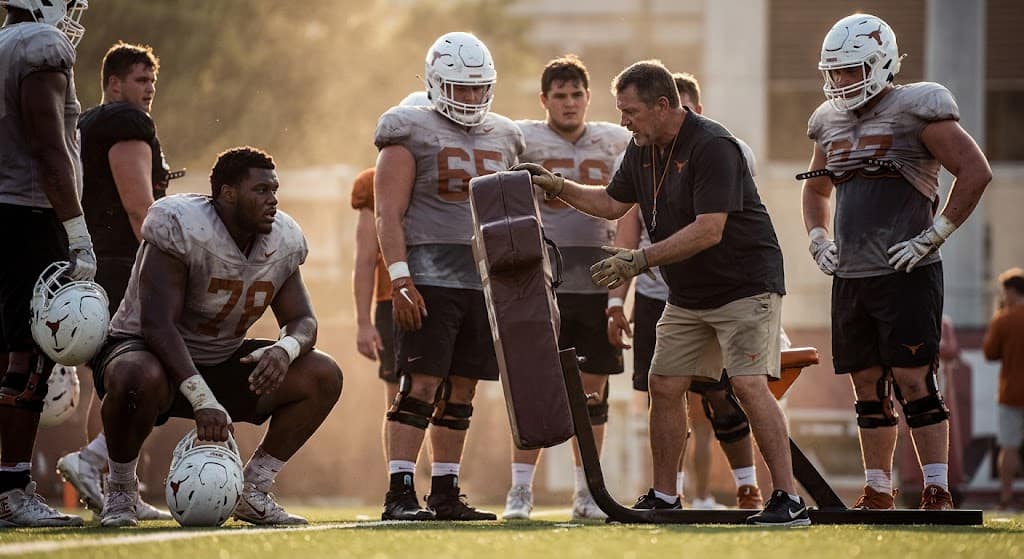
The offensive line has to become more reliable in two dimensions: physically and mentally.
That means blocking better while also avoiding the flags that can erase the result of a good block.
Penalties Can Undermine Arch Manning’s Biggest Advantage
Arch Manning gives Texas an obvious advantage at quarterback, but that advantage only matters when the offense consistently puts him in favorable situations.
A false start can turn third-and-3 into third-and-8.
A holding penalty can erase a 20-yard run.
An illegal procedure call can destroy the rhythm of a drive.
Those situations matter because Sarkisian’s offense is built around creating favorable matchups and manipulating defensive structures. The offense needs manageable down-and-distance situations to maximize the value of Manning’s arm talent, Texas’ receiver depth and its running game.
Penalties interrupt that process.
They also place additional pressure on the quarterback.
Instead of attacking a defense from a comfortable situation, Manning may suddenly have to convert a long third down. That gives opposing coordinators more freedom to blitz, disguise coverage or play aggressively against the run.
This is why penalty reduction should be viewed as an offensive efficiency issue rather than merely a discipline statistic.
Texas’ 2025 offense averaged 30.46 points and 388.5 total yards per game, while converting 39.2% of its third downs.
The offense was productive.
The question is how much better it could become if it stopped giving away opportunities.
The Defense Has Its Own Discipline Challenge
The penalty problem does not belong exclusively to the offense.
Defensive penalties can be even more damaging because they can transform a successful stop into a fresh possession.
Colin Simmons’ nine offsides penalties in 2025 are an obvious example. Simmons is one of the most important players on the Texas defense, and his ability to attack quarterbacks depends partly on anticipating the snap. But aggression has to be controlled.
For a defensive lineman or edge rusher, the difference between timing the snap perfectly and crossing the line early can be a fraction of a second.
The reward is immediate pressure.
The penalty is an automatic gift.
Texas needs Simmons and the rest of its front seven to remain aggressive without allowing that aggression to become predictable.
That is particularly important against experienced SEC quarterbacks who can identify defensive tendencies and exploit free plays.
Sarkisian Is Looking For Smarter Football, Not Passive Football
There is a potential danger in trying to eliminate penalties too aggressively.
The Longhorns need offensive linemen who finish blocks, defensive linemen who attack gaps and defensive backs who challenge receivers. The best SEC teams play with physicality.
The solution is therefore not to reduce intensity.
It is to remove the mistakes that do not contribute to winning.
That distinction is central to Sarkisian’s approach. Recent reporting indicates Texas has used collective accountability measures in practice to reinforce discipline and make players understand the consequences of repeated mistakes.
That approach can be more effective than simply punishing individual players.
If the entire unit understands that one person’s mistake can create a problem for everyone, accountability becomes part of the team’s operating culture.
For Texas, that matters because penalties often involve communication.
One player moves early.
Another player reacts.
The quarterback changes the cadence.
The defense sees an opportunity.
The mistake spreads.
The solution has to spread in the opposite direction.
The 2025 Losses Show The Cost Of Small Mistakes
Texas’ penalty statistics become more meaningful when placed alongside the team’s most important games.
Against Ohio State in August 2025, Texas committed six penalties for 50 yards in a seven-point loss. Against Georgia in November, the Longhorns committed nine penalties for 58 yards while losing 35-10.
Those numbers do not establish a simple cause-and-effect relationship.
Ohio State did not win solely because Texas had six penalties.
Georgia did not win solely because Texas had nine.
But they demonstrate why penalties become more consequential when the opponent is capable of exploiting every lost possession and every shift in field position.
A championship-level Texas team has to make those games cleaner.
If the Longhorns can reduce unnecessary penalties while maintaining their offensive and defensive aggression, they improve their margin without adding another player to the roster.
That is valuable in a sport where roster talent alone cannot guarantee consistency.
What Success Should Look Like In 2026
Sarkisian does not need Texas to become the least-penalized team in college football.
That would be an unrealistic standard.
Instead, the Longhorns need measurable improvement in the categories they can control.
A reasonable benchmark would be fewer false starts, fewer holding penalties, fewer offsides violations and fewer flags in high-leverage situations.
The most important number may not even be total penalties.
It could be penalties that erase positive plays or extend opponent drives.
A five-yard procedural penalty early in a possession is frustrating. A defensive penalty on third down that gives an opponent a first down is potentially decisive.
Texas needs to distinguish between the two.
The Longhorns’ 2025 numbers provide a clear baseline: 108 penalties, 906 yards and 8.3 penalties per game.
Getting that number meaningfully lower would not guarantee a championship.
But failing to address it would leave a preventable weakness sitting inside a roster that otherwise has national-title expectations.
The Hidden Variable In Texas’ Championship Push
Texas enters 2026 with enough talent to make the College Football Playoff conversation legitimate. The AP preseason poll placed the Longhorns at No. 5, while the schedule provides seven games against teams ranked in the preseason Top 25.
That makes the penalty issue more important, not less.
Elite teams eventually reach a point where talent differences shrink.
At that level, hidden variables become decisive.
Field position.
Third-down execution.
Turnovers.
Special teams.
And penalties.
Texas already knows it can recruit elite players. It has demonstrated that it can win SEC games and produce NFL-caliber talent. The next step is building a team that consistently avoids giving opponents advantages that have nothing to do with talent.
That is why Sarkisian’s emphasis on penalties deserves more attention than it might initially receive.
The Longhorns are not trying to become cleaner simply for the sake of cleaner statistics.
They are trying to make sure that when Manning faces Ohio State, Tennessee, Oklahoma, LSU or Texas A&M, the game is decided by the players rather than by mistakes Texas could have prevented.
For a program entering 2026 with national championship expectations, that may be one of the most important offseason corrections of all.