Texas entered Neyland Stadium on Sept. 26 carrying the No. 1 ranking in the country and the pressure that comes with it. The Longhorns left Knoxville with a 20-17 victory over No. 14 Tennessee, a 4-0 record and a much clearer picture of what their defense can become in SEC play.
At the center of that performance was Colin Simmons.
The junior edge rusher tied the Texas program record with five sacks, matching Shane Dronett’s single-game mark from 1990. Simmons finished with eight total tackles, five tackles for loss and a forced fumble as Texas produced 10 sacks, the second-highest single-game total in program history.
The numbers tell only part of the story.
Texas did not win in Knoxville because Arch Manning carried the offense or because the Longhorns produced another fourth-quarter comeback like the one against Ohio State. Texas won because its defense repeatedly put Tennessee quarterback Faizon Brandon in difficult situations, disrupted a Volunteers offense that had been one of the nation’s most productive rushing units and protected a three-point lead during the final minutes.
Simmons’ five-sack performance became the most visible example of that defensive identity.
Simmons Turned Pressure Into A Game-Changing Weapon
The most striking part of Simmons’ performance was not simply that he recorded five sacks. It was how consistently Texas was able to make Tennessee uncomfortable.
The official Texas statistics show Simmons recorded five sacks for 52 yards, along with six solo tackles, two assists, five tackles for loss and a forced fumble. Rasheem Biles added a sack, while Maraad Watson, Zina Umeozulu and Hero Kanu also recorded sacks.
That distribution matters.
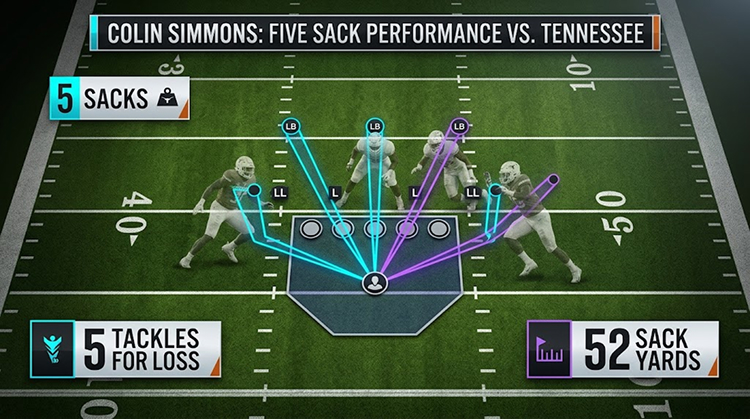
Tennessee could not simply focus every protection scheme on Simmons because Texas had other defenders capable of winning their individual matchups. The result was a defensive front that repeatedly attacked the quarterback without requiring the Longhorns to send every available defender.
That is one of the clearest signs of a defense becoming structurally dangerous.
For the latest Texas defensive statistics and game information, the official Texas football program provides the team’s complete weekly data and roster updates.
Simmons was the headline, but the pressure was collective.
Texas finished with 10 sacks and held Tennessee to 221 total yards, including only 70 rushing yards. The Volunteers had entered the game averaging nearly 300 rushing yards per contest, making the defensive performance particularly significant.
That is a much bigger development than one player’s record-tying afternoon.
Tennessee Could Not Build Its Offense Around The Run
Tennessee’s offense presented a specific challenge for Texas.
The Volunteers had the personnel to make Brandon’s job easier through the running game. DeSean Bishop and DeSean Morris combined for 67 rushing yards, while Brandon added 23 carries but finished with only two net rushing yards after accounting for sacks.
Texas disrupted that plan.
The Longhorns limited Tennessee to 70 rushing yards on 44 attempts, an average of just 1.6 yards per carry. That forced Brandon into more difficult passing situations and allowed Texas’ defensive front to dictate the rhythm of the game.
This is where Simmons’ performance becomes more meaningful.
A pass rusher becomes far more dangerous when the opponent cannot consistently establish the run. Tennessee had fewer opportunities to keep Texas’ defensive front honest, and Simmons repeatedly exploited the resulting passing situations.
The five sacks were therefore connected to the broader defensive performance rather than existing independently from it.
Will Muschamp Has Built A Defense That Can Win Games
Texas’ defensive transformation also reflects the work of defensive coordinator Will Muschamp.
The Longhorns did not simply rely on Simmons to create chaos. They used multiple defenders to pressure Brandon, while the secondary continued to limit the explosive passing plays Tennessee needed to erase the deficit.
The official Texas statistics show Rasheem Biles led the team with 13 tackles, including two tackles for loss and one sack. Justin Cryer added nine tackles, while Jelani McDonald finished with eight.
That gives Texas an important combination.
Simmons can create immediate disruption from the edge. Biles can attack from the second level. Kanu and the interior defenders can collapse the pocket. The defensive backs can then play with more aggression because the quarterback has less time to wait for routes to develop.
It is a complementary structure.
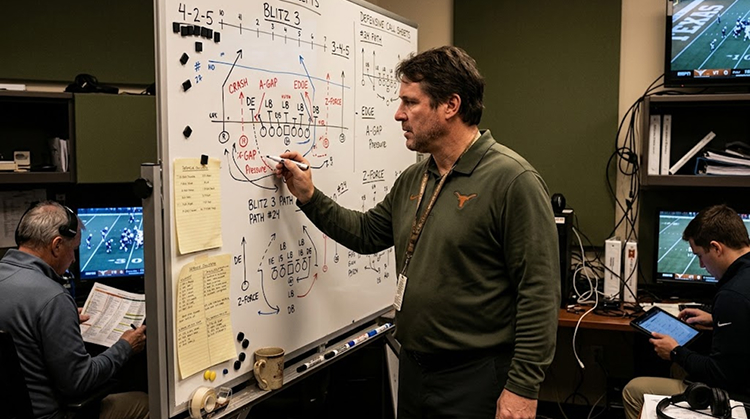
That distinction could become increasingly important as Texas moves through the SEC schedule.
One elite pass rusher can change a game. Multiple defenders capable of creating pressure can change the way an opponent has to design its entire offensive plan.
Hero Kanu Shows The Defensive Front Is Bigger Than Simmons
Simmons received most of the attention, but Hero Kanu delivered one of the other important moments for Texas’ defensive front.
Kanu recorded a sack against Tennessee, contributing to the 10-sack total. His ability to create pressure from the interior gave Texas another way to disrupt Brandon.
That is significant because elite defenses cannot depend entirely on edge pressure.
If an opposing offensive coordinator decides to use additional blockers against Simmons, Texas needs someone else to exploit the space created elsewhere.
Kanu provides that possibility.
His presence also changes how offenses evaluate Texas before the snap. A protection plan that accounts for Simmons must still consider Kanu, Biles and the other defenders capable of attacking gaps.
That makes the entire front more difficult to predict.
For a team entering the season with championship expectations, defensive unpredictability is one of the most valuable assets it can develop.
Simmons’ Five Sacks Changed How Tennessee Had To Protect Brandon
Tennessee’s protection problems became increasingly visible as the game progressed.
Simmons repeatedly won his matchup, and Tennessee eventually had to account for him as a constant threat. The problem was that concentrating too much attention on one edge player created opportunities for other Texas defenders.
That is exactly what happened.
Texas finished with 10 sacks despite Simmons accounting for half of them.
The statistic provides a useful way to understand the defensive identity.
If Simmons had recorded five sacks while the rest of the defense generated almost nothing, the performance could be treated primarily as an individual outburst.
Instead, Texas had five different players record at least one sack.
That makes Simmons’ five-sack performance more important because it demonstrates how one dominant player can amplify the effectiveness of everyone around him.
Texas Won Even Though The Offense Had Problems
The defensive identity became even more important because Texas’ offense was hardly dominant.
The Longhorns finished with 262 total yards, including just 61 rushing yards. Arch Manning completed 14 of 19 passes for 201 yards and threw one interception. Raleek Brown provided the biggest offensive contribution with 67 rushing yards and two touchdowns.
Brown’s second touchdown proved decisive.
His four-yard touchdown run with 5:41 remaining gave Texas a 20-10 lead, creating enough separation for the defense to protect the advantage during Tennessee’s late push.
Tennessee eventually cut the margin to 20-17 with a 30-yard touchdown pass from Brandon to Mike Matthews with 1:22 remaining.
Texas still needed one final defensive stand.
That is where the new identity became particularly important.
The Longhorns did not need to manufacture another offensive explosion. They needed their defense to finish the game.
It did.
The Final Hail Mary Became A Defensive Statement
Tennessee’s final possession ended with Brandon’s desperation Hail Mary attempt falling incomplete.
That final play was symbolic because Texas had spent most of the afternoon controlling the quarterback rather than allowing him to dictate the game.
The Volunteers produced 151 passing yards, but Brandon was sacked repeatedly and struggled to create consistent rhythm. Texas’ defense had already done enough to make the final possession about one desperate throw rather than a sustained scoring drive.
That is what championship-level defenses try to create.
They do not necessarily prevent every big play. They prevent opponents from stringing enough successful plays together to control the game.
Texas allowed Tennessee to score 17 points, but only 10 came from conventional offensive production. Tennessee also scored on a 57-yard punt return by Qua Moss.
The defensive numbers therefore remain striking.
The Longhorns gave up only one offensive touchdown through the first 58 minutes.
Simmons Also Provided A Lesson In Discipline
There was one complication to Simmons’ record-setting afternoon.
After one of his sacks, Simmons was penalized for an inappropriate celebration that Texas head coach Steve Sarkisian later described as unacceptable. The penalty erased the immediate impact of the play and became another example of the discipline issue Texas had already been trying to address. Simmons apologized after the game.
The incident is relevant because it shows the difference between aggression and control.
Simmons’ physicality was one of the primary reasons Texas won the game. His five sacks were a historic performance. But Texas also cannot afford to give opponents free yardage through emotional mistakes.
The Longhorns were penalized 11 times for 115 yards against Tennessee, making discipline an obvious issue despite the victory.
That makes Simmons’ celebration more than a side story.
Texas wants an aggressive defense. It needs that aggression to remain within the boundaries of disciplined football.
Sarkisian’s response was consistent with that standard: the player was not removed permanently, but the mistake had to be addressed.
The Defense Has Become Texas’ Safety Net
The most important development from Knoxville may be that Texas now has a defensive unit capable of protecting the team when the offense struggles.
That was not the story of the Ohio State game.
Against Ohio State, Texas trailed 23-3 entering the fourth quarter and needed 21 unanswered points to complete a historic 24-23 comeback.
Against Tennessee, the script was completely different.
Texas never needed 20 points in one quarter. It needed its defense to make a 20-point total stand up.
That is a different form of team development.
A championship contender needs an offense capable of winning shootouts, but it also needs a defense capable of winning games where the offense is inconsistent.
The Tennessee game provided evidence of the second version.
Texas’ defense held a ranked SEC opponent to 221 yards while producing 10 sacks.
For the broader Texas defense outlook, the Tennessee performance provides a much stronger data point than the early-season shutouts and blowouts because the opponent had enough talent to test the Longhorns in a hostile SEC environment.
Simmons’ Performance Gives Texas A Different Kind Of Confidence
The five-sack performance changes the way opponents have to prepare for Simmons.
Before Tennessee, he was already one of the most recognizable young defensive stars in college football. After tying the Texas single-game sack record in Knoxville, offensive coordinators now have a very specific problem to solve.
How do you prevent Simmons from taking over a game without creating opportunities for everyone else?
There is no simple answer.
Extra protection can reduce the number of routes available to the quarterback. Chip help from running backs or tight ends can affect the running game. Slide protections can create favorable matchups elsewhere. Quick passes can reduce the time Simmons has to reach the quarterback, but they also require receivers to win quickly against Texas’ secondary.
Every solution has a cost.
That is what makes a dominant pass rusher so valuable.
Texas’ Defensive Identity Is Now About Pressure And Depth
Simmons’ five sacks will dominate the statistical discussion, but the deeper story is the number of ways Texas can now attack an offense.
The Longhorns produced 10 sacks against Tennessee. Simmons had five. Biles had one. Kanu had one. Watson and Umeozulu also registered sacks.
That distribution suggests Texas does not need one player to make every play.
Simmons can be the centerpiece without becoming the entire defense.
That distinction will matter as the season progresses because opposing teams will have more film and more opportunities to design specific protections for him.
Texas now has evidence that those adjustments can create openings for other defenders.
The defense has become a system rather than a collection of individual talents.
The Next Challenge Is Sustaining The Standard
Texas is now 4-0 overall and 1-0 in SEC play after winning at Tennessee. The victory also extended the Longhorns’ run of success against ranked opponents, with Texas Athletics noting that the program now has an FBS-leading 16 victories over top-25 opponents since 2023.
But the Tennessee game also revealed areas that Texas must continue to address.
The offense produced only 262 yards.
The rushing attack averaged 1.7 yards per carry.
Texas committed 11 penalties for 115 yards.
And Tennessee still had an opportunity to tie the game late.
The defense prevented those issues from becoming decisive.
That is precisely why Simmons’ performance matters so much.
Texas did not simply discover that Simmons can record five sacks. It discovered that its defense can take control of an SEC game even when the offense is operating below its normal standard.
That is a significant development for a team carrying the No. 1 ranking.
The Longhorns now have a defensive identity built around pressure, versatility and depth. Simmons is the most visible symbol of it, but Biles, Kanu, Umeozulu, Watson, Cryer and the rest of the unit are part of the same transformation.
Five sacks made Colin Simmons the story of Sept. 26.
Ten sacks made Texas’ defense the story of the game.
And holding Tennessee to 70 rushing yards, 221 total yards and one offensive touchdown for nearly the entire afternoon showed why this Texas team can win SEC games in a completely different way than it did against Ohio State.
Simmons’ record-tying performance was spectacular.
The more important development is what it revealed about everyone playing alongside him.