Texas enters the Red River Rivalry as the No. 1 team in the country, but Oklahoma may have the specific defensive profile capable of exposing the Longhorns’ biggest weakness. The Sooners are 2-2 after losses to Michigan and Georgia, yet their defense has repeatedly kept games within reach. That matters against a Texas offense averaging 231.25 passing yards and struggling to establish consistent production on the ground. With the Longhorns preparing for Oklahoma at the Cotton Bowl on Saturday, Oct. 10, at 2:30 p.m. CT, the matchup may depend less on Texas’ overall talent and more on whether Steve Sarkisian can find enough answers against an aggressive Sooners defense. Texas 2026 football statistics
Oklahoma’s Record Does Not Tell The Full Defensive Story
Oklahoma’s 2-2 record makes the Sooners look vulnerable, but the defensive numbers tell a more complicated story. Oklahoma opened the season by shutting out UTEP 51-0, held New Mexico to 185 total yards in a 14-6 victory and limited Michigan to 289 total yards in a 17-10 loss. The Georgia game was the major setback, with the Sooners allowing 41 points and 306 total yards in Athens.
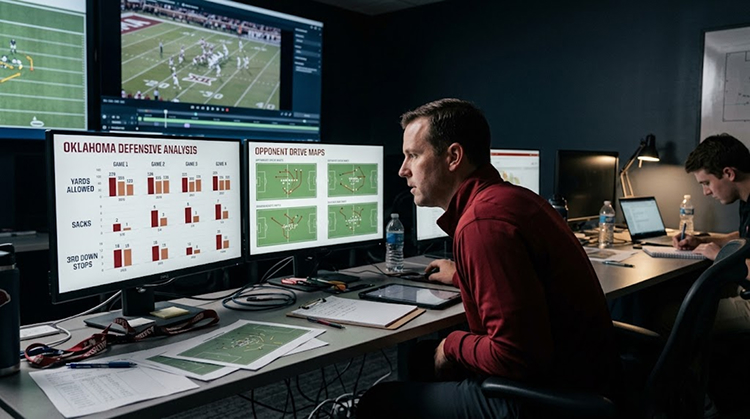
That four-game sequence shows why Texas cannot evaluate Oklahoma simply by looking at its record. The Sooners have already demonstrated that their defense can control the pace of a game. New Mexico managed only 69 rushing yards and 116 passing yards, while Michigan converted just three of 13 third-down opportunities against Oklahoma.
Oklahoma also entered the season with significant experience up front. Defensive tackles David Stone, Jayden Jackson, Danny Okoye, Adepoju Adebawore and Taylor Wein were identified as key returning contributors before the season, giving Brent Venables a deep group capable of generating pressure without relying on one player. Oklahoma defensive preview
Oklahoma Has Already Shown It Can Generate Pressure
The Sooners have recorded 13 sacks through four games, including four against UTEP, two against Michigan, six against New Mexico and one against Georgia. The six-sack performance against New Mexico is particularly relevant because it demonstrates how quickly Oklahoma can turn pressure into a defensive game plan when the opponent struggles to stay ahead of the chains. Oklahoma sack statistics
The challenge for Texas will be preventing those pressure numbers from turning into repeated second- and third-and-long situations.
That responsibility begins with the offensive line. Texas has already faced questions about its protection and rushing efficiency, and Oklahoma will have an opportunity to attack both areas simultaneously. A defense does not need to sack Manning repeatedly to disrupt the Longhorn offense. If Oklahoma can force hurried throws, shorten the pocket and eliminate easy rushing lanes, it can reduce the number of comfortable situations available to Texas’ quarterback.
That could become especially important because Manning has shown that his best football comes when Texas can establish rhythm early.
Arch Manning Needs More Than Big Plays
Manning has already shown the ability to produce explosive moments. Against Texas State, he threw for 305 yards and four touchdowns. Against Tennessee, however, the game became much more difficult once Texas’ rushing attack failed to consistently move the chains.
The Oklahoma matchup could follow a similar pattern.
The Sooners do not need to completely shut down Manning. Their goal can be much simpler: make Texas earn every first down. That means disguising coverage, creating pressure without selling out against the run and forcing Manning to make repeated accurate decisions in tight windows.
For Texas, the answer cannot simply be throwing more passes.
A one-dimensional passing attack would allow Oklahoma to increase pressure and reduce the number of defensive looks it must prepare for. Sarkisian needs the running game to create manageable down-and-distance situations, even if Texas does not suddenly become a dominant rushing offense.
David Stone Gives Oklahoma Another Interior Threat
One of Oklahoma’s most important defensive pieces is defensive tackle David Stone, whose presence gives the Sooners another way to disrupt an offense from the middle.
Stone already produced a critical play against New Mexico, stopping Scottre Humphrey on fourth-and-1 near the Oklahoma goal line. That play illustrated the value of Oklahoma’s interior defensive strength: the Sooners can win short-yardage situations without relying entirely on edge pressure.
That matters against Texas because interior disruption can change the way Manning operates from the pocket.
If Oklahoma can collapse the middle while its edge defenders maintain outside contain, Manning may have fewer escape lanes and less time to wait for longer developing routes. Texas’ receivers can create separation, but those routes have to develop before Oklahoma’s pressure arrives.
The Longhorns therefore face a protection problem that goes beyond identifying one dangerous pass rusher.
Third Down Could Decide The Matchup
Texas’ performance on third down has already become one of the clearest indicators of its offensive inconsistency.
The Longhorns converted only three of 13 third downs against Tennessee, and that helped keep the game within one possession deep into the fourth quarter. Texas ultimately survived because its defense repeatedly ended Tennessee drives.
That formula is dangerous to repeat against Oklahoma.
If the Sooners consistently create third-and-long situations, they can unleash their pass rush while forcing Texas to rely on Manning’s arm. Conversely, if Texas stays ahead of the chains, Oklahoma will have to defend the run, intermediate passing game and play-action concepts simultaneously.
The difference between third-and-3 and third-and-9 may therefore be more significant than the raw number of Oklahoma sacks.
Texas’ Receivers Could Force Oklahoma To Change Its Approach
Oklahoma cannot concentrate exclusively on Manning and the rushing attack because Texas has legitimate perimeter threats.
Ryan Wingo has already emerged as Texas’ leading receiver with 239 yards through four games, while Cam Coleman has 194 and Emmett Mosley V has 173. Those numbers give Sarkisian several options for creating favorable matchups.
That could force Oklahoma to choose between bringing additional pressure and protecting its secondary.
If the Sooners blitz too frequently, Manning has the opportunity to attack one-on-one coverage with receivers capable of winning vertically. If Oklahoma keeps more defenders in coverage, Texas may have more time to establish its passing concepts and eventually create openings underneath.
This is where Sarkisian’s play-calling becomes critical. The goal should be to make Oklahoma defend multiple answers rather than allowing the Sooners to dictate the terms of every snap.
Texas’ Offensive Numbers Create The Opening
The biggest reason Oklahoma’s defense is such a concern is that Texas has not consistently forced opponents to defend the entire field.
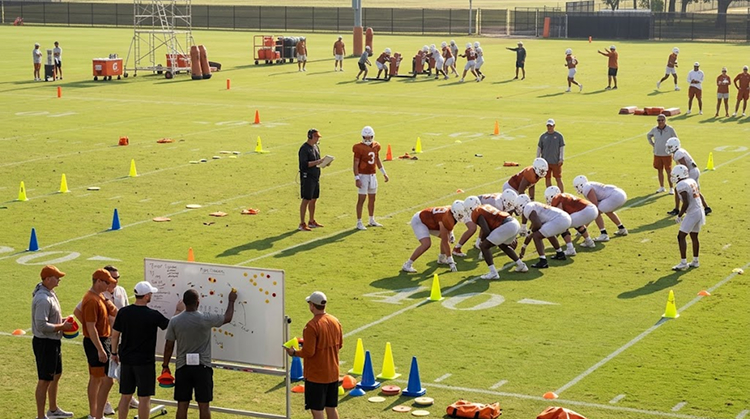
Arch Manning has produced 862 passing yards, seven touchdowns and a 63.48% completion rate through four games. Those numbers are strong enough to make Texas dangerous, particularly with receivers such as Ryan Wingo, Cam Coleman and Emmett Mosley V. The problem is that Texas has not matched its passing ability with the same level of consistency on the ground.
That creates a tactical opportunity for Oklahoma.
If the Sooners can limit early-down rushing success, they can put Manning into more obvious passing situations. That allows Oklahoma’s defensive front to attack protections rather than reacting to a balanced offense. Texas has already experienced the consequences of that type of game against Tennessee, when the Longhorns finished with only 61 rushing yards and 262 total yards.
Manning still completed 14 of 19 passes for 201 yards against Tennessee, but Texas converted only three of 13 third downs. The Longhorns won because their defense dominated the matchup, producing 10 sacks and holding Tennessee to 221 total yards. Texas-Tennessee game statistics
Oklahoma’s Defensive Success Has Come From Complementary Football
The Sooners’ defensive performance against New Mexico was a clear example of how the unit can support an offense that is struggling.
Oklahoma won 14-6 despite producing only 299 total yards. The defense held New Mexico to 185 yards and prevented the Lobos from sustaining enough drives to create a comeback. That is the kind of football Oklahoma can realistically try to play against Texas.
The Sooners do not necessarily need to score 30 points.
If Oklahoma can hold Texas in the low 20s, create a few negative plays and force the Longhorns to settle for field goals, the pressure shifts onto Manning and the Texas offense. That is particularly relevant because Texas has already won a 20-17 game against Tennessee despite producing only 262 total yards.
Oklahoma has shown it can play that kind of low-scoring game. Oklahoma-New Mexico defensive performance
The Georgia Game Shows The Defensive Risk
There is also a reason Texas should not overreact to Oklahoma’s defensive success.
Georgia exposed weaknesses in the Sooners’ overall structure, scoring 41 points while producing 306 total yards. Oklahoma’s defense recorded only one sack in that game, and Georgia converted three of 12 third downs while controlling the game with explosive scoring stretches.
Texas can study that film for clues.
The Longhorns have more proven receiving depth than Oklahoma faced in some of its earlier games, and Manning has a higher passing ceiling than the quarterbacks Oklahoma faced during its 14-6 win over New Mexico. If Texas can prevent the Sooners from creating repeated negative plays, the matchup could look very different from Oklahoma’s earlier defensive performances.
That is why this game is less about whether Oklahoma has a good defense and more about whether Texas can force that defense into uncomfortable decisions.
The Cotton Bowl Adds Another Variable
The setting itself makes the matchup more difficult to predict.
Texas and Oklahoma will meet at the Cotton Bowl in Dallas on Oct. 10, with kickoff scheduled for 2:30 p.m. CT on ABC. The game is played in the middle of the State Fair of Texas, creating one of the most distinctive environments in college football. More than 100,000 people travel to the State Fair for the Red River Rivalry each year, according to the fair’s official information. State Fair Red River Rivalry information
That atmosphere can amplify defensive momentum.
A third-down stop, sack or turnover can immediately shift the energy across the stadium. Oklahoma’s defense has the personnel to create those moments, and Texas has to prevent one negative play from becoming a sequence of them.
The Longhorns’ last four meetings with Oklahoma have produced three Texas victories, including a 34-3 win in 2025. But the rivalry’s history also shows how quickly the game can move away from expectations. Texas-Oklahoma game history
Sarkisian Needs A Different Offensive Formula
The most important adjustment for Texas may be resisting the temptation to make the game entirely about Manning.
Texas has enough receiving talent to attack Oklahoma vertically, but the offense needs complementary production. Raleek Brown’s performance against Tennessee showed the value of having a running back who can create scoring opportunities even when the overall rushing attack is inconsistent. Brown finished with 67 rushing yards and two touchdowns in the 20-17 win.
The return of Hollywood Smothers could also matter if Texas can use multiple backs to keep Oklahoma from predicting personnel tendencies.
That would allow Sarkisian to create more favorable down-and-distance situations and reduce the pressure on Manning to make difficult throws on every possession.
The First Quarter Could Reveal Texas’ Plan
One of the most revealing parts of the Red River Rivalry could be the opening quarter.
If Texas immediately establishes the run and uses short completions to move the chains, Oklahoma may have to reduce its pressure packages. If Texas struggles to gain yards early, the Sooners could become increasingly aggressive and force Manning into a game of quick decisions.
That makes the opening possessions strategically important.
Texas does not need to score on every early drive. It needs to show Oklahoma that the defense cannot simply sit back and wait for predictable passing downs.
A few successful runs, a screen, a tight end target or a controlled play-action sequence could have value even without producing explosive yardage. The objective would be to make Oklahoma defend the entire offensive structure.
Oklahoma’s Defense Is The Biggest Test Of Texas’ Offense
Texas enters the rivalry with the better record, the No. 1 ranking and a defense that has already demonstrated it can win a major SEC game. Oklahoma, however, possesses the defensive characteristics that could make the matchup uncomfortable.
The Sooners have 13 sacks through four games, have held two opponents below 200 total yards, and showed against New Mexico that they can win a game primarily through defensive control. Their 2-2 record does not erase those performances.
For Texas, the central question is therefore straightforward: can Sarkisian build an offense that keeps Oklahoma from dictating the game?
If the Longhorns run effectively enough to stay ahead of the chains, Manning should have opportunities to exploit Oklahoma’s secondary. If Texas falls behind schedule repeatedly, the Sooners’ pass rush and third-down defense could become the defining story of Red River.
The game is scheduled for Saturday, Oct. 10, at 2:30 p.m. CT at the Cotton Bowl. For a Texas team carrying the No. 1 ranking into Dallas, the biggest challenge may come from an Oklahoma defense that has already shown it can make talented offenses uncomfortable. Official Texas-Oklahoma game information