
Texas has reached one of the most revealing stages of its 2026 preseason: full-pad practices. For Steve Sarkisian, this is where the evaluation moves beyond offseason projections and into a more demanding test of whether the Longhorns can play the physical style required to survive the SEC. After five early practices built around base offensive work, third-down situations and red-zone execution, Texas has begun testing that identity with full contact ahead of its first full-pads scrimmage.
The timing is important. Texas opens the season against Texas State on September 5 before hosting Ohio State on September 12, then enters a nine-game SEC schedule that will demand depth and consistency across the line of scrimmage. The Texas football 2026 roster gives Sarkisian significant experience up front, but the question is whether that experience can translate into the kind of physical dominance Texas will need against the conference’s strongest teams.
Physicality is therefore more than a preseason buzzword. It is becoming one of the central questions surrounding Texas’ championship ambitions.
Steve Sarkisian Is Making Physicality A Program Priority
Sarkisian has spent much of the early portion of camp emphasizing a point that may sound simple but has major consequences for Texas’ 2026 season: the Longhorns need to become more physical.
Recent reporting from the Houston Chronicle indicates that Sarkisian specifically identified physicality as an area Texas must improve, particularly on offense. He pointed toward deficiencies in the rushing game and red-zone execution against elite competition, areas that became increasingly important when Texas faced teams capable of matching its overall athleticism.
That assessment changes the way full-pad practices should be viewed.
The purpose is not simply to see which players can deliver the biggest hits. Sarkisian is trying to establish whether his team can consistently win the types of plays that decide close SEC games: short-yardage situations, goal-line snaps, inside runs, pass protection against elite fronts and third downs when defenses know exactly what the offense needs.
Texas has plenty of skill-position talent. Arch Manning is entering his first season as the full-time starting quarterback, Ryan Wingo is expected to play a major role at receiver, and players such as Ryan Niblett provide additional explosiveness.
But those players cannot determine the outcome of every possession.
Eventually, Texas has to win at the point of attack.
The Offensive Line Is The First Physicality Test
The most encouraging part of the early full-pad work may be what has been reported about the offensive line.
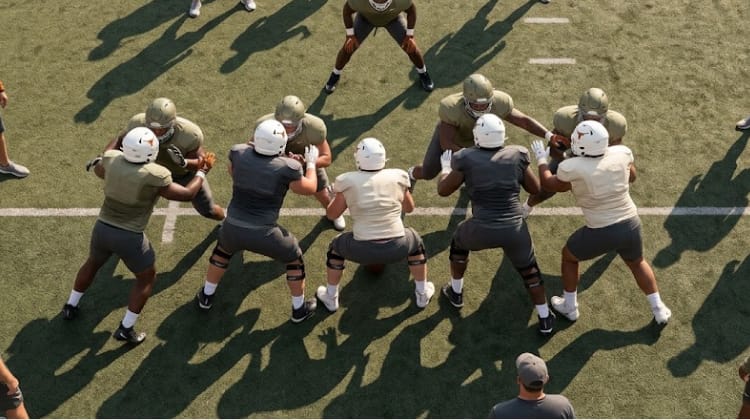
Connor Robertson, Trevor Goosby and Brandon Baker have been among the veterans singled out during camp, while Melvin Siani has also been mentioned as part of the physical push up front.
The current Texas roster lists Robertson as a senior at 6-foot-4 and 316 pounds, Goosby as a junior at 6-foot-7 and 325 pounds, Baker as a junior at 6-foot-4 and 315 pounds, and Siani as a senior at 6-foot-6 and 317 pounds.
Those numbers demonstrate why Texas has the physical dimensions to build a strong front, but size alone does not solve the problem.
| Offensive Lineman | 2026 Status | Listed Size |
|---|---|---|
| Connor Robertson | Senior | 6’4″, 316 lbs. |
| Trevor Goosby | Junior | 6’7″, 325 lbs. |
| Brandon Baker | Junior | 6’4″, 315 lbs. |
| Melvin Siani | Senior | 6’6″, 317 lbs. |
The challenge is consistency.
An offensive line can dominate one drive and struggle on the next. Against an SEC opponent, those fluctuations can turn a touchdown opportunity into a field goal or a manageable third down into a long-yardage situation.
For Manning, this becomes even more significant.
A young quarterback can be protected statistically by an explosive passing game, but championship-level offenses still need the ability to function when the passing game is disrupted. If Ohio State or an SEC opponent can consistently collapse the pocket and eliminate Texas’ rushing attack, Sarkisian’s offense becomes easier to defend.
The full-pad practices are therefore an early examination of whether Texas can prevent that scenario.
Will Muschamp Is Bringing Another Layer Of Physicality
The defensive side of the ball has also contributed to the tougher tone.
Defensive coordinator Will Muschamp has implemented a “No Thud, No Play” mentality during camp, creating an environment where the defense is expected to bring significant intensity to running periods.
That approach matters because Texas’ offense does not have to wait until September to discover what SEC physicality feels like.
It can experience it every day in practice.
A defense featuring players such as Colin Simmons and Jelani McDonald gives Texas a demanding test, particularly for the offensive line and quarterback. The goal is to create an internal standard where winning against teammates becomes difficult enough that game-day competition does not represent a dramatic jump in intensity.
This is particularly important for a roster that includes 47 new players through transfers and freshmen, according to recent reporting.
A large influx of new players creates opportunity, but it also makes physical identity harder to establish.
Players can learn terminology relatively quickly.
They can learn assignments.
Building the trust necessary to play violent, coordinated football together takes longer.
Texas Has To Be Ready For Ohio State Immediately
The schedule leaves Texas very little room for a slow physical development.
The Longhorns open against Texas State on September 5, but the real early measuring stick arrives seven days later when Ohio State visits Austin.
That matchup makes the first full-pads scrimmage especially relevant.
Texas will have an opportunity to discover whether its offensive line can handle sustained contact, whether the running game can create movement and whether the defense can maintain its intensity for an extended period.
The Texas Longhorns schedule places the Ohio State game on September 12, giving Sarkisian only one regular-season game before facing one of the country’s most prominent programs.
Ohio State’s trip to Austin is already being treated as one of the defining road games on the Buckeyes’ 2026 schedule, further raising the importance of the matchup.
That game could expose physical weaknesses immediately.
If Texas cannot consistently protect Manning, run against a talented front or defend Ohio State’s rushing attack, the problems will be difficult to hide.
Conversely, if Texas controls the line of scrimmage against Ohio State, the perception of Sarkisian’s team changes quickly.
The Running Game Needs To Become More Than A Supporting Act
Texas’ need for physicality is particularly important in the running game.
Sarkisian’s offense has traditionally been associated with quarterback development and creative passing concepts, but the SEC presents situations where throwing the ball 40 times is not always the ideal solution. Wind, defensive fronts, field position, injuries and game script can all force a team to win differently.
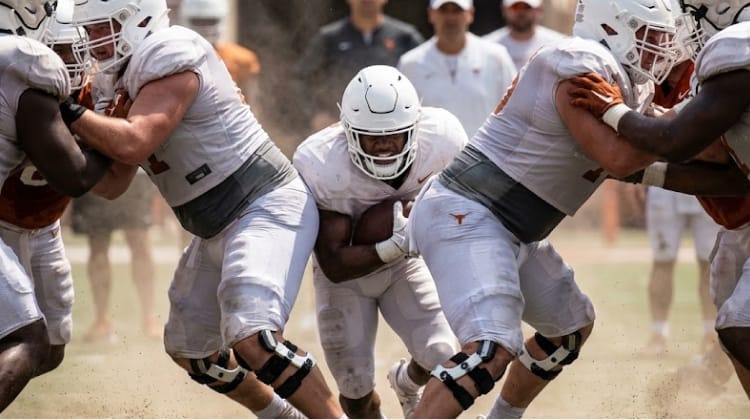
Recent Houston Chronicle reporting specifically connected Sarkisian’s renewed physical emphasis with Texas’ previous rushing and red-zone shortcomings.
That makes the running back room one of the most important areas to monitor during the remaining weeks of camp.
Texas has added significant experience and competition to its roster, including senior Raleek Brown and junior Hollywood Smothers, while Derrek Cooper has also been identified among the players contributing to the physical tone of camp.
The objective should not simply be accumulating rushing yards.
Texas needs a running game that can produce when the defense knows what is coming.
That means converting third-and-2.
It means finishing drives from inside the 10-yard line.
It means protecting a fourth-quarter lead without requiring Manning to make a difficult throw on every possession.
That is the difference between an offense that produces impressive statistics and one that can control an SEC game.
The SEC Will Punish Inconsistency
Ohio State may be the first major test, but the SEC schedule is where physicality becomes a weekly requirement.
Texas will eventually have to deal with different defensive structures, elite defensive linemen, experienced linebackers and offenses capable of forcing long possessions. The physical burden is cumulative.
That is why depth matters as much as the starting lineup.
A team can survive one difficult matchup with its best five offensive linemen playing nearly every snap. It is much harder to survive an entire season if injuries force inexperienced players into major roles.
The current Texas football roster shows the depth of the offensive line, with players such as Robert Sweeney, Brooks Kieschnick Jr., Jaydon Chatman, Jackson Christian, Andre Cojoe, Paris Patterson and Nicolas Robertson alongside the more established starters.
That depth will matter when Texas reaches the second half of the schedule.
The physicality question is therefore also a roster-management question.
The Red Zone May Be The Most Important Indicator
One of the clearest ways to evaluate Texas’ physical progress will be red-zone performance.
Inside the 20-yard line, the field becomes compressed. Passing windows shrink. Defensive speed becomes less valuable in open space because there is less room to create separation.
That is where offensive line strength and running-game efficiency become critical.
Texas can move the ball between the 20s with Manning’s arm and its collection of receivers. The harder test is whether it can finish drives when an opponent has fewer areas of the field to defend.
Sarkisian’s comments about improving red-zone and rushing performance make this one of the most important areas to monitor during camp.
A championship-level Texas team should be able to enter the red zone and make opponents uncomfortable.
It should be able to run the football when the defense expects it.
It should be able to protect Manning long enough to create a second or third option.
And when the ball reaches the goal line, the offensive line should be capable of moving defenders backward.
That is what physical identity looks like in measurable terms.
The Bigger Question Is Whether Texas Can Sustain It
The first full-pad practices are encouraging, but they do not prove that Texas has solved its physicality concerns.
Training-camp intensity is one thing.
Sustaining that intensity through a nine-game SEC schedule is another.
The most important development over the next several weeks will be whether the physical approach becomes consistent across practices and eventually transfers to games.
That will require the offensive line to maintain its standard, the running backs to consistently finish runs, the receivers to block effectively and the defense to keep creating difficult practice environments.
Players such as Robertson, Goosby, Baker and Siani provide experience up front. Cooper provides another option in the running game. Wingo gives the offense an explosive receiving threat. Manning supplies the quarterback talent around which Sarkisian can build.
But the foundation is still physical.
Texas’ Championship Ceiling May Start In The Trenches
Texas entered the 2026 season with enough talent to generate national championship discussion. The question is whether talent can become a complete team.
The early full-pad practices are providing Sarkisian with the first real opportunity to answer that question.
The Longhorns do not need to abandon the offensive identity that has made Sarkisian one of college football’s most respected offensive coaches. They need to add another layer to it.
The passing game can create explosive plays.
Manning can make difficult throws.
Wingo and the rest of the receiver room can stretch defenses.
But when Texas faces an elite SEC opponent late in the season, there will eventually be a possession where none of those advantages are enough.
There will be a third-and-2.
There will be a goal-line snap.
There will be a fourth-quarter drive when the opponent knows Texas wants to run.
There will be a moment when the Longhorns have to move someone against his will.
That is why these first full-pad practices matter.
Sarkisian is not simply preparing Texas to play harder. He is trying to establish whether this roster can develop the physical foundation required to turn elite individual talent into a championship-level SEC team.
The first major answer could arrive on September 12 against Ohio State.
The larger answer will come much later, when Texas reaches the most demanding stretch of its SEC schedule and discovers whether the physical identity built in August can survive November.