
Texas is adding another layer to an already crowded preseason awards conversation. On August 25, 2026, quarterback Arch Manning, wide receiver Cam Coleman and offensive lineman Trevor Goosby were named to the preseason watch list for the Earl Campbell Tyler Rose Award, giving the Longhorns three representatives for an honor built around offensive production, Texas ties and the character traits associated with its namesake.
The recognition matters because the three players represent very different pieces of Steve Sarkisian’s offense. Manning is the quarterback expected to carry championship-level expectations, Coleman is a major transfer addition expected to transform the receiving corps, and Goosby is the veteran left tackle responsible for helping keep Manning protected. Their inclusion also reinforces a larger point about the 2026 Longhorns: Texas has legitimate award-level talent at multiple levels of the offense.
For a program entering a season with Texas State on September 5 and Ohio State on September 12, the timing is significant. The Longhorns do not have months to develop their identity. The spotlight begins immediately, and these three players are positioned to become central figures in determining how far the team can go.
Why Three Longhorns Made The Same Watch List
The Earl Campbell Tyler Rose Award is different from many national honors because its eligibility criteria are connected directly to Texas. The award recognizes the top offensive player in Division I football who also meets a Texas connection, such as playing football at and graduating from a Texas high school or currently playing at a Texas four-year institution. The award also emphasizes integrity, teamwork, sportsmanship, drive, community and perseverance.
That makes Texas particularly relevant to the award, but being placed on the watch list still requires a player to enter the season with a credible national profile.
Manning, Coleman and Goosby arrive at that point through completely different paths.
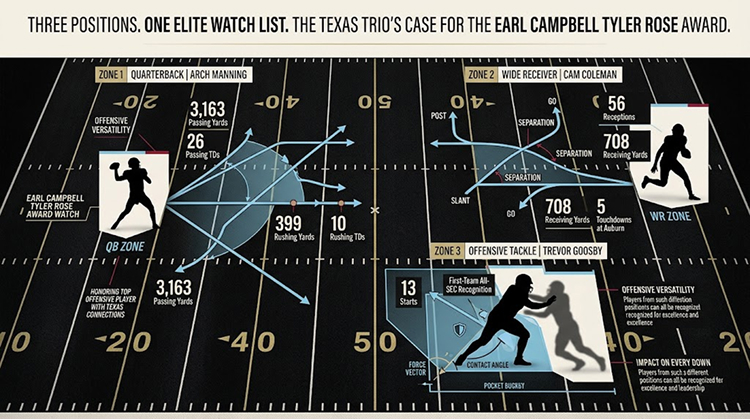
Manning enters 2026 after producing 3,163 passing yards and 26 touchdown passes in 13 starts during his first full season as Texas’ starter in 2025. He also rushed for 399 yards and 10 touchdowns, making him the second-leading rusher on the team and giving the Longhorns a quarterback capable of influencing games with both his arm and legs.
Coleman enters after transferring from Auburn, where he started all 12 games in 2025 and led the Tigers with 56 receptions for 708 yards and five touchdowns. His 12.6 yards per catch provided a proven downfield element before he even played his first game for Texas.
Goosby brings a different kind of value. He was a 2025 First-Team All-SEC selection after starting all 13 games at left tackle. That experience becomes particularly important for a Texas offense that expects to face elite defensive fronts throughout the SEC schedule.
Together, they represent the quarterback, perimeter and protection components of an offense that needs to perform at a championship level.
Arch Manning’s Award Case Starts With His 2025 Finish
Manning’s presence on the watch list is hardly a surprise. This is his second consecutive preseason appearance on the Earl Campbell Tyler Rose Award watch list, and he was one of 22 semifinalists for the award in 2025.
The more interesting question is what his second season as the starter can look like.
His 2025 numbers already provide a substantial foundation. Manning completed 248 of 404 passes, good for a 61.39 percent completion rate, while throwing for more than 3,100 yards. His 26 passing touchdowns were complemented by 10 rushing scores.
But the most compelling portion of his statistical profile came late in the season.
Over Texas’ final six games, Manning produced 1,714 passing yards, 205 rushing yards and 20 total touchdowns. He averaged 320 yards of total offense per game during that stretch and helped Texas win seven of its final eight games.
That late-season production is important because award races are rarely decided by preseason reputation alone. Manning has already demonstrated that he can produce when the schedule becomes more demanding.
His performance against Michigan in the Citrus Bowl further elevated the profile. Manning threw for 221 yards and two touchdowns while rushing for a career-high 155 yards and two additional scores in Texas’ 41-27 victory. He finished with 376 total yards and four touchdowns against the Wolverines.
The 2026 schedule, however, provides a much different test.
Texas opens against Texas State before hosting Ohio State on September 12. Tennessee follows on September 26, with Oklahoma, Florida, Ole Miss, Missouri, LSU and Texas A&M also appearing later on the schedule.
For Manning, the award case will therefore be tied closely to whether his production survives that level of competition.
Texas fans can follow the broader Longhorns 2026 season coverage as Manning’s statistical case develops.
Cam Coleman Gives Manning A Different Kind Of Weapon
Coleman’s selection may be just as important to Texas’ offensive outlook because it represents what the Longhorns believe their passing game can become.
The junior receiver arrived from Auburn in spring 2026 after two seasons in which he played 23 games and made 22 starts. His 2025 campaign included 708 receiving yards and five touchdowns, but his production was not limited to a single type of game. He recorded 107 yards against Missouri, 143 against Vanderbilt and 88 against Oklahoma.
That history gives Sarkisian a receiver with established SEC experience before Coleman ever takes a meaningful snap for Texas.
It is also worth remembering that Coleman is not the only highly regarded receiver in Austin. Ryan Wingo was already one of the team’s most productive returning receivers, and both Wingo and Coleman were named to the Biletnikoff Award preseason watch list on August 19.
That creates an intriguing dynamic for Manning.
Instead of relying on one primary receiver, Texas can potentially force defenses to account for multiple perimeter threats. If Coleman commands safety help, opportunities can open for Wingo and other receivers. If defenses attempt to play more aggressively against the run, Manning can attack those structures vertically.
Coleman’s value to the Earl Campbell Award race therefore extends beyond his individual statistics. His production could directly influence Manning’s numbers as well.
The award recognizes one offensive player, but Texas’ offensive construction could make it easier for several Longhorns to build compelling cases simultaneously.
Trevor Goosby Represents The Foundation Of The Offense
Goosby’s inclusion provides perhaps the clearest reminder that offensive success starts well before the quarterback throws the football.
The senior offensive lineman was a First-Team All-SEC performer in 2025 after starting every game at left tackle. He also earned preseason First-Team All-America recognition from Walter Camp and was placed on the Lombardi Award and Outland Trophy watch lists entering 2026.
His job becomes particularly important because Manning’s value to Texas depends on keeping the quarterback upright.
Goosby already has experience protecting Manning against the highest level of competition. He started at left tackle in Texas’ 2025 opener against Ohio State, when Manning made his first career start against the Buckeyes. The Longhorns lost that game 28-14, but the experience gives Goosby valuable familiarity with the environment Texas will encounter again on September 12.
The upcoming rematch creates a fascinating connection between Goosby’s individual award case and Manning’s.
A quarterback cannot produce efficiently without protection. A left tackle cannot build an award case without the offense producing consistently. Their performances are connected.
And Texas’ schedule means that connection will be tested immediately.
The Award Watch List Is Only The Beginning
Being named to a preseason watch list does not guarantee a semifinalist position, much less a finalist spot.
The Earl Campbell Tyler Rose Award’s process moves from the preseason watch list to a group of up to 16 semifinalists in November, followed by up to five finalists in December. Weekly recognition during the season also helps establish the national conversation around candidates.
That structure makes the opening weeks especially important.
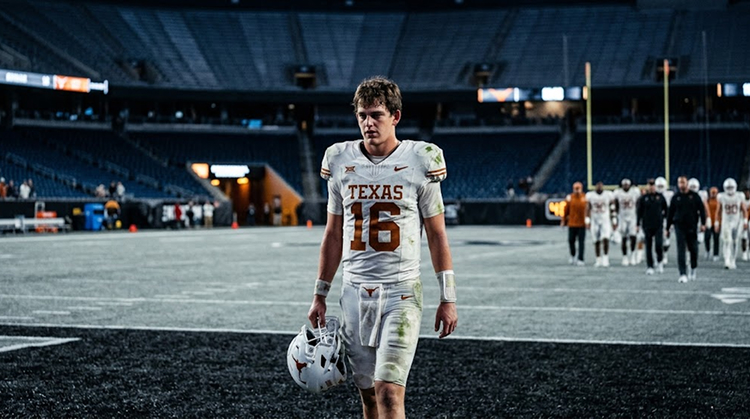
Texas State should give the Longhorns an opportunity to establish rhythm before the Ohio State matchup. But the Buckeyes will provide the first serious measuring stick for Manning, Coleman and Goosby.
The September 12 game is scheduled for 6:30 p.m. CT at Darrell K Royal-Texas Memorial Stadium, with ABC carrying the nationally significant matchup.
The matchup also has historical weight. Ohio State defeated Texas 28-14 in the 2025 season opener, meaning the Longhorns enter the rematch with an immediate opportunity to demonstrate how much the roster has changed.
For Manning, that means efficiency and decision-making.
For Coleman, it means proving that his Auburn production can translate into a larger role in Austin.
For Goosby, it means handling one of the nation’s most demanding defensive environments while keeping Texas’ quarterback clean.
Three Award Candidates, One Offensive Identity
| Player | Position | 2025 Production / Recognition | 2026 Award Significance |
|---|---|---|---|
| Arch Manning | QB | 3,163 passing yards, 26 TDs, 399 rushing yards, 10 rushing TDs | Texas’ primary offensive engine |
| Cam Coleman | WR | 56 receptions, 708 yards, 5 TDs at Auburn | Proven SEC receiver entering Texas |
| Trevor Goosby | OT | 13 starts, First-Team All-SEC | Protects Manning and anchors the line |
The significance of the three-player group is that it mirrors the way Texas wants its offense to operate.
Manning controls the ball.
Coleman can change the geometry of the field.
Goosby controls the first point of contact in the passing game and run game.
If all three perform at the level their preseason recognition suggests, Texas should have an offense capable of competing with the strongest teams on its schedule.
That does not mean all three will become finalists. The award is ultimately an individual honor, and statistics will matter. But Texas’ offensive structure gives each player a realistic path to remaining relevant deep into the season.
Texas Has More Award-Level Talent Than A Single Star
The broader significance of the Earl Campbell Tyler Rose watch list is that Texas continues to accumulate national recognition across multiple positions.
Earlier in the summer, the Longhorns produced a nation-leading five Walter Camp Preseason All-America selections, including Manning, Goosby and Coleman. Texas also had 11 players selected to the 2026 Preseason All-SEC Team, with Coleman and Goosby among the First-Team selections and Manning on the Second Team.
That pattern matters more than any individual watch list.
Texas is entering the 2026 season with expectations built around depth rather than one superstar carrying the entire roster. Manning is the obvious headline name, but Coleman gives him another proven SEC receiver while Goosby provides veteran protection at the most important position group surrounding the quarterback.
The challenge is converting recognition into production.
The Longhorns have no shortage of preseason honors. What they need now are performances that justify them.
The first opportunity comes September 5 against Texas State. One week later, the standard rises dramatically when Ohio State arrives in Austin. From that point, Texas enters the heart of an SEC schedule that includes Tennessee, Oklahoma, Florida, Ole Miss, Missouri, LSU, Arkansas and Texas A&M.
For Manning, Coleman and Goosby, the Earl Campbell Tyler Rose Award watch list is therefore less a destination than a starting point.
Manning has to turn his late-2025 momentum into sustained quarterback play. Coleman has to prove his Auburn production translates immediately to Texas. Goosby has to make sure the offense has the protection required to function against elite defensive fronts.
If those three pieces align, Texas will have more than three names on an award watch list.
It will have three players representing the central structure of an offense built to compete for the SEC and, ultimately, the national championship.