Arch Manning Visits have become part of the public picture around the Texas quarterback, not just because of his name or position, but because of where those appearances have taken place. Since June 2025, the documented stops have included a teammate’s youth camp in St. Louis, the Manning Passing Academy in Louisiana, a medical center visit in Austin and a middle school football game in the Austin area.
For Texas football readers, the value is practical. A starting quarterback’s presence can pull college football closer to families, youth players and school communities that usually see the Longhorns from a distance. That does not require a speech, a staged recruiting pitch or an overproduced appearance. In several of these cases, the point was simpler: show up, interact, throw with kids, encourage families and let younger players see a college quarterback in a normal setting.
The available public details do not include direct quotes from every family or player involved, so the impact should be framed through the documented actions rather than assumed reactions. Still, the pattern is clear enough to matter. Manning’s off-field stops have connected elite college football to the grassroots levels that help feed Texas football culture.
Arch Manning Visits And Austin Football Ties
Arch Manning Visits At St. David’s
On July 21, 2026, Manning visited St. David’s Medical Center in Austin with Texas offensive linemen Dylan Sikroski and Jackson Christian. The research notes for the visit say the three surprised newborns and former NICU patients, played games, tossed footballs with children and families, and helped distribute onesies reading “Born at St. David’s. Born to be a Longhorn.”
That type of stop matters because it reaches a part of the fan base that is not built around ticket prices, kickoff windows or stadium noise. A hospital visit is not a football clinic. It is not a spring practice. It is a moment where the program becomes visible in a family setting, including for children who may be dealing with medical stress or recovery.
For a Texas quarterback, those appearances carry extra weight. The position already draws attention across Austin. When the player attached to that attention is willing to step into community spaces, the connection between the team and the city becomes less abstract.
Why Small Moments Carry Weight
The football value is not in the autograph itself. It is in proximity. A young fan who tosses a football with a Longhorn player at a hospital or sees him at a school game can begin to associate the sport with access rather than distance. That is part of how local football identity grows.
Texas has a deep high school and youth football culture, but college programs still have to earn local trust. The Longhorns play on Saturdays in front of national cameras. Families live the sport on weeknights, at clinics, in middle school stadiums and around youth practices. Manning’s documented appearances crossed into those smaller spaces.
That matters for the Longhorns’ public presence in Austin. It also matters for the children who see college players as people they can approach, not just names on a depth chart. For more on how Manning’s on-field role fits Texas’ broader plans, our breakdown of the Arch Manning role in 2026 connects the quarterback discussion to roster expectations.
Youth Camp Work Shows A Player Development Thread
Manning Passing Academy As Teaching Space
In late June 2026, Manning participated in the Manning Passing Academy in Thibodaux, Louisiana. The camp serves youth players in grades 8-12, and Manning’s role included coaching younger quarterbacks and skill players on throwing fundamentals and football understanding. Yahoo Sports documented Manning throwing at the event and described his work around the camp setting at the Manning Passing Academy.
The camp setting is different from a public appearance. It asks a college player to teach. That can help younger athletes understand the daily habits behind the position: footwork, timing, ball placement, decision-making and communication. A quarterback who can explain those pieces to younger players is doing more than representing a brand. He is passing along football knowledge.
That matters across Texas even though the camp was in Louisiana. Many Texas high school players attend regional camps throughout the South, and quarterback development has become a year-round process for families who can access it. Seeing a Texas quarterback teach in that environment reinforces the link between college football and the development track many young players are already trying to follow.
The St. Louis Camp Connection
In June 2025, Manning traveled with Texas teammate Ryan Wingo and others to St. Louis to assist with Wingo’s Skills & Drills football camp. On3 reported that Manning engaged with neighborhood children in a part of St. Louis referred to locally as “the trenches,” and the account emphasized that he did so without a large entourage or heavy fanfare during Wingo’s camp.
That detail is relevant because the setting was tied to a teammate’s community, not Manning’s own spotlight. For player development and team culture, that kind of appearance can say something about locker-room respect. A quarterback showing up for a teammate’s camp helps extend the team’s influence beyond campus and beyond Austin.
It also reflects how college football relationships can support youth access. A camp led by one player can become more meaningful when teammates join in, especially in neighborhoods where athletes may not always see Power Four players up close. That is not recruiting in the formal sense. It is exposure, encouragement and football instruction.
Middle School Presence Connects Saturdays To Weeknights
Why October 1 Mattered Locally
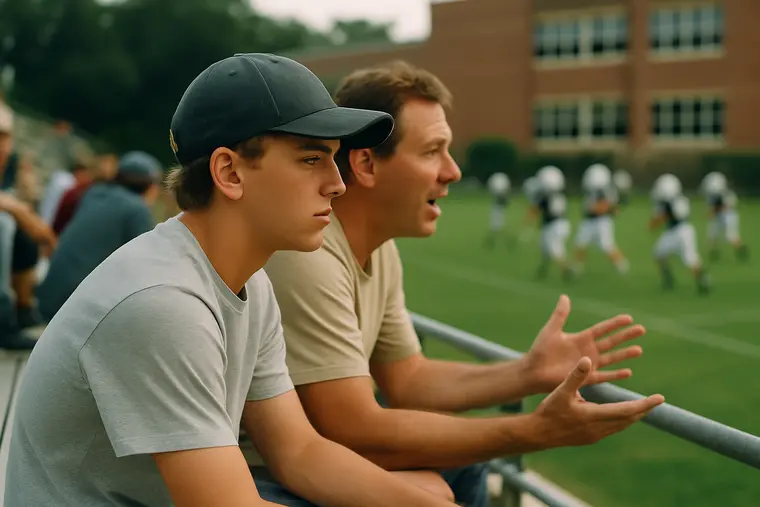
On October 1, 2026, Manning attended a local middle school football game in the Austin area between Hill Country Middle School and Lake Travis. The visit was notable because it took place away from a college stadium, after the lights had shifted to younger athletes and their families.
Middle school football sits near the base of the Texas football pyramid. Those players are not yet Friday night headliners, and they are years away from college evaluation. A visible Longhorn quarterback at that level can make the sport feel connected from the earliest school stages to the college game.
The reporting around that appearance also listed Manning’s season performance at that point: a 63.5 percent completion rate, seven touchdown passes and three interceptions. That context matters because the attention around the visit was not separated from his role as Texas’ quarterback. He was not a former player making a ceremonial stop. He was an active college quarterback showing up during the season calendar.
A Practical Signal For Young Players
For seventh and eighth graders, the lesson is not that a college quarterback will attend every game. The lesson is that their level of football is part of the same local culture. The middle school game, the high school rivalry, the youth camp and the Longhorn Saturday all exist on the same football map.
That is especially true in Central Texas, where school communities often overlap with college fandom. Families who attend middle school games may also follow Texas closely. Players who start at local schools may later feed into high school programs that college staffs track. Community appearances do not create prospects by themselves, but they can help keep young athletes engaged long enough to keep developing.
- Hospital visits connect players with families outside the normal football audience.
- Youth camps give younger athletes direct teaching from college players.
- School-game appearances reinforce the link between grassroots football and Texas Saturdays.
Why Arch Manning Visits Matter In Texas
What Texas Families Can Take From It
Arch Manning Visits matter because they show a version of college football that is not limited to performance, rankings or national discussion. The Texas quarterback is still judged first by how he plays. That is the reality of the position. But the way he spends time around younger players and families can shape how the program is experienced locally.
The documented stops from June 2025 through October 1, 2026, show a consistent range: a teammate’s camp, a family-run quarterback academy, a medical center in Austin and a middle school game. None of those settings required a recruiting claim to be meaningful. Each one placed a college player in front of people who help form the sport’s base.
For Texas football culture, that is the main point. A program’s connection to its region is built through wins, yes, but also through visibility in ordinary places. When college players show up at camps, schools and community spaces, they give younger athletes a closer view of the path. They also remind families that the sport can still be local, even when the attention around it is national.