Trevor Goosby returned to the Texas lineup against Texas State, but his status remains one of the most important variables surrounding Saturday’s matchup with No. 1 Ohio State. The Longhorns dominated their opener 59-7 at Darrell K Royal-Texas Memorial Stadium on Sept. 5, yet the level of competition changes dramatically when the Buckeyes arrive in Austin on Sept. 12. Goosby’s ability to handle a full workload could influence how Steve Sarkisian and offensive line coach Kyle Flood structure the front, particularly as Texas continues to sort through its left guard rotation.
The situation is worth watching because Goosby was one of the most highly regarded offensive linemen in the country entering 2026. Texas named him a preseason first-team All-SEC selection, and he returned to Austin after earning first-team All-SEC honors following the 2025 season. His presence gives Texas an established answer at left tackle, while his absence or limited availability would force the Longhorns to rely more heavily on the depth they spent the offseason developing.
Goosby’s Knee Injury Has Already Changed Texas’ Preparation
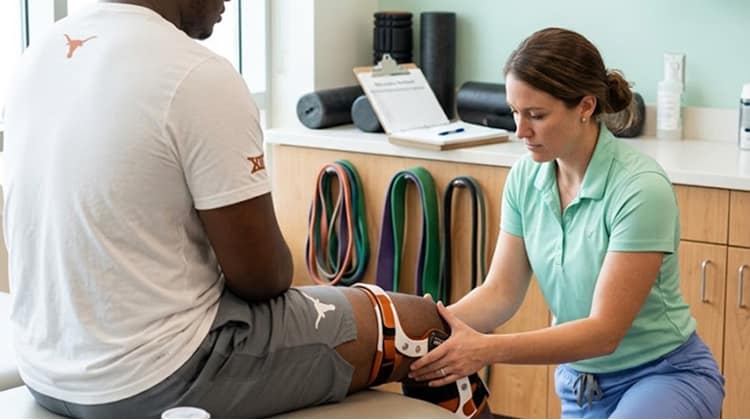
Goosby suffered a non-contact knee injury during an Aug. 17 practice. Subsequent reporting identified the injury as a bone bruise in his left knee, creating uncertainty about whether he would be available for the beginning of the season. He ultimately returned to practice before the opener and was cleared by Sarkisian to play against Texas State.
That recovery was important because Texas entered the season with expectations that Goosby would anchor the left side of the offensive line. The 6-foot-7, 325-pound lineman had started all 13 games during the 2025 season and entered 2026 with significant NFL attention. Texas also recognized his importance by placing him among its first-team preseason All-SEC selections alongside players such as Arch Manning, Cam Coleman, Rasheem Biles and Colin Simmons.
The latest injury information, however, still lists Goosby as questionable with a knee issue for the Sept. 12 game against Ohio State. That does not mean he will miss the matchup, but it does create a legitimate question about his workload and whether Texas wants to put its star tackle through every possible snap against the nation’s No. 1 team.
For Texas, that distinction matters.
Texas Saw Goosby Back In The Starting Lineup
The best news for the Longhorns came on Sept. 5.
Goosby was back on the offensive line as Texas opened the season with a 59-7 victory over Texas State. The official Texas participation report lists Goosby alongside Dylan Sikorski, Connor Robertson, Melvin Siani and Brandon Baker on the offensive line.
The larger offensive performance provided plenty of evidence that the unit was capable of functioning efficiently. Texas produced 516 total yards, including 360 through the air and 156 on the ground. Arch Manning threw for 305 yards and four touchdowns, while Texas scored on eight of its nine drives.
That performance does not automatically answer every offensive-line question, though.
Texas State is not Ohio State.
The Buckeyes finished the opening weekend with a 56-3 victory over Ball State and remained No. 1 in the AP Top 25. Ohio State limited Ball State to 165 total yards while quarterback Julian Sayin threw for 320 yards and three touchdowns. The difference in defensive talent means Texas cannot assume that the protection and blocking rhythm displayed against Texas State will carry over unchanged.
That is why Goosby’s status becomes more significant this week.
The Left Guard Competition Is Still Unresolved
The more interesting part of Texas’ offensive-line situation may be what happens immediately inside Goosby.
Sarkisian confirmed that Texas is likely to continue rotating Dylan Sikorski and Laurence Seymore at left guard. Against Texas State, Sikorski played 33 snaps while Seymore played 36, showing that the Longhorns were not ready to declare one player the permanent winner of the competition.
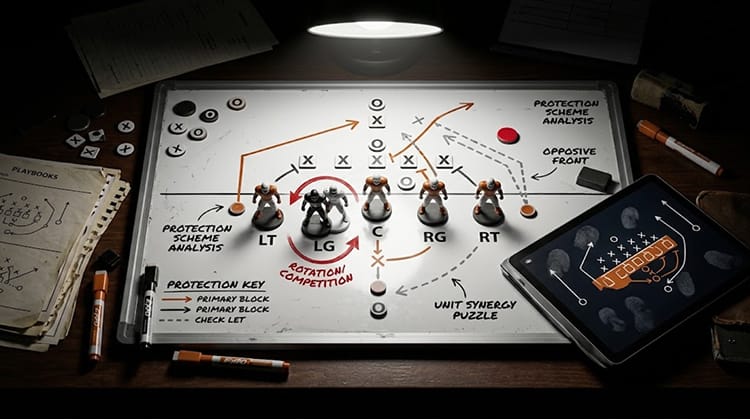
Sikorski, an Oregon State transfer, produced a stronger overall performance according to Pro Football Focus, receiving a 66.8 grade compared with Seymore’s 54.5. Neither player allowed a pressure in pass protection during the opener, but the distinction in run blocking gave Sikorski an early advantage.
That rotation could become much more consequential against Ohio State.
If Goosby is completely healthy and capable of handling his normal workload, Texas can preserve continuity at left tackle while allowing the coaching staff to evaluate Sikorski and Seymore at guard. If Goosby needs to be monitored, however, the Longhorns may have to think more carefully about how they distribute snaps and whether they want additional flexibility across the front.
The Texas offensive line outlook becomes especially important here because the issue is no longer simply about identifying five starters. Texas needs five players who can communicate, adjust protections and maintain consistent technique against a defense capable of punishing even small mistakes.
Goosby’s Experience Matters Against Ohio State
The value of Goosby goes beyond his size.
He enters the season with experience in high-level SEC competition, a full season of starting experience at left tackle and recognition from conference coaches. After the 2025 season, he earned first-team All-SEC honors, while Texas also entered 2026 expecting him to be one of the anchors of the offense.
That experience is particularly valuable against Ohio State because Texas has already seen what happens when the Buckeyes create pressure and force the quarterback to operate without a clean rhythm.
The previous meeting remains part of the context. Texas lost to Ohio State 14-7 on Aug. 30, 2025, before falling again 28-14 in the national championship game on Jan. 10, 2025. The Sept. 12 meeting will be the sixth matchup between the programs, with Ohio State holding a 3-2 series advantage.
Manning has improved since that first meeting, but the offensive line will still be central to whether those improvements can show up against the Buckeyes.
A healthy Goosby gives Texas one more veteran capable of handling the physical and mental demands of the matchup.
Andre Cojoe Gives Texas A Realistic Backup Option
Texas also spent the offseason preparing for the possibility that Goosby might miss time.
Andre Cojoe received work at left tackle while Goosby was recovering, giving the Longhorns a player with recent experience in that role rather than forcing an entirely inexperienced lineman into the lineup. Reporting from Texas’ preseason preparation indicated that Cojoe was preparing to step in while Goosby was unavailable.
That preparation could prove valuable even if Goosby starts Saturday.
An offensive line does not have to use a backup only after an injury occurs. Texas can manage a player’s workload, alter personnel packages or prepare contingency combinations during the week so that a potential in-game change does not become an emergency.
That is especially relevant for a player returning from a knee injury.
If Goosby begins the game and feels completely comfortable, Texas can keep its preferred structure intact. If his workload needs to be reduced, Cojoe gives Flood another option without forcing the coaching staff to redesign the entire offense.
Ohio State Will Test The Entire Left Side
The matchup against Ohio State is where Texas’ offensive-line planning becomes a real football question rather than a depth-chart exercise.
The Buckeyes enter Austin ranked No. 1 after their 56-3 opening victory. Ohio State’s defensive speed, physicality and ability to create pressure will force Texas to make faster decisions than it did against Texas State.
The official Texas football schedule lists the Ohio State game for 6:30 p.m. CT on Saturday, Sept. 12, at DKR-Texas Memorial Stadium, with ABC carrying the matchup.
The question for Texas will be whether the offensive line can protect Manning long enough for the quarterback to use the weapons that made the opener so productive.
Ryan Wingo caught seven passes for 121 yards against Texas State. Cam Coleman caught three passes for 70 yards and two touchdowns in his Texas debut. Hollywood Smothers contributed 70 rushing yards on 10 carries while also catching two touchdown passes.
Those players create matchup problems for Ohio State, but those advantages only matter if Manning has time to access them.
That puts pressure on every member of the offensive line.
The Interior Rotation Could Be More Important Than It Looks
It would be easy to focus entirely on Goosby because he is the established star.
The larger issue may actually be how the five-man combination works together.
Sikorski and Seymore are still competing for consistency at left guard. Robertson has to maintain communication at center. Brandon Baker continues to develop at right tackle. Goosby provides the veteran presence on the left edge.
Against Texas State, those pieces were good enough for Texas to control the game. Against Ohio State, communication errors can create immediate problems.
A defensive front does not need to dominate every snap to change an offense. One missed assignment on third down can force a punt. One protection breakdown can produce a sack. One negative run can turn a manageable second down into a difficult passing situation.
That is why Sarkisian’s decision to continue evaluating the left guard position is reasonable.
Texas does not need to identify a winner simply for the sake of having a permanent starter. It needs to identify which combination gives Manning the best chance to operate efficiently against elite competition.
Goosby’s Availability Could Influence Texas’ Play Calling
There is also a strategic component.
If Texas believes Goosby is fully healthy, Sarkisian can call the game without constantly considering whether the left tackle needs protection or whether a particular formation places additional stress on the recovering knee.
If Goosby is limited, Texas could compensate through formations, tight-end alignments, running-back protections or quicker passing concepts.
That does not necessarily mean Texas will become conservative.
Manning demonstrated against Texas State that the offense can spread the ball around quickly. His four touchdown passes came while connecting with eight different receivers, giving Sarkisian plenty of ways to keep the defense from concentrating on one player.
But Ohio State can challenge protection in ways Texas State could not.
The more comfortable Goosby is physically, the more freedom Sarkisian has to maintain the full offensive menu.
Saturday Will Reveal Whether Texas’ Depth Is Real
Texas spent the offseason building an offensive line capable of supporting a championship-level offense.
Ohio State is the first opponent capable of seriously testing that claim.
The Longhorns do not necessarily need Goosby to play every snap to succeed. They need the offensive line to function as a coordinated five-man unit regardless of personnel changes.
That makes his status more than an injury update.
It is a test of whether Texas has enough depth to absorb uncertainty without changing the identity of the offense.
If Goosby handles a full workload and Sikorski or Seymore separates himself at left guard, Texas could leave Saturday with considerably more clarity about its offensive front. If Goosby’s knee requires careful management and the guard rotation continues, Sarkisian may have to keep developing multiple combinations deeper into the season.
Either way, Ohio State provides the measuring stick.
Texas enters the game ranked No. 4 in the AP Top 25, while Ohio State remains No. 1 with 46 first-place votes.
The Longhorns already showed against Texas State that their offense has explosive potential. The next question is whether the offensive line can protect that potential against the best team in the country.
For Goosby, Saturday is about more than simply being listed as available.
It is about proving that his knee is ready for the physical demands of a game that could expose every weakness in Texas’ rebuilt offensive front.