Colin Simmons enters the Red River Rivalry as the most difficult defensive matchup Oklahoma has to solve.
The Texas edge rusher just produced the most dominant pass-rushing performance in Longhorns history, recording 5.5 sacks against Tennessee on Sept. 26 after a postgame statistical correction gave him an additional half-sack. The performance broke the Texas single-game record previously shared by Shane Dronett and pushed Simmons to 7.5 sacks through four games in 2026.
Now Oklahoma has to prepare for him.
The Sooners enter the Oct. 10 Red River Rivalry at the Cotton Bowl with a 2-2 record, while No. 1 Texas is 4-0 after victories over Texas State, Ohio State, UTSA and Tennessee. Oklahoma has already allowed significant pressure against several opponents, and its offensive line is dealing with the continued absence of left tackle Michael Fasusi, who has been out since the season opener.
For Texas, the matchup offers an opportunity to turn the biggest strength of its defense into the biggest weakness of Oklahoma’s offense.
For Oklahoma, the first question is simple: how do you keep John Mateer upright against a pass rusher who just recorded 5.5 sacks against a ranked SEC opponent?
Simmons’ Tennessee Performance Changed The Matchup
Simmons was already one of the most dangerous defensive players in college football before the Tennessee game.
The performance in Knoxville changed the scale of the conversation.
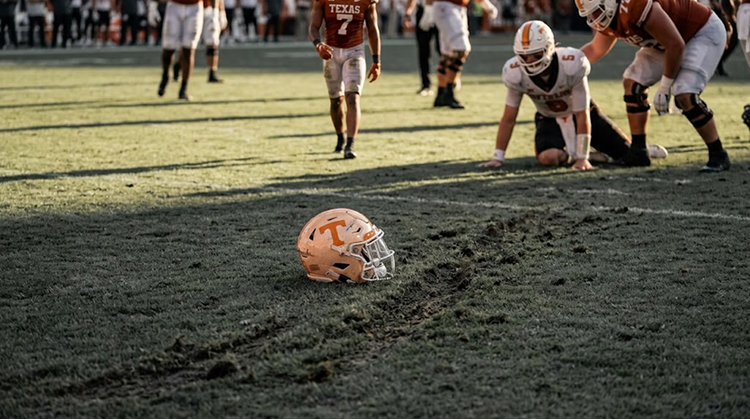
Texas defeated No. 14 Tennessee 20-17 on Sept. 26 while producing 10.5 sacks, with Simmons accounting for 5.5 of them. He also recorded nine tackles, a forced fumble and a quarterback pressure. The Longhorns held Tennessee to 221 total yards and 70 rushing yards.
The half-sack correction made Simmons the sole Texas record holder for sacks in a single game.
That distinction matters heading into Oklahoma because the Sooners cannot simply prepare for the player Simmons was during the first three games of the season. They now have to prepare for a player who demonstrated that he can completely disrupt an SEC offense from the edge.
Simmons currently has 7.5 sacks in four games, including one against Ohio State, one against UTSA and 5.5 against Tennessee.
The Texas defensive performance against Tennessee also demonstrated that Simmons does not need to win every snap for Texas to overwhelm an opponent. The Longhorns produced pressure from multiple positions, allowing Simmons to attack while the rest of the defensive front created additional problems.
That makes Oklahoma’s protection decision much more complicated.
Oklahoma’s Protection Numbers Are Already A Warning
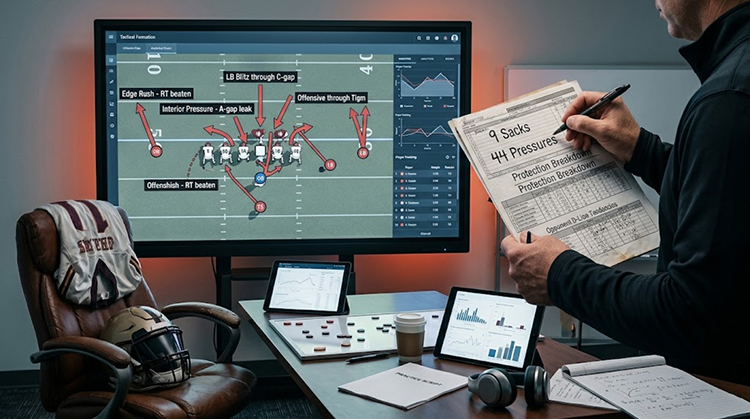
Oklahoma has given up nine sacks and 44 pressures through its first four games, according to recent reporting. The quality of the opposing defensive fronts partly explains those numbers, with Michigan and Georgia both presenting major challenges. But the fact that New Mexico generated 10 pressures and two sacks against the Sooners adds another layer to the concern.
New Mexico’s pressure was especially revealing because Oklahoma won that game 14-6.
The Sooners allowed six sacks in the game themselves while John Mateer was sacked once, according to the official box score. Oklahoma’s offense managed 14 points despite Mateer throwing for 238 yards and two touchdowns.
That does not automatically mean Oklahoma’s offensive line will collapse against Texas.
It does mean Texas has reason to believe pressure can disrupt the Sooners’ offensive rhythm.
The problem becomes more serious because Simmons is a fundamentally different challenge from many of the rushers Oklahoma has already faced.
He can win with speed around the edge, convert speed into power and continue pursuing the quarterback after the initial protection breaks down. His Tennessee performance showed that even when an offense knows pressure is coming, stopping him repeatedly is another matter.
Michael Fasusi’s Absence Makes The Problem Bigger
The most important personnel development for Oklahoma’s offensive line is the continued absence of Michael Fasusi.
The highly regarded left tackle has been out since the opener against UTEP, and recent reporting indicates that he will not return for the Red River Rivalry.
That is particularly relevant against Simmons because offensive tackles are often the first line of defense against elite edge rushers.
The tackle must control the initial rush while maintaining enough balance to prevent the defender from converting outside speed into an inside move. A quarterback can help with protection, but every adjustment carries a cost elsewhere in the offense.
If Oklahoma keeps a running back or tight end in to help the tackle, Mateer has fewer receiving options.
If the Sooners leave the tackle isolated, Simmons gets more opportunities to attack one-on-one.
If Oklahoma uses quick passes to neutralize the rush, the offense becomes more dependent on short-area execution.
None of those options eliminates the problem.
The official Oklahoma football information confirms that John Mateer remains the centerpiece of the Sooners’ offense, making protection around him particularly important against Texas.
John Mateer Has Already Shown He Can Be Pressured
Mateer is not an inexperienced quarterback.
The fifth-year quarterback transferred to Oklahoma after his time at Washington State and entered 2026 as the Sooners’ established starter. Through the first three games in the official Oklahoma statistics, he had completed 47 of 75 passes for 652 yards, six touchdowns and three interceptions.
But his performances against Michigan and Georgia exposed different forms of pressure.
Against Michigan on Sept. 12, Mateer completed 17 of 33 passes for 189 yards, one touchdown and one interception while being sacked three times.
Two weeks later against Georgia, he completed 25 of 34 passes for 231 yards and two touchdowns, but he was again sacked three times and threw an interception as Oklahoma lost 41-13.
That Georgia game is especially relevant because the Bulldogs showed how pressure can change Oklahoma’s offensive efficiency.
Mateer was not completely ineffective statistically. He still produced 231 passing yards and two touchdowns.
The problem was the overall effect of the pressure.
Oklahoma scored 13 points.
That distinction is critical for Texas.
The Longhorns do not necessarily need Simmons to produce another five-sack performance. If his presence forces Mateer to speed up his reads, changes the Sooners’ protection calls or creates opportunities for other Texas defenders, Simmons can dominate the matchup without approaching his Tennessee numbers.
Texas Has More Than One Pass-Rush Threat
This is where the Red River matchup becomes particularly dangerous for Oklahoma.
Simmons’ national attention could encourage the Sooners to devote additional resources to him. But Texas just demonstrated against Tennessee that its defensive front is capable of generating pressure beyond one player.
The Longhorns finished with 10.5 sacks in Knoxville.
Hero Kanu, Rasheem Biles, Maraad Watson and Zina Umeozulu were among the other Texas defenders contributing sacks in the Tennessee victory.
That means Oklahoma cannot approach the game with a simple “stop Simmons” strategy.
If the Sooners slide protection toward Simmons, Texas can attack elsewhere.
If Oklahoma keeps its protection balanced, Simmons may receive more one-on-one opportunities.
If the Sooners keep extra blockers in the formation, their passing concepts become more limited.
The objective for Texas defensive coordinator Will Muschamp is therefore not necessarily to create another statistical explosion from Simmons.
It is to force Oklahoma to choose which problem it wants to accept.
The Red River Rivalry Raises The Stakes
The timing of this matchup makes the protection issue more significant.
Texas and Oklahoma will meet at the Cotton Bowl on Saturday, Oct. 10 at 2:30 p.m. CT, with ABC carrying the game. Texas enters the rivalry at 4-0, while Oklahoma is 2-2 after its 41-13 loss to Georgia.
Texas has also won the last two meetings.
The Longhorns defeated Oklahoma 34-3 in 2025 after the Sooners won 34-30 in 2024. Texas also won 49-0 in 2023.
Those recent results create a psychological element, but the matchup itself is more important than historical momentum.
Oklahoma has to protect against the nation’s top-ranked team while dealing with one of college football’s hottest pass rushers.
Texas has a different problem.
The Longhorns’ offense has struggled to produce consistently, meaning Oklahoma’s defense could keep this game close if the Sooners can avoid giving Texas short fields and negative plays.
That makes every Simmons-generated sack potentially more valuable.
Simmons Could Force Oklahoma Into A Different Offense
The best way to evaluate Simmons’ potential impact is to think beyond sacks.
Suppose Oklahoma begins the game keeping a running back next to Mateer on obvious passing downs.
Texas now has information.
The Longhorns know Oklahoma is worried about the edge rush enough to sacrifice a receiver.
Texas can respond with different defensive looks and pressure combinations.
If Oklahoma releases the running back, Texas can test the protection again.
If the Sooners use quick-game concepts, Texas can tighten its coverage and force Mateer to make precise throws before the pass rush arrives.
That is how an elite edge rusher can control a game without constantly touching the quarterback.
Simmons changes the decision tree.
Every protection adjustment made because of him affects something else.
Texas’ Defensive Identity Gives Simmons More Freedom
Simmons’ rise has also coincided with a broader transformation of Texas’ defense.
The Longhorns are entering the Red River game after holding Tennessee to 221 yards and producing one of the most disruptive defensive performances of the season. The Tennessee offense entered that game averaging more than 500 total yards per contest, yet Texas repeatedly forced negative plays.
That defensive confidence gives Simmons freedom.
Texas does not need to manufacture every sack through exotic pressure packages.
The Longhorns can allow Simmons to rush naturally and use the rest of the defense to prevent Oklahoma from escaping through quick throws or designed runs.
That is an important difference from a defense that relies entirely on blitzing.
Simmons can create pressure with four rushers.
When that happens, Texas can keep more defenders in coverage.
For Mateer, that combination creates a difficult equation: fewer free receivers and less time to find them.
Mateer’s Mobility Is Oklahoma’s Best Counter
There is one factor Oklahoma can use to make Simmons’ job more difficult: Mateer’s mobility.
The quarterback has demonstrated the ability to create yards with his legs, including 45 rushing yards on 13 carries against Michigan despite losing 27 yards on sacks.
That creates a potential escape route for Oklahoma.
Designed quarterback movement can change the launch point and prevent Simmons from attacking the same spot on every passing play.
Bootlegs, rollouts and quick quarterback movement can also force Simmons to hesitate instead of immediately attacking the quarterback.
But those concepts have limitations.
Moving the quarterback reduces the available field on some plays and can expose the offense to backside pressure.
Texas will likely want to make Mateer uncomfortable without allowing him to turn broken plays into explosive runs.
That is another reason Simmons’ discipline will matter.
The Red River Game Could Be Won At The Edge
The most obvious matchup in the Cotton Bowl will involve quarterbacks, but the more decisive battle could take place several yards outside the pocket.
Simmons has already produced 7.5 sacks in four games, and his 5.5-sack performance against Tennessee established a Texas single-game record.
Oklahoma has allowed pressure throughout September and will enter the rivalry without Fasusi.
Mateer has already been sacked three times by both Michigan and Georgia.
That combination gives Texas a clear defensive advantage on paper.
Still, the Longhorns cannot assume the matchup will automatically produce sacks.
Oklahoma has had two weeks to prepare during the bye period, and Brent Venables and his offensive staff will have extensive film from Tennessee to study.
The Sooners will know exactly what Simmons can do.
The question is whether they have enough answers to stop him without opening the door for the rest of Texas’ defense.
Simmons Does Not Need Another Record To Control Red River
The temptation will be to measure Simmons against his Tennessee performance.
Five-and-a-half sacks is an enormous number, and another performance at that level would immediately become one of the defining individual games in the rivalry’s history.
But Texas does not need that.
Two sacks could matter enormously if both come on third down.
One strip-sack could change the game if it creates a short field.
Several pressures could be enough if they force Mateer into inaccurate throws or hurried decisions.
A consistent pass rush could also make Oklahoma abandon portions of its offensive game plan.
That is the real importance of Simmons entering Red River.
He has reached a point where the opponent’s preparation for him becomes part of the game itself.
Oklahoma Has To Solve The Simmons Problem First
The Red River Rivalry will contain dozens of individual matchups, but Oklahoma’s protection plan around Colin Simmons deserves special attention.
The Sooners have already surrendered nine sacks and 44 pressures through four games, while Mateer has experienced significant pressure against Michigan and Georgia. Michael Fasusi remains unavailable, and Texas is bringing a defensive front that just produced 10.5 sacks against Tennessee.
Simmons enters the matchup with 7.5 sacks, a Texas single-game record and three national player-of-the-week awards from the Bednarik Award, Nagurski Trophy and Walter Camp Award after his Tennessee performance.
That makes the central question for Oklahoma straightforward.
Can the Sooners protect John Mateer without sacrificing the rest of their offense?
If the answer is no, Texas has the defensive personnel to make that weakness decisive.
And if Simmons forces Oklahoma to devote too much attention to him, the Longhorns have already shown that another defender can finish the play.
The Oct. 10 meeting at the Cotton Bowl will therefore test more than Oklahoma’s offensive line.
It will test whether the Sooners can construct an offensive game plan that survives the most dangerous pass rusher Texas has had in years.