

Arch Manning is entering one of the most important stretches of his Texas career, and his recent performances are giving the Longhorns reasons to believe their quarterback is beginning to find his best form. On November 6, the Texas senior was named one of 10 finalists for the 2026 Johnny Unitas Golden Arm Award, recognizing his development as one of the country’s leading college quarterbacks. Three days later, he delivered another statement performance, throwing for 297 yards and three touchdowns in Texas’ 34–20 victory over No. 18 Missouri.
The timing of the recognition could hardly have been better. Manning’s selection came after a challenging stretch that included consecutive losses to Oklahoma and Florida, raising questions about the consistency of the Texas offense and his ability to handle pressure during important moments. Since then, the Longhorns have responded with three consecutive victories against Ole Miss, Mississippi State and Missouri.
Manning has played an important role in that turnaround. His 297-yard performance against Missouri represented his highest passing total since the season opener, and his three touchdown passes helped Texas secure a valuable SEC road victory at Faurot Field.
The latest achievement also places Manning among an impressive group of quarterbacks competing for one of college football’s established individual honors. However, the bigger question for Texas is whether his recent improvement can continue against the demanding opponents waiting during the final weeks of the regular season.
Arch Manning Earns National Recognition With Johnny Unitas Award Finalist Selection
The Johnny Unitas Golden Arm Award announced its 2026 Top 10 on November 6, narrowing the original group of 27 quarterbacks selected for the preseason watch list.

Manning became one of the 10 players advancing in the selection process, joining quarterbacks such as CJ Carr of Notre Dame, Devon Dampier of Utah, Noah Fifita of Arizona, Sam Leavitt of LSU and Gunner Stockton of Georgia.
The recognition was particularly meaningful for Texas because Manning became the program’s first finalist for the award since Quinn Ewers reached the Top 10 in 2024. Former Longhorns quarterback Colt McCoy won the honor in 2009.
The award evaluates more than passing statistics. Its selection committee considers performance on the field alongside leadership, character, sportsmanship, academic achievement and citizenship.
That broader evaluation makes the finalist selection relevant to Manning’s development as the leader of the Texas program. He has faced significant expectations since becoming the Longhorns’ starting quarterback, and his responsibilities extend beyond executing Steve Sarkisian’s offensive system.
Manning must manage the offense, communicate with teammates, respond to difficult situations and maintain confidence when opponents create problems.
His selection does not guarantee that he will win the award. The committee will continue narrowing the field before announcing the recipient at its December 9 ceremony in Baltimore. Nevertheless, reaching the Top 10 confirms that Manning’s season has attracted national attention beyond Austin.
The Missouri Performance May Have Been Manning’s Most Important Statement Yet
Manning’s November 7 performance against Missouri provided another reason for optimism.
The Texas quarterback completed 28 of 38 passes for 297 yards and three touchdowns without throwing an interception. He completed approximately 74% of his attempts and connected with multiple receivers as the Longhorns overcame a competitive Missouri team on the road.
The performance became particularly important during the fourth quarter.
Texas and Missouri entered the final period tied at 20–20. Manning then found running back Raleek Brown for a 23-yard touchdown reception with 5:03 remaining, giving the Longhorns a lead they would not surrender.
Brown added an eight-yard rushing touchdown with 1:25 remaining to complete the scoring.
The decisive passing touchdown demonstrated Manning’s ability to recognize an opportunity and deliver the ball in a critical situation. Brown came out of the backfield and created separation against Missouri’s coverage, while Manning placed the football where his receiver could make the play.
It was also an example of how Manning’s development can benefit the entire offense.
Texas entered the matchup dealing with injuries to several important contributors, including wide receiver Cam Coleman and running back Hollywood Smothers. Rather than depending on one established target, Manning distributed the football and allowed other players to contribute.
Freshman wide receiver Jermaine Bishop Jr. caught a 25-yard touchdown, while freshman running back Derrek Cooper recorded his first career receiving touchdown on a 24-yard play.
Manning’s performance was therefore about more than accumulating passing yards. It showed that he could maintain offensive production while working with a changing group of contributors.
Three Consecutive Wins Have Changed the Conversation About Texas’ Quarterback
The Missouri victory completed a three-game winning streak that has helped Texas regain momentum after a difficult October.
The Longhorns lost consecutive games against Oklahoma and Florida, both by three points. Those results exposed problems with offensive consistency and created pressure on Manning and the coaching staff to find solutions.
Texas responded with a 34–27 victory over Ole Miss on October 24, followed by a 31–3 win against Mississippi State on October 31.
Manning produced 212 passing yards and three total touchdowns against Ole Miss, including two rushing scores. Against Mississippi State, he completed 16 of 20 passes for 220 yards and three touchdowns without an interception.
The Missouri game then produced his strongest passing performance of the three victories.
That progression is important because it suggests Texas is developing a more dependable offensive approach rather than relying on one exceptional afternoon.
Manning’s production has increased across the three games, while the offense has found different ways to score. Against Ole Miss, his mobility added another dimension. Against Mississippi State, his passing efficiency helped Texas control the game. Against Missouri, he delivered explosive plays and a decisive fourth-quarter touchdown.
The challenge now is maintaining that level of execution against defenses that will study the Longhorns’ recent performances and attempt to disrupt their rhythm.
Manning’s Season Statistics Show Progress, but There Is Still Room to Improve
Manning’s updated season numbers provide a useful picture of his development.
Following the Missouri victory, Texas’ official cumulative statistics credited him with 2,024 passing yards, 18 touchdown passes and seven interceptions through nine games. He had completed 168 of 254 attempts, producing a completion rate of 66.14%.
| Statistic | Manning’s 2026 season |
|---|---|
| Games played | 9 |
| Passing yards | 2,024 |
| Completion percentage | 66.14% |
| Passing touchdowns | 18 |
| Interceptions | 7 |
| Rushing yards | 114 before Missouri |
The numbers show why Manning belongs in the national award conversation. His completion percentage is above 66%, and his 18 touchdown passes demonstrate his ability to finish scoring opportunities.
However, the seven interceptions also reveal an area that needs attention.
Texas cannot afford to give away possessions against opponents such as LSU and Texas A&M. Turnovers can quickly change the direction of competitive SEC games, particularly when the Longhorns are playing away from Austin.
Manning’s decision-making must therefore remain a priority. He needs to recognize when a passing window is closing, avoid forcing throws into coverage and understand when taking a sack or throwing the ball away is the better decision.
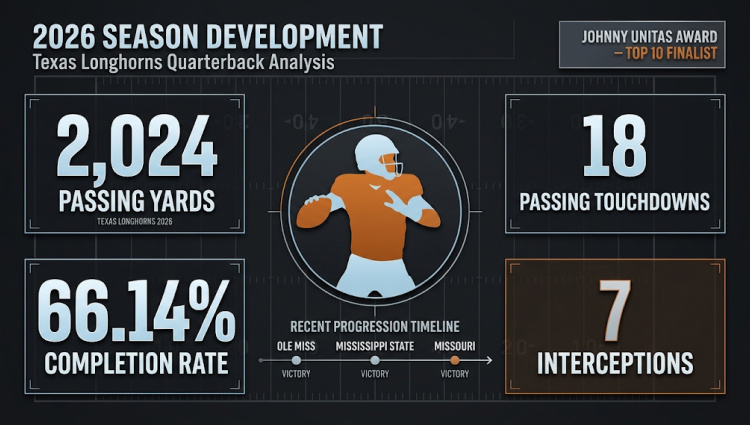
His recent performances are encouraging, but the next stage of his development depends on combining efficiency with consistent ball security.
Texas’ Receiving Depth Is Helping Manning Find More Offensive Answers
Another important part of Manning’s improvement has been the involvement of different receivers.
Ryan Wingo and Emmett Mosley V have provided experience and production, while Coleman has offered another important target when available. The emergence of Bishop and Cooper against Missouri has given Texas additional options.
That depth matters because defenses cannot concentrate exclusively on one receiver.
Against Missouri, Manning completed passes to multiple targets and used Brown as a receiving threat from the backfield. The touchdown to Bishop also showed that Texas can create scoring opportunities through younger players when established contributors are unavailable.
Brown’s versatility has become particularly valuable following Smothers’ injury. His 133 total yards against Missouri included 85 rushing yards and 48 receiving yards.
For Manning, having a running back capable of contributing as a receiver creates opportunities to attack linebackers and defensive backs in space.
The development of these connections could become increasingly important as Texas approaches its final regular-season games. The Longhorns need an offense capable of adjusting when opponents take away their preferred targets.
Sarkisian’s system offers several ways to distribute the football, but its effectiveness depends on Manning’s ability to recognize defensive coverage and make accurate decisions.
The Missouri game provided evidence that the quarterback and his supporting cast are beginning to operate with greater confidence.
The Johnny Unitas Award Recognition Comes With a Bigger Leadership Responsibility
Manning’s finalist selection also raises an important question about his role within the Texas program.
The Golden Arm Award considers leadership and character alongside statistical production. Those qualities are particularly relevant for a quarterback leading a team with College Football Playoff ambitions.
Texas has experienced significant adversity during the season. Injuries have affected multiple position groups, the offense has faced criticism following consecutive defeats, and the team has had to adjust its lineup during an important portion of the schedule.
Manning’s response has been central to the Longhorns’ recovery.
His performance against Missouri showed a quarterback willing to distribute opportunities and trust younger teammates. Instead of attempting to carry the entire offense, he allowed Brown, Bishop and Cooper to become part of the winning formula.
That approach can help build confidence throughout the roster.
A quarterback’s leadership is often most visible when the team faces difficult circumstances. The ability to remain composed, communicate effectively and continue executing after mistakes can influence how an entire offense responds.
Manning still has areas to improve, but his recent performances suggest that he is becoming more comfortable managing those responsibilities.
LSU Provides Manning’s Next Major Opportunity
Texas now turns its attention to another important SEC road game against LSU on November 14 at Tiger Stadium in Baton Rouge.
The Tigers enter the matchup after losing 31–13 to Alabama on November 7. Texas, meanwhile, arrives with three consecutive victories and renewed confidence following its comeback against Missouri.
The matchup presents another opportunity for Manning to demonstrate that his recent improvement can translate against a difficult opponent away from home.
LSU’s defense will have to account for Texas’ expanding offensive options. Brown’s ability to contribute as both a runner and receiver could create matchup problems, while the emergence of Bishop and Cooper gives Manning additional targets.
The Longhorns must also protect their quarterback. Texas has dealt with offensive-line injuries, including the season-ending loss of Trevor Goosby, and the remaining unit must provide Manning enough time to make decisions.
A strong performance against LSU would strengthen the argument that Manning has moved beyond the inconsistent stretch that followed the Oklahoma and Florida losses.
It would also give Texas another opportunity to improve its position in the national rankings before the final weeks of the regular season.
For the award committee, continued production against quality opponents could make Manning’s candidacy more competitive as the field narrows.
Arch Manning Is Finding His Best Form, but Consistency Will Define His Season
Being named a Johnny Unitas Golden Arm Award finalist is an important milestone for Manning, but the recognition also reflects the progress he has made throughout a challenging season.
His 2,024 passing yards, 18 touchdown passes and 66.14% completion rate provide a strong statistical foundation. His recent performances against Ole Miss, Mississippi State and Missouri have also helped Texas recover from consecutive defeats and return to the center of the SEC playoff conversation.
The Missouri game was especially encouraging. Manning completed 28 passes, threw three touchdowns and delivered the decisive scoring play when the Longhorns needed it most.
However, the next step is maintaining that performance level. Texas still needs better consistency, improved protection and careful decision-making from its quarterback. The remaining schedule will test whether the offense can sustain its recent momentum against high-level competition.
Manning has earned national recognition, but the most important part of his season is still ahead.
If he continues distributing the football effectively, limits turnovers and performs well in the biggest remaining games, his Johnny Unitas Award candidacy could become even stronger. More importantly, Texas could enter the final stretch with the quarterback confidence and offensive consistency needed to compete for a College Football Playoff position.