

Arch Manning enters the final days before Texas opens the 2026 season carrying a different kind of pressure than he faced one year ago. The hype is still enormous, but this time there is a full season of starting experience behind it. The No. 5 Longhorns will host Texas State on Saturday, September 5, at Darrell K Royal-Texas Memorial Stadium, with kickoff scheduled for 2:30 p.m. CT on ESPN. One week later, Ohio State arrives in Austin for the matchup that has dominated the national conversation all offseason.
That schedule makes the Texas State opener more important than its status as a nonconference game suggests. Steve Sarkisian does not need Manning to throw for 500 yards or produce a highlight reel every quarter. He needs evidence that the quarterback has progressed in the areas that will determine whether Texas can compete with the country’s best teams.
Manning’s 2025 numbers provide plenty of reasons for optimism. He completed 248 of 404 passes for 3,163 yards and 26 touchdowns while adding 399 rushing yards and 10 rushing touchdowns. Texas finished 10-3, won seven of its final eight games and collected five victories against Top-20 opponents.
But the next step is different.
Against Texas State, Sarkisian needs Manning to demonstrate command, efficiency and decision-making. Those three qualities could tell Texas more about its quarterback than an inflated statistical performance against an overmatched defense.
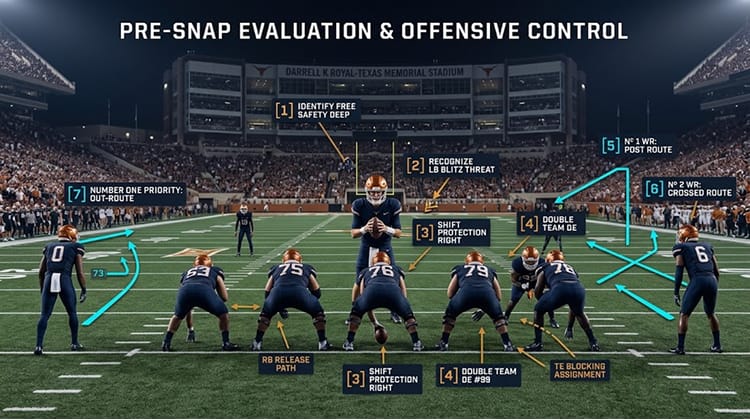
1. Manning Needs To Control The Offense From The First Snap
The first objective is not necessarily statistical.
It is command.
Manning enters his second season as Texas’ full-time starter with an understanding of Sarkisian’s system that he did not have entering the 2025 opener at Ohio State. Last season, his first start came in one of the most difficult environments imaginable, and he finished 17-of-30 for 170 passing yards, one touchdown and one interception while adding 38 rushing yards.
The circumstances against Texas State should be completely different.
Texas will be at home. Manning will have an experienced group of offensive teammates around him. The offensive line has spent an entire offseason working together, while receivers such as Ryan Wingo and Cam Coleman give the quarterback multiple high-level options outside the numbers.
That should allow Sarkisian to evaluate Manning’s ability to operate the offense rather than simply survive it.
The most useful early possessions will reveal whether Manning is consistently getting the offense into the right play, identifying defensive leverage before the snap and making clean decisions when the defense changes after the snap.
Those details become critical against Ohio State.
Texas State is entering its first season in the Pac-12 and brings a dangerous offensive identity under head coach G.J. Kinne, but its defense is undergoing significant changes under first-year defensive coordinator Will Windham. Recent previews have emphasized the talent gap between the programs while also warning that Texas State’s tempo and offensive firepower can create problems if Texas becomes careless.
Manning should therefore be judged on how professionally he handles the game.
If Texas scores quickly, that is useful. If the offense has to sustain a 12-play drive, that may be even more informative.
The quarterback’s job is to make the game feel controlled.
2. Accuracy Has To Become A Week-To-Week Strength
The second requirement is more obvious: Manning has to show improved accuracy.
This is the area that has generated the most discussion during the preseason.
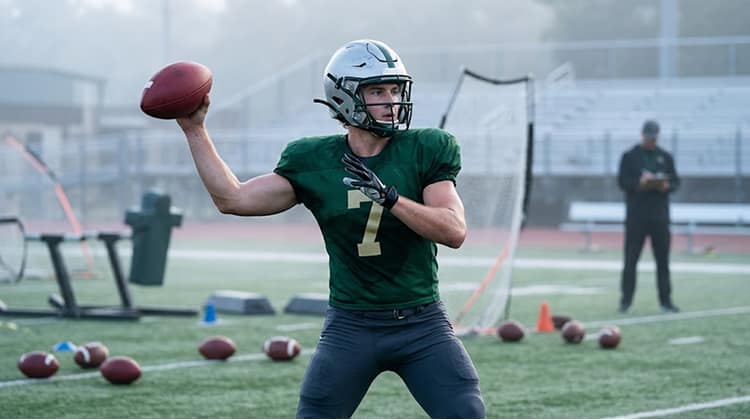
Several recent reports have raised concerns about inconsistency during camp, while former ESPN analyst David Pollack publicly questioned whether Manning was still working through some rust after missing spring practices. Those observations have created an interesting contrast with the quarterback’s statistical improvement during the second half of the 2025 season.
Texas does not need to pretend those questions do not exist.
It needs Manning to answer them on the field.
His 2025 completion percentage was 61.39%, according to Texas’ official statistics. That number was respectable, but it also leaves room for substantial improvement for a quarterback expected to operate one of the SEC’s most ambitious offenses.
The encouraging part was how Manning finished the season.
Over his final six games, he produced 1,714 passing yards, 14 passing touchdowns and five rushing touchdowns while averaging 320 total yards per game. His Citrus Bowl performance against Michigan was particularly significant: Manning completed 21 of 34 passes for 221 yards and two touchdowns while adding 155 rushing yards and two more scores.
That version of Manning is the one Texas needs to see consistently.
Against Texas State, accuracy should be evaluated beyond completion percentage.
The coaching staff should be looking at ball placement, timing and whether receivers are getting opportunities to make plays after the catch. A seven-yard completion thrown perfectly in stride can be more valuable to the offense than a 15-yard completion that forces the receiver to stop and adjust.
This becomes especially important with Texas’ expanded receiving options.
Ryan Wingo enters the season as one of the Longhorns’ most important returning playmakers, while Cam Coleman provides another explosive target. Manning does not need to force the ball to either player. He needs to distribute it according to the coverage.
That is what an elite quarterback does.
| Manning Evaluation Area | What Texas Should Watch Against Texas State |
|---|---|
| Accuracy | Ball placement on intermediate and vertical throws |
| Decision-making | Avoiding unnecessary contested throws |
| Pocket management | Movement without abandoning protection |
| Pre-snap control | Recognizing defensive alignment and pressure |
| Distribution | Using multiple receivers instead of forcing one matchup |
| Red-zone execution | Converting opportunities into touchdowns |
The Texas State game provides the perfect environment for that evaluation because the Longhorns should have enough talent around Manning to keep the quarterback from having to manufacture every positive play himself.
3. He Has To Prove He Can Protect The Football
The third requirement may be the most important one.
Protect the football.
Texas does not need Manning to play conservatively. Sarkisian’s offense depends on aggression, explosive throws and the ability to attack defenses vertically. But there is a major difference between aggressive quarterback play and unnecessary risk.
Manning threw seven interceptions during the 2025 regular season, according to Texas’ official cumulative statistics.
For a team with national championship aspirations, the goal should be to reduce the number of possessions lost because of quarterback decisions.
This is where Texas State provides an interesting first test.
The Bobcats’ offense has received significant attention because quarterback Brad Jackson and several returning receivers give Kinne a system capable of playing at a fast pace. That creates an incentive for Texas to turn its own offensive possessions into points rather than short drives that give Texas State additional opportunities.
Manning therefore needs to understand the game situation.
If Texas leads 14-0, there is little reason to attempt a low-percentage throw into double coverage. If the Longhorns face third-and-12, the calculus changes. If Texas is inside the red zone, protecting the ball becomes even more valuable because every turnover eliminates a high-value scoring opportunity.
That situational awareness is a major component of quarterback development.
Manning has already demonstrated that he can produce spectacular individual performances. His 376 total yards and four touchdowns against Michigan proved that his athletic ceiling is extraordinarily high.
Now Texas needs consistency between those performances.
The difference between a talented quarterback and a championship-caliber quarterback is often not the ability to produce the spectacular play.
It is knowing when the spectacular play is actually necessary.
The Texas State Game Is Really About Ohio State
There is an unavoidable reality surrounding Saturday’s opener: everybody in Austin knows Ohio State is coming.
Texas State would love to make that a problem.
Recent previews have emphasized the unusual setup. Texas is heavily favored, but the Bobcats have enough offensive tempo and returning playmakers to punish mistakes. At the same time, Ohio State will arrive in Austin exactly one week later for one of the most anticipated games of the season.
That means Sarkisian has two jobs.
First, he has to win Saturday.
Second, he has to use the game to prepare the team for what comes next without exposing unnecessary information or risking important players.
Manning sits at the center of both objectives.
The ideal opener would give him enough meaningful snaps to establish rhythm, test the passing game, work through different coverages and build confidence without requiring four quarters of maximum workload.
That is particularly relevant because Texas’ championship case ultimately depends on how Manning performs against elite competition.
His 2025 season already included a difficult start against Ohio State, but it ended with the quarterback playing some of his best football. He helped Texas finish with a 10-3 record and defeated Michigan in the Citrus Bowl.
The September 12 rematch with Ohio State therefore becomes an early referendum on whether Manning’s late-season development was sustainable.
Sarkisian Needs A Quarterback Who Can Make The Offensive Line Better
Manning’s performance cannot be separated from Texas’ offensive line.
That was one of the major themes surrounding the Longhorns throughout the offseason. The unit has undergone changes, and the health of All-SEC left tackle Trevor Goosby has been an important storyline entering the season.
Goosby returned to practice before the opener after missing time with a bone bruise, while Laurence Seymore III also returned to practice during the final week before Texas State.
That gives Texas a potentially important advantage: Manning should have a more stable protection structure than he had at several points last season.
But the quarterback also has a responsibility.
Manning can make the offensive line better by getting the ball out on time, recognizing pressure and avoiding unnecessary sacks. He can make it worse by holding the ball too long or turning manageable situations into extended third downs.
Recent analysis of Texas’ 2026 outlook has specifically highlighted the relationship between Manning, Sarkisian and offensive-line performance.
That relationship will be worth watching Saturday.
If Manning consistently gets the offense into favorable down-and-distance situations, Texas’ offensive line can play aggressively. If he repeatedly faces third-and-long because of missed opportunities on earlier downs, the defense can dictate the situation.
That distinction becomes enormous against SEC opponents.
The Three Numbers That Matter Most
The easiest way to evaluate Manning after Texas State will be to look at the box score.
The better approach will be to examine three numbers alongside the tape:
Completion percentage on accurate, catchable throws.
Turnovers and turnover-worthy decisions.
Third-down efficiency.
Touchdowns will obviously matter. Passing yards will matter. But those three measurements should tell Texas much more about whether Manning is prepared for Ohio State.
The Longhorns do not need a quarterback who produces empty statistics against Texas State.
They need a quarterback who looks like he can manage an elite game seven days later.
That distinction should shape how Sarkisian evaluates the opener.
Texas Has Already Seen Manning’s High-End Ceiling
There is a reason expectations remain so high.
Manning has already demonstrated the physical ability to become one of college football’s most dangerous quarterbacks.
He has the arm strength to attack vertically. He can extend plays outside the pocket. His rushing ability forces defenses to account for another dimension. And his late-2025 production demonstrated that he can operate efficiently when the game slows down for him.
Texas’ official statistics show that he accounted for 3,562 total yards and 36 touchdowns in 2025 when passing and rushing production are combined.
The challenge now is turning those flashes into a reliable weekly standard.
That is why Saturday matters.
The Texas State game will not determine whether Manning is a great quarterback. It will not determine whether Texas reaches the College Football Playoff. It certainly will not decide the outcome of the Ohio State game.
But it can provide the first meaningful evidence that Manning has moved from talented starter to commanding leader.
For Texas, that is the progression that matters most.
Why Saturday Could Reveal More Than The Score
The Longhorns enter September ranked No. 5 nationally, while Manning remains one of the country’s most prominent Heisman candidates. Reuters included him among its top candidates for the award entering the 2026 season, reinforcing how much national attention is already attached to the Texas quarterback.
That spotlight will only become brighter when Ohio State arrives.
Before then, Manning has one final opportunity to establish the tone.
He needs to command Sarkisian’s offense.
He needs to deliver the ball accurately.
And he needs to protect possessions without becoming overly cautious.
If he accomplishes those three objectives against Texas State, the numbers should take care of themselves.
More importantly, Texas could enter September 12 with something far more valuable than a lopsided opening-week victory: confidence that its quarterback is ready for the part of the schedule that will actually define the season.
The first chapter of the 2026 Manning era begins Saturday in Austin. The real test starts seven days later.