Arch Manning entered the 2026 season carrying expectations unlike almost any quarterback in college football. After serving as Texas’ starting quarterback in the 2025 season, Manning now has an opportunity to establish himself as the unquestioned leader of Steve Sarkisian’s program. The most notable change during fall camp, however, has not been a new throw or a statistical milestone. It has been Manning’s willingness to speak, compete and take ownership of the team before Texas faces Ohio State on September 12.
Sarkisian has noticed the transformation. Recent reporting from Texas fall camp describes Manning as significantly more vocal and confident than he was a year ago, with the head coach emphasizing the quarterback’s growing comfort in a leadership role. That development comes at an important moment because Texas will open its most demanding stretch of the season almost immediately, with Ohio State visiting DKR-Texas Memorial Stadium in a nationally anticipated matchup.
The change matters because leadership will be part of Manning’s evaluation in 2026. The Longhorns are no longer preparing for a future quarterback. They are building around their starter, and Manning’s ability to influence teammates could be just as important as his ability to read a defense.
From Waiting To Lead
Manning’s evolution is not simply about becoming louder.
During his earlier time at Texas, the quarterback was frequently described as reserved and deliberate. That approach made sense for a young player learning behind Quinn Ewers and gradually taking on more responsibility. But the circumstances are different now.
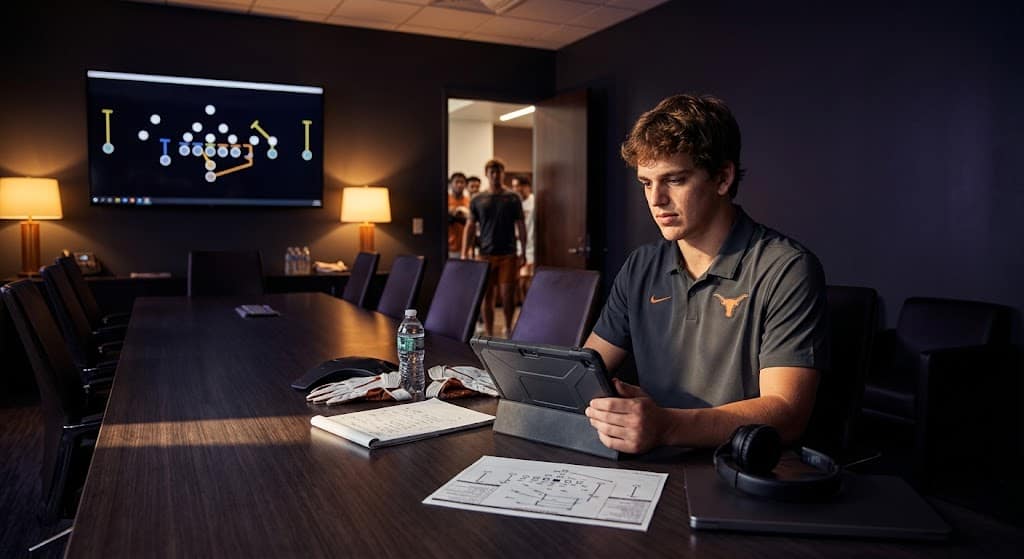
Manning is entering the season as the established quarterback.
The roster is being constructed around his skill set.
The offense is being shaped around his decisions.
And the expectations surrounding Texas are enormous.
Sarkisian recently described Manning’s transformation from a player who believed he needed to earn leadership through performance into someone who understands that he already has a responsibility to lead. That distinction is important because quarterback leadership cannot wait until everything is going well.
A quarterback who only speaks after a touchdown is reacting to success. A quarterback who communicates during difficult practices, corrects teammates and competes with defensive players is helping establish the standard that exists before the scoreboard matters.
That appears to be the direction Manning is taking.
The Timing Could Not Be More Important
Texas does not have the luxury of easing Manning into his leadership role over several months.
The Longhorns open the regular season against Texas State on September 5, then host Ohio State one week later on September 12 at 6:30 p.m. CT. ESPN’s College GameDay is scheduled to broadcast from Austin for the matchup, adding another layer of national attention to Manning’s first major test of the season.
Ohio State also enters the matchup with a recent psychological advantage.
The Buckeyes defeated Texas 28-14 on August 30, 2025, limiting the Longhorns to 14 points. That followed Texas’ 24-21 victory over Ohio State in the College Football Playoff semifinal on January 10, 2025. The teams therefore enter their 2026 meeting with a recent history of meaningful games rather than a simple nonconference matchup.
For Manning, that creates an unusual leadership challenge.
He will have to prepare teammates for an opponent that already knows how to defend Texas.
He will have to manage expectations surrounding a game that will dominate national coverage.
And he will have to help the offense maintain composure if Ohio State creates early problems.
That is where his developing leadership could become tangible.
Manning Is Building Chemistry, Not Just Statistics
One of the clearest examples of Manning’s changing role has come through his interactions with the receiving corps.
A recent mic’d-up practice segment offered a rare glimpse into Manning’s personality and communication style. The footage showed him interacting with teammates while developing chemistry with new transfer receiver Cam Coleman and returning wideout Ryan Wingo.
Coleman has become one of the most intriguing additions to the Texas offense after transferring from Auburn. Wingo, meanwhile, returns as an established part of the receiving group.
That gives Manning two important relationships to develop before the season begins.
The quarterback does not have to simply know where Coleman and Wingo will line up.
He needs to understand how they react when a route breaks down.
He needs to know how aggressively they will attack contested throws.
He needs to recognize when they expect the ball early.
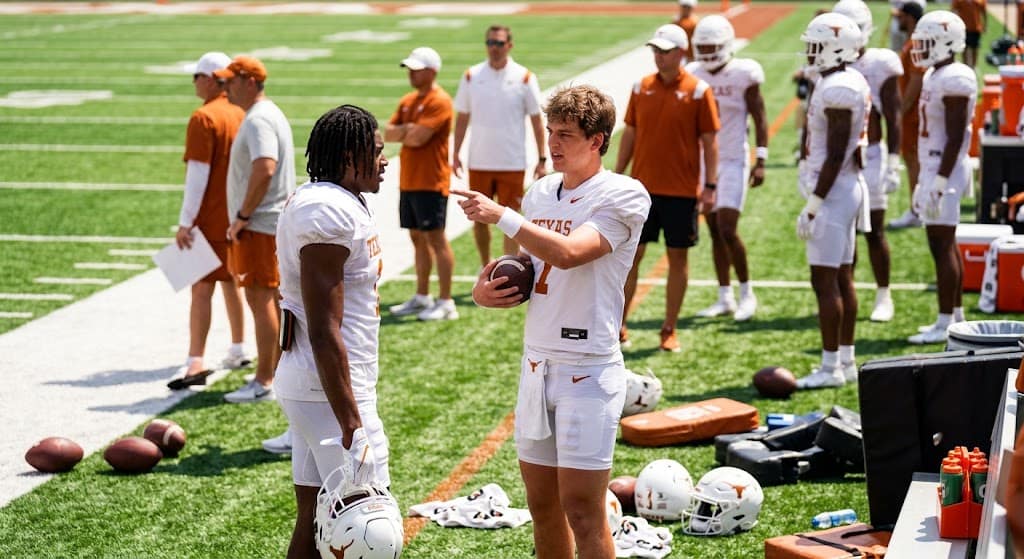
Those details are developed through repetition and communication.
Manning’s increased vocal presence therefore has an offensive purpose. A quarterback who communicates more effectively can accelerate the development of the passing game.
Cam Coleman Gives Manning Another Leadership Opportunity
Coleman’s arrival makes the leadership question even more interesting.
The former Auburn receiver brings SEC experience and a proven physical skill set into a Texas offense that already features Wingo and several other talented targets. Recent practice coverage highlighted Coleman’s one-handed catch and the chemistry developing between him and Manning.
For Manning, that relationship is about more than throwing the football to a talented newcomer.
He needs Coleman to understand the offense.
He needs him to trust the quarterback’s timing.
And he needs Coleman to become comfortable enough in Texas’ system that he can react naturally when defenses change the picture after the snap.
Those relationships can determine whether a transfer receiver becomes a productive player or a genuine difference-maker.
The quarterback is often at the center of that process.
Manning’s willingness to communicate with Coleman, challenge him and build trust can accelerate it.
Ryan Wingo Needs A More Consistent Connection
The same principle applies to Ryan Wingo.
Wingo enters 2026 as one of Texas’ most important returning receivers. The Texas Athletics game center lists him with 834 receiving yards entering the upcoming Ohio State matchup.
His relationship with Manning could become one of the defining components of the offense.
Recent practice footage showed Wingo making a difficult catch, an encouraging development after inconsistency became part of his 2025 narrative.
For Manning, that means leadership extends into accountability.
A quarterback has to trust his receiver.
The receiver has to trust the quarterback.
But both also have to be willing to demand improvement from one another.
That dynamic is particularly important for Texas because the offense will face defenses capable of disguising coverages and creating pressure without sacrificing numbers in the secondary.
If Manning and Wingo can establish reliable timing against those defenses, Texas will have another weapon capable of changing games.
The Quarterback Room Also Depends On Manning
Leadership becomes even more significant because Texas has depth behind Manning.
The Longhorns are not simply preparing one quarterback for the season. Younger quarterbacks must learn the offense, prepare for potential opportunities and understand how Sarkisian wants the position played.
That makes Manning a living example for the rest of the room.
His preparation habits matter.
His communication matters.
His reaction to mistakes matters.
His relationship with coaches matters.
A veteran quarterback who responds poorly to adversity can unintentionally create instability throughout a position group. A quarterback who treats mistakes as part of the process can establish a different standard.
That becomes particularly valuable for a team with championship ambitions.
The younger players are watching how Manning handles the pressure.
Physicality Is Testing More Than The Offensive Line
Texas’ fall camp has also introduced a more physical environment, giving Manning another opportunity to demonstrate leadership away from the spotlight.
The Longhorns moved into full-pad practices during August, with Sarkisian emphasizing physicality as an essential component of preparing for the nine-game SEC schedule and the Ohio State matchup.
That environment matters for quarterbacks because they do not control how physical the rest of the roster becomes.
They can, however, influence the attitude surrounding it.
Manning has reportedly embraced the competitive side of practice, including spirited exchanges with defensive star Colin Simmons. Sarkisian has viewed that competitiveness as part of Manning’s broader transformation.
That is a useful distinction.
Leadership does not always look calm.
Sometimes it looks like a quarterback challenging an elite defensive player.
Sometimes it looks like teammates talking trash during practice.
Sometimes it looks like refusing to back away from competition.
The important part is whether that competitiveness strengthens the team rather than dividing it.
The First Scrimmage Provided A Reality Check
Manning’s leadership development does not mean everything in camp has gone perfectly.
Texas’ first fall scrimmage provided a reminder that development remains ongoing. A flu outbreak affected the roster, and several players were unavailable. Sarkisian said the defense performed well, while the offense produced explosive plays from players including Wingo and Coleman. Manning’s own outing was limited and inconsistent, with the disruption to practice rhythm cited as part of the context.
That is precisely why leadership matters.
A quarterback’s response to an uneven practice can reveal more than a perfect seven-on-seven session.
Does he become frustrated?
Does he point fingers?
Does he maintain confidence?
Does he communicate with teammates?
Those moments do not appear in a box score, but they influence the culture around the quarterback position.
Manning’s challenge is to make his response consistent with the leadership role Sarkisian believes he is ready to occupy.
Ohio State Will Measure More Than His Arm
The September 12 game against Ohio State will naturally become a referendum on Manning’s quarterback play.
That is unavoidable.
But it should also be viewed as a test of everything around the position.
Ohio State’s defense will challenge Texas’ offensive line.
Its secondary will test Manning’s receivers.
Its pass rush will test his pocket discipline.
And its overall defensive structure will test how quickly he can process information.
The quarterback will have to communicate before and during the game.
That is where the leadership story becomes connected to football performance.
A quarterback cannot throw his way out of every problem.
Sometimes the offense needs to settle down.
Sometimes a receiver needs encouragement after a missed opportunity.
Sometimes an offensive lineman needs reassurance after allowing pressure.
Sometimes the quarterback has to demand greater execution.
Those responsibilities become more visible when the opponent is Ohio State.
Texas Needs Manning To Own The Offense
Sarkisian remains the architect of Texas’ offense, but the quarterback has to become its on-field extension.
That does not mean Manning should override the coaching staff.
It means he needs to understand the purpose behind each call well enough to communicate it effectively.
The difference is subtle but significant.
A quarterback who merely executes instructions can operate an offense.
A quarterback who understands why the offense is attacking a particular defensive weakness can help manage it.
That is the next step for Manning.
He has already gained experience.
He has already played meaningful football.
Now he has to turn that experience into command.
The upcoming Texas schedule makes the requirement even clearer. After Ohio State, the Longhorns travel to Tennessee on September 26, host Oklahoma on October 10 in Dallas and later face Ole Miss, Missouri, LSU and Texas A&M.
There will be very little time to reset after mistakes, making the Texas Longhorns 2026 season one of the most demanding tests of Manning’s development.
There will be very little time to reset after mistakes.
Leadership Could Become Manning’s Biggest 2026 Development
The most interesting part of Manning’s 2026 evolution may ultimately have little to do with his arm strength.
Texas already knows he can make the throws.
The question is whether he can become the person teammates naturally follow when the game becomes uncomfortable.
That process appears to be underway.
Sarkisian sees a quarterback who is more vocal.
His teammates are seeing a player who is more comfortable interacting with them.
Practice footage has shown Manning building relationships with Coleman and Wingo.
And the physical intensity of fall camp is giving him opportunities to demonstrate competitiveness rather than simply talk about it.
That combination could matter enormously against Ohio State.
Texas does not need Manning to become someone else.
It needs him to become more completely himself as the starting quarterback.
The quiet, highly scrutinized prospect who once waited for his opportunity has given way to a player who now has the responsibility to establish the standard.
That is a much different job.
And with Ohio State arriving in Austin on September 12, Manning has only a few weeks to prove that he is ready to own it.