

Arch Manning’s 2026 season has moved beyond the question of whether he can become Texas’ starting quarterback. That question was answered last year. Now the standard is much higher: Can Manning become one of the defining quarterbacks in college football?
That expectation gained another piece of evidence on August 24, when Manning was named to the preseason watch list for the 2026 Manning Award, presented by the Allstate Sugar Bowl. The recognition comes only months after he became one of 15 finalists for the 2025 award following his spectacular Citrus Bowl performance against Michigan.
The timing is significant. Texas enters the season ranked No. 5 in the preseason AP poll, and Manning returns after starting all 13 games in 2025. He completed 248 of 404 passes for 3,163 yards and 26 touchdowns while adding 399 rushing yards and a team-best 10 rushing touchdowns.
Those numbers established Manning as a productive starting quarterback.
The Manning Award watch list signals something different.
It places him among the quarterbacks expected to define the national conversation.
The Manning Award Means More Than A Preseason Watch List
The Manning Award is different from many quarterback honors because its voting process considers postseason performance. Created by the Allstate Sugar Bowl in honor of Archie, Peyton and Eli Manning, the award is presented after the College Football Playoff and bowl season rather than being determined solely by regular-season statistics.

That distinction makes Manning’s inclusion particularly relevant.
A quarterback can accumulate impressive numbers during September and October, but the Manning Award leaves room for postseason performances to change the conversation. That structure already worked in Manning’s favor last season.
He was not initially among the original 10 finalists announced in December 2025. Instead, he was added to the finalist group on January 8 after his performance against Michigan.
The performance was difficult to overlook.
Manning completed 21 of 34 passes for 221 yards and two touchdowns, while rushing for a career-high 155 yards and two more touchdowns. He accounted for 376 total yards and four touchdowns in Texas’ 41-27 Citrus Bowl victory and earned game MVP honors.
That postseason performance changed the way his 2025 season was viewed.
The 2026 watch-list selection therefore represents more than another preseason accolade. It puts Manning back into a process where the biggest games at the end of the season can ultimately determine his standing.
Manning Already Has The Production To Support The Hype
There is a temptation to discuss Manning almost entirely through his surname, recruiting pedigree and NFL projection.
The 2025 statistics make that unnecessary.
In his first full season as Texas’ starter, Manning produced 3,163 passing yards and 26 touchdown passes while completing 61.39% of his attempts. He also became an important part of the running game, producing 399 yards and 10 touchdowns on 92 carries.
| 2025 Arch Manning Statistic | Result |
|---|---|
| Games Started | 13 |
| Completions | 248 |
| Attempts | 404 |
| Completion Rate | 61.39% |
| Passing Yards | 3,163 |
| Passing TDs | 26 |
| Rushing Yards | 399 |
| Rushing TDs | 10 |
The rushing production is particularly important when evaluating Manning’s potential ceiling.
Texas did not have to protect him as a stationary passer. Sarkisian was able to use Manning’s mobility as part of the offense, and the quarterback finished as the Longhorns’ second-leading rusher in 2025.
That creates another dimension for opposing defenses in 2026.
Defenders have to account for the quarterback in the run game while also respecting his ability to attack vertically through the passing game. With Ryan Wingo, Cam Coleman and other talented receivers surrounding him, Texas has the personnel to force defenses into difficult choices.
The question now is whether Manning can make those choices consistently hurt.
The Final Six Games Of 2025 Changed The Conversation
The most revealing part of Manning’s 2025 season may not have been his full-season statistics.
It was how he finished.
Over Texas’ final six games, Manning generated 1,714 passing yards, 205 rushing yards and 20 total touchdowns, averaging 320 yards of total offense per game. He accounted for 14 passing touchdowns, five rushing touchdowns and one receiving touchdown during that stretch.
That production helps explain why the Manning Award recognized him after the season.
Manning became increasingly dangerous as the season progressed, and the Michigan performance gave voters a postseason example of what his ceiling could look like.
This matters heading into 2026 because expectations are now based on demonstrated production rather than projection.
He has already shown that he can handle a full SEC schedule.
He has already shown that he can produce in a bowl game.
Now he has to prove he can sustain that level against an even more demanding schedule while Texas carries championship expectations.
Texas Has Built The Environment For A National Award Candidate
Manning’s individual case cannot be separated from the structure around him.
Steve Sarkisian enters his sixth season as Texas’ head coach, and the Longhorns have built one of the most talented rosters in the country. Texas is ranked No. 5 in the preseason AP poll and will open the season at home against Texas State on September 5 before hosting No. 1 Ohio State one week later.
That is an unusually demanding start for a quarterback expected to compete for national awards.
The Ohio State matchup, in particular, provides an immediate measuring stick.
The Buckeyes defeated Texas 14-7 in the 2025 season opener, meaning Manning and the Longhorns will have a chance to reverse that result in Austin. The matchup also places Manning directly against another highly regarded quarterback in Ohio State’s Julian Sayin.
A strong performance against the defending national champion would immediately strengthen Manning’s national narrative.
A poor performance would not eliminate him from the award race, but it would reinforce the idea that his biggest remaining challenge is consistency against elite defenses.
That is why the opening month matters so much.
The Ohio State Rematch Could Set The Tone
Texas begins 2026 with Texas State before facing Ohio State on September 12.
That sequencing gives Sarkisian a unique situation.
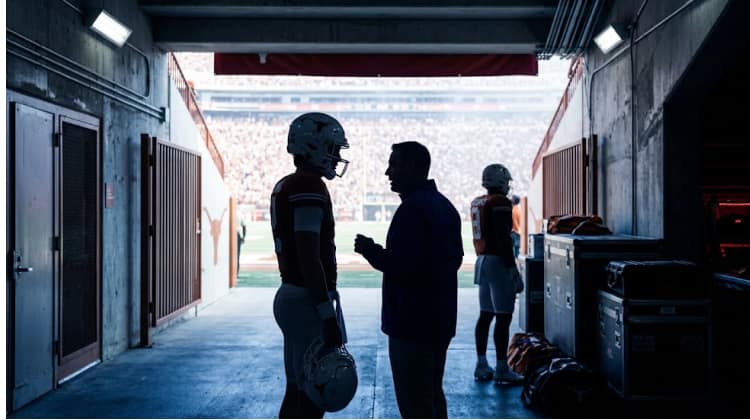
The first game should allow Manning and the offense to establish rhythm. The second is immediately one of the most significant games of the regular season.
The Ohio State game is therefore more than a revenge opportunity.
It is Manning’s first national audition of 2026.
The Buckeyes held Texas to seven points in the 2025 meeting. This time, the Longhorns have the advantage of playing at home, and Manning enters the matchup with a full season of starting experience.
That changes the evaluation.
He will not be viewed as a talented quarterback learning how to operate the offense. He will be viewed as the leader of a preseason top-five team expected to compete for the SEC and national championship.
That distinction is at the heart of his 2026 pressure.
The SEC Schedule Will Test More Than His Arm
The Manning Award race will not be decided by one game.
Texas’ conference schedule gives Manning multiple opportunities to establish himself against elite competition.
The Longhorns are scheduled to play Tennessee, Oklahoma, Florida, Ole Miss, Mississippi State, Arkansas, Missouri, LSU and Texas A&M during the 2026 regular season.
Several of those games will force Manning to operate in very different environments.
Tennessee brings a difficult road environment early in the season. Oklahoma creates the annual rivalry pressure of the Red River matchup. LSU and Texas A&M provide late-season SEC tests where the stakes could be enormous.
That schedule is precisely what can elevate Manning’s award candidacy.
A quarterback does not become a national standard simply by accumulating statistics against weaker opponents. The strongest cases are built through production when the quality of the opponent rises.
Manning will have opportunities to do exactly that.
His Competition Is Already Established
The Manning Award watch list also puts Manning into a crowded national quarterback field.
The 2025 finalists included players such as Julian Sayin of Ohio State, Dante Moore of Oregon, Marcel Reed of Texas A&M, Gunner Stockton of Georgia, Ty Simpson of Alabama and Diego Pavia of Vanderbilt.
Manning’s own 2025 statistics compare favorably with that group, but they also show why another step is necessary.
Fernando Mendoza won the 2025 Manning Award after leading Indiana to its first national championship. Mendoza finished the season with 3,172 passing yards and 36 touchdown passes before completing a championship run that included multiple College Football Playoff victories.
That is the standard.
The award is not simply asking which quarterback can produce 3,000 yards.
It rewards quarterbacks who combine individual production with postseason impact.
For Manning, that means Texas’ team success and his individual award case are now tightly connected.
Sarkisian’s Offense Gives Manning Multiple Ways To Win
The strongest argument for Manning’s potential leap is the system around him.
Sarkisian has consistently built offenses around quarterback flexibility, formation variation and matchup creation. Manning’s ability to threaten defenses as both a passer and runner gives Texas more options than a traditional pocket quarterback.
The arrival of Cam Coleman also adds another major target to an already talented receiving group. Coleman and Manning were both named to the Maxwell Award preseason watch list earlier in August, while Manning has also appeared on the Walter Camp and Johnny Unitas Golden Arm watch lists.
That accumulation of honors tells its own story.
Manning is not being evaluated as a single-award candidate.
He is appearing across multiple national award races because the expectation surrounding him has become broader.
He is expected to be one of the country’s best quarterbacks.
The Bigger Question Is Efficiency
For all of Manning’s production, his 61.39% completion rate from 2025 leaves room for improvement.
That does not mean Texas needs Manning to transform into a high-volume short-passing quarterback.
Instead, the next step is efficiency within Sarkisian’s offense.
Better decision-making on intermediate throws, improved consistency on routine completions and fewer wasted possessions would make Manning more dangerous without requiring him to dramatically increase his volume.
That is particularly important because Texas will face defenses capable of creating pressure and disguising coverage.
The Longhorns’ offensive line is also dealing with uncertainty after first-team All-SEC left tackle Trevor Goosby suffered a knee bone bruise during preseason practice.
Manning’s ability to operate effectively even when protection is imperfect could become one of the most important parts of his 2026 development.
The national award conversation will follow the results.
The Postseason Could Be The Deciding Factor Again
There is an interesting symmetry between Manning’s 2025 and 2026 situations.
Last year, his postseason performance against Michigan moved him onto the Manning Award finalist list.
This year, the award’s postseason component gives him another opportunity to make the same kind of late-season statement.
The difference is that expectations are much higher.
Texas is no longer simply trying to prove it belongs among the SEC’s elite programs. The Longhorns are entering the season with national championship expectations, and Manning is one of the primary reasons.
If Texas reaches the SEC Championship Game or College Football Playoff, Manning will have a chance to build his case on the biggest stages available.
If he performs well there, the watch-list recognition from August could become the first step toward something much bigger.
If Texas falls short, his individual statistics may still earn recognition, but the national narrative will be more complicated.
That is the nature of the Manning Award.
Manning Is No Longer A Prospect Waiting For His Moment
The most important shift entering 2026 is simple: Arch Manning’s evaluation has changed.
He is no longer primarily the highly recruited quarterback waiting behind Quinn Ewers.
He is no longer judged mainly on potential.
He is a returning starter who produced 3,163 passing yards and 36 total touchdowns in 2025, helped Texas win 10 games, earned Citrus Bowl MVP honors and became a Manning Award finalist after his postseason performance.
The national award watch lists are reflecting that change.
For Texas, the objective is even larger.
Sarkisian needs Manning to turn individual talent into consistent championship-level quarterback play while navigating one of the toughest schedules in college football.
For Manning, the 2026 season is an opportunity to establish himself as more than one of the most recognizable players in college football.
It is the chance to become one of its defining quarterbacks.
The first evidence will arrive September 5 against Texas State.
The first major test comes one week later against Ohio State.
After that, the SEC schedule will determine whether the preseason expectations were simply hype—or the beginning of a season in which Arch Manning becomes the national standard his name, talent and production now suggest he can be.