

The Arch Manning role in Texas’ 2026 playoff push is not hard to identify, but it is easy to oversimplify. He is the center of the Longhorns’ plan, not the entire plan. That distinction matters for a program that finished 11-3 in 2025, beat Michigan in the Citrus Bowl on December 31, 2025, and still missed the College Football Playoff for the first time since 2022, as noted by Sports Illustrated’s Texas outlook.
That 2025 ending left Texas in a tricky place. The Citrus Bowl win gave the program a useful finish and gave Manning, the game’s MVP, a postseason performance to carry into the offseason. It also reminded everyone in Austin that a strong record and a quality bowl win are not the same as a playoff season in the expanded College Football Playoff era.
Steve Sarkisian’s task is to build an offense that lets Manning set the terms without asking him to rescue every drive. That means controlled aggression, better answers on schedule, and enough balance to make Texas difficult to defend in SEC play. CBS Sports framed Texas as reloading around Manning and being positioned for a 2026 CFP run under Sarkisian in its 2026 preview.
Why The Arch Manning Role Has Changed
The shift is less about name recognition and more about responsibility. Manning was no longer just the former five-star quarterback with the most recognizable football last name in the sport after the Citrus Bowl. By January 2026, he had produced a postseason win over Michigan, earned MVP honors in that game, and was named one of 15 finalists for the Manning Award, which recognizes the nation’s top quarterback.
Those facts do not guarantee a playoff run. They do change the operating assumption inside the program. Texas can enter the 2026 season treating Manning as the offensive reference point rather than a quarterback still waiting for proof that he can carry a major assignment.
The Arch Manning Role Starts With Ownership
That is the part of the Arch Manning role that matters most inside the building. Texas does not need him to imitate a veteran who has already played three full seasons as a starter. It needs him to own protections, tempo, route adjustments, and the emotional tone of a team carrying SEC and CFP expectations.
The research around Texas’ offseason points to Manning taking a more visible leadership position during workouts. That is not a cosmetic detail. Quarterback leadership can be overplayed from the outside, but it becomes real when it affects daily standards: how receivers finish routes, how the line communicates, how backs handle pass protection, and how quickly the offense corrects a poor series.
For more on that piece of the conversation, this site’s prior analysis of Arch Manning’s 2026 role fits the same question Texas faces now: how much of the offense should run through him, and how much support must be built around him?
How The Arch Manning Role Shapes The Offense
The cleanest version of the Arch Manning role is not a pass-heavy showcase. It is an offense that uses his arm talent and mobility to stress defenses without turning every Saturday into a quarterback survival test.
Sarkisian has built his reputation as a play-caller on spacing, sequencing, and forcing defenders into bad choices. With Manning, the best version of that approach should include more than deep shots and highlight throws. Texas has to give him defined answers early in games, keep the run game credible, and use his movement skills without exposing him to unnecessary contact.
Balance Should Be A Tool, Not A Talking Point
Balance is often discussed in empty terms, but for Texas it has a practical meaning. The Longhorns added offensive pieces through the transfer portal, with the research identifying wide receiver Cam Coleman and running backs Raleek Brown and Hollywood Smothers among the additions. Their value is not just statistical. Their presence can help Texas avoid becoming too Manning-dependent.
If Coleman gives Texas another receiving option who can win outside, Sarkisian can use formations to isolate matchups and keep safeties honest. If Brown and Smothers give the backfield more speed and rotation value, Manning can operate off more favorable down-and-distance situations. That is how a quarterback becomes central without becoming overburdened.
The playoff version of Texas probably needs Manning to create explosive plays, but it also needs him to accept efficient ones. A five-yard throw that keeps Texas ahead of schedule may matter as much in November as a throw that circulates across social media on a Saturday night. The offense has to reward patience, not just arm strength.
- Early-down efficiency: Texas needs manageable third downs so Manning is not living in obvious passing situations.
- Run-game credibility: The backs must punish light boxes when defenses commit extra attention to the passing game.
- Quarterback movement: Designed movement and selective runs can use Manning’s mobility without making it the whole plan.
- Receiver distribution: A playoff offense cannot depend on one target to solve coverage every week.
Why The Playoff Push Cannot Be Quarterback-Only
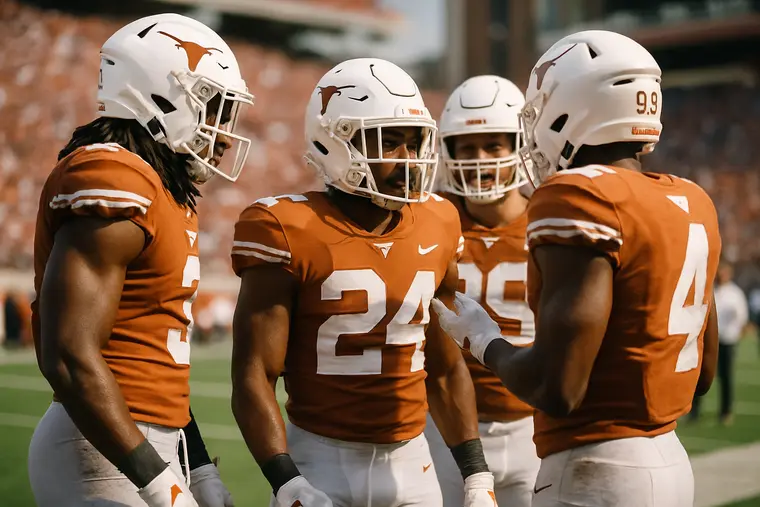
Texas’ 2026 expectations are high because the roster is being framed as more than a quarterback story. That matters. The Longhorns were good enough to win 11 games in 2025, but not good enough to reach the CFP. The margin from strong season to playoff season will likely come from repeatable strengths, not one player’s peak moments.
The March 2026 hire of Will Muschamp as defensive coordinator, with a reported $8.4 million investment, signaled that Texas understood the assignment on the other side of the ball. If Manning is the headliner, the defense has to be the stabilizer. SEC games rarely allow an offense to stay clean for four quarters. A playoff-caliber defense gives the quarterback room to play a mature game instead of forcing late drives to cover for repeated breakdowns.
Muschamp’s Defense Changes The Quarterback Math
A better defensive structure can change how Sarkisian calls games. If Texas can create shorter fields, protect leads, and limit explosive responses, Manning does not need to press. That is where complementary football becomes real rather than a coaching phrase.
The Longhorns’ best path is not to ask Manning to win shootouts every week. It is to ask him to make the offense reliable enough that the defense can play from advantageous situations. If Texas is ahead or even on the scoreboard, pass rush, coverage disguise, and field position become more valuable. If Texas is constantly chasing games, every Manning dropback carries extra weight.
That is also why the Heisman conversation should be treated as a byproduct, not a blueprint. Manning enters the 2026 season with national award attention, but Texas cannot build a season around individual validation. A deep CFP run would strengthen any award case. Chasing award moments can weaken the team structure needed to get there.
What The Arch Manning Role Means For Texas
The Arch Manning role should be judged by control as much as production. Texas needs the high-end throws, but it also needs the quieter signs of quarterback growth: clean operation before the snap, fewer wasted possessions, better answers against pressure, and the discipline to let the roster work around him.
That is the real test for Sarkisian, too. The temptation with a quarterback of Manning’s profile is to make every game feel like a referendum. The smarter approach is to make Texas hard to defend in multiple ways. Manning can be the central piece while the offensive line, backs, receivers, tight ends, and defense all carry real responsibility.
If Texas reaches an SEC Championship appearance and makes a deep CFP run, Manning will almost certainly be a major reason. If Texas falls short, the review should go beyond quarterback performance. The 2026 Longhorns are being built around a premium quarterback, but playoff teams are not built on premium quarterbacks alone.
That is why the most important version of Manning may not be the most spectacular one. Texas needs the quarterback who can turn talent into rhythm, expectations into weekly preparation, and big-play ability into winning decisions. If he does that, the Longhorns’ playoff push will have a foundation sturdy enough to last beyond a few highlight drives.