
The Texas AP Poll Drop was not just a routine correction after a rivalry loss. It was a sharp reassessment of how much trust the Longhorns had built, how quickly that trust can erode, and how little margin remains once SEC play starts taking weight in October.
Texas lost 27-24 to Oklahoma on October 10, 2026, at the Cotton Bowl. It was the Longhorns’ first loss of the season, and it landed harder because Oklahoma entered with a losing record and was outside the AP Top 25. The next day, Texas fell from No. 1 to No. 7 in the AP poll, while the Coaches Poll placed the Longhorns at No. 6. Sports Illustrated reported Texas stood at 4-1 overall and 1-1 in SEC play after the Oklahoma loss after the Red River result.
That kind of fall can feel severe for a one-score game. In this case, it reflected more than the scoreboard. Texas had been No. 1 for four consecutive weeks, its longest stretch there since 1977, and had earned that spot after a dramatic early-season win over Ohio State. Voters were not simply moving Texas down because it lost. They were re-pricing the Longhorns’ week-to-week reliability.
Why The Texas AP Poll Drop Hit Hard
The Ranking Was Built On A Narrow Case
Texas had a strong case for No. 1 before the Oklahoma game, but it was still a case built on September momentum. The Longhorns’ rally from a 20-point fourth-quarter deficit to beat Ohio State 24-23 on September 12-13 gave them national credibility and pushed them to the top of the poll. NCAA.com documented Texas climbing to No. 1 in the AP Top 25 after that early-season shake-up in the September rankings.
That Ohio State result still matters. It remains Texas’ best proof that this roster can absorb trouble and answer against a high-end opponent. But polls are not résumés frozen in September. They are weekly measurements of trust, strength and current form. Losing to Oklahoma did not erase the Ohio State comeback, but it did create a competing piece of evidence.
The issue for Texas was the opponent profile. A close loss to a top-five team often produces a softer landing. A loss to an unranked rival with a losing record usually does not. Rivalry games can be strange, and Texas-Oklahoma has produced plenty of results that ignored form charts. Poll voters still had to judge the full picture: No. 1 team, neutral-site rivalry, first loss, unranked opponent, conference implications.
What The Texas AP Poll Drop Says About Trust
The Texas AP Poll Drop says voters still see Texas as a serious team, but not as the safest team. Falling to No. 7 is not a collapse out of the national conversation. It is a placement in the next tier, behind teams voters viewed as more complete through October 11, 2026.
Georgia moved to No. 1 at 6-0 after beating Alabama. Notre Dame, Miami, Ohio State and Indiana filled out the rest of the top five in the new AP poll. That matters because Texas did not fall into a weak top 10. It fell into a crowded race where voters had alternatives with cleaner records or stronger recent statements.
This is where style matters. Texas lost by three, but the reaction suggests the performance did not protect the ranking. A No. 1 team can survive a poor quarter or a road wobble. It has a harder time surviving a full rivalry game that leaves doubts about execution, control and finishing drives.
The Oklahoma Loss Changed The Voter Case
One Loss Is Manageable, The Context Is Not
A 4-1 record is not a damaged season by itself. In the expanded playoff era, one loss in October does not end national goals. The problem is that Texas also moved to 1-1 in SEC play, which changes the week-to-week math inside the league. The Longhorns now have less room for another flat performance, especially if the conference race tightens around teams with similar résumés.
That is why the Texas AP Poll Drop felt like more than a media reaction. It was an early warning about control. Texas no longer controls the narrative as the unbeaten No. 1 team. It has to rebuild the argument through cleaner football, not reputation.
There is a difference between being punished and being reclassified. Texas was reclassified from the clear top team to a contender with something to prove. That is a fair place after a first loss, especially given the opponent’s standing entering the Cotton Bowl.
The Longhorns Still Have A Path
The encouraging part for Texas is that the drop did not push the Longhorns outside the range where a strong finish can repair the damage. No. 7 keeps them close enough to climb quickly if they win and if teams above them take losses. It also keeps the locker room from needing to pretend the season is fine without proof. The ranking delivers pressure, but pressure can sharpen a team if the response is honest.
The response begins with Florida at home, which was listed as the next game after the poll slide. That setting gives Texas a chance to show whether Oklahoma exposed a deeper flaw or forced a needed correction. A narrow escape would help the record. A cleaner performance would help the perception.
For Texas readers, this is not only a national poll story. It affects how every Saturday in Austin feels from here. Home games carry more urgency. SEC standings deserve closer attention. The margin between playoff positioning and a nervous November is thinner than it looked before the Cotton Bowl.
The Response Has To Be More Than Cosmetic
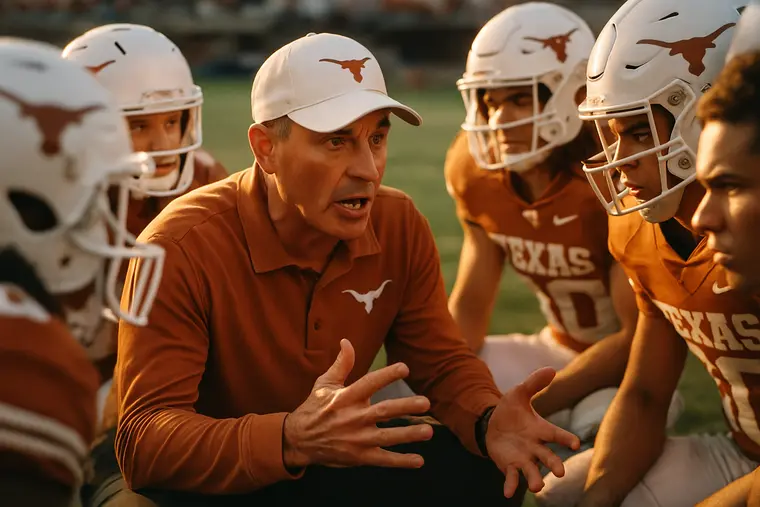
Texas Needs Evidence, Not Messaging
Steve Sarkisian’s team does not need a public relations reset. It needs football evidence. That means cleaner early downs, better control in high-leverage possessions and fewer stretches where the offense lets a manageable game become tense. The research before the Oklahoma game had already raised questions about offensive ranking and consistency, a theme tied to our earlier analysis of Texas’ offensive issues before Oklahoma.
Poll voters respond to wins, but they also respond to how wins look against the schedule. Texas does not need to chase style points in a reckless way. It does need to play with the steadiness expected from a roster that spent four weeks at No. 1. That is the practical lesson from the Cotton Bowl.
The defense, special teams and situational offense all share the burden now. A team trying to climb back cannot keep relying on one dramatic answer. The Ohio State comeback showed resilience. The Oklahoma loss showed that resilience is less useful when a team spends too much of the game chasing its own mistakes.
The SEC Margin Is Already Smaller
The SEC record matters because the league will not give Texas many soft landings. A 1-1 conference start is not fatal, but it leaves less cushion for injuries, road stress, weather, emotional rivalry spots and plain bad football. The Longhorns can still be a playoff-caliber team. They cannot keep giving voters reasons to doubt their floor.
That is the central football question after the Texas AP Poll Drop: is Texas a top-tier team that had one rivalry stumble, or a talented team with enough week-to-week volatility to fall short of its ceiling? The next several games will answer that through blocking, tackling, protection calls and red-zone decisions, not slogans.
What The Texas AP Poll Drop Really Means
The Texas AP Poll Drop means the Longhorns lost their benefit of the doubt. They did not lose their season. Those are different things, and Texas has to treat them differently.
If Texas answers with composed, physical football, the Oklahoma loss can sit as a costly but survivable rivalry scar. If the same issues continue, the No. 7 ranking from October 11, 2026, may be remembered as the first clear sign that the Longhorns’ No. 1 profile was ahead of their weekly consistency.
The fair read is measured. Texas remains highly ranked, still owns a major win over Ohio State, and still has enough schedule strength to climb. The warning is just as real. A team that wants to stay in the national race cannot let one bad afternoon become a pattern, especially in a state where every Longhorns game carries local attention from Austin to Dallas to high school locker rooms full of future recruits watching how Texas responds.
For now, the poll drop should be treated less like a verdict and more like a demand. Texas has to earn back the trust it spent in Dallas.