
By Oct. 7, 2026, Texas Heat Rules are no longer a preseason talking point. They have become part of the football week. Starting on Aug. 1, 2026, the University Interscholastic League made Wet Bulb Globe Temperature readings mandatory for outdoor athletic and marching band practices, not just recommended, according to Click2Houston’s report on the UIL policy. That one change has altered how coaches build practice plans, how trainers prepare fields, and how families should think about the rhythm of a Texas football week.
The key distinction matters: the UIL policy applies to practices, not games or competitions. That does not mean Friday night is untouched. It means the effect is indirect. Teams are adjusting through shorter outdoor windows, different practice times, tighter equipment decisions, and more careful sideline planning. In a state where football routines can feel fixed from August through December, the heat policy has introduced a practical question: how much preparation can a team lose before Friday execution starts to show it?
Texas Heat Rules And The New Practice Clock
Texas Heat Rules Start Before The First Rep
The new system begins before players stretch, jog, or put on pads. Under the UIL policy described by Texas Public Radio, WBGT readings must be taken within 15 minutes before an outdoor practice or activity begins and then repeated every 30 minutes during the session as TPR reported. That requirement changes the job description for every program, especially smaller staffs that already split duties across coaching, equipment, transportation, and player supervision.
This is not simply a thermometer check. WBGT accounts for heat, humidity, wind, sun angle, and cloud cover, which makes it a better gauge of stress on athletes than air temperature alone. For football, that distinction is useful because the sport adds helmets, shoulder pads, turf heat, and repeated high-effort bursts. A day that looks manageable by temperature can still produce a restrictive WBGT reading if humidity and sun exposure stack up.
The Thresholds Force Hard Choices
The policy tiers are clear enough that coaches cannot treat them as suggestions. Below 82 degrees WBGT, normal outdoor practice is allowed. From 82 to 86.9, a rapid cooling zone must be available. From 87 to 90, practice is limited to two hours, equipment is restricted, and rest breaks increase. From 90.1 to 92, outdoor activity is capped at one hour, protective gear is not allowed, and conditioning drills are barred. At 92.1 or higher, practice must be canceled or moved indoors.
Those numbers matter because they turn heat from a general concern into a scheduling constraint. A staff can write a full two-hour plan, but the field reading can erase parts of it. That is a new kind of competitive pressure. The best staffs will not be the ones that complain most loudly about lost time. They will be the ones that decide in advance which periods are essential, which can move indoors, and which can be cut without weakening Friday performance.
Why Practice Policy Still Reaches Friday Night
Games Are Different From Practices
The UIL has not made the WBGT practice tiers mandatory for games or competitions. That distinction should calm one misunderstanding. This is not a rule that automatically cancels every hot Friday kickoff. Still, the fact that game play is treated differently from practice does not remove the operational burden from schools. If athletes practice less outdoors during the week, coaches must adapt the plan that reaches the stadium.
That is where the football analysis starts. Offensive timing, special teams spacing, defensive substitution patterns, and conditioning all depend on repetition. A team that loses full-speed outdoor work on Tuesday or Wednesday may still be safe and prepared, but it may need to simplify certain calls. Younger teams may feel that more than veteran teams. Programs with indoor options may protect more of their teaching time than schools without easy indoor space.
Friday Logistics Are Becoming More Connected
Game-day planning now starts earlier in the week. If afternoon practices are often moved to early morning or late evening to avoid higher WBGT periods, families face transportation changes. Coaches face staff availability issues. Band directors and athletic trainers share the same heat reality. For related Friday operations, our earlier look at Texas heat safety planning explains why cooling zones, staffing, and sideline routines are becoming part of the weekly football checklist.
The smartest schools will treat Friday as the final step in a heat-aware week, not as a separate event. That means water access, shaded recovery areas, athletic training coverage, and communication with visiting teams should be settled before buses arrive. None of that wins a district game by itself. Poor planning, though, can drain energy from players and staff before the second half begins.
Coaches Are Losing Dead Time, Not Just Practice Time
Shorter Windows Reward Organized Programs
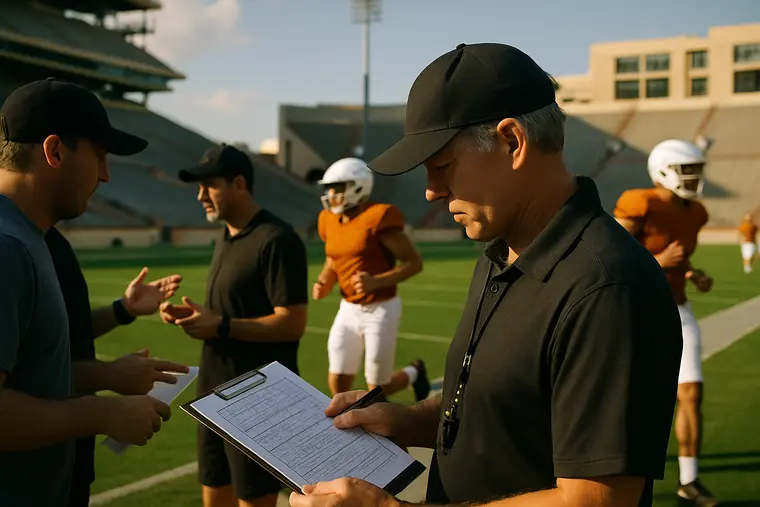
The most useful coaching adjustment may be cutting the dead spaces that often live inside practice. Long transitions, repeated huddles between drills, slow scout-team substitutions, and unclear teaching periods become more costly when WBGT rules shorten the outdoor window. The better response is not to race through everything. It is to make every period cleaner.
For high school coaches, that may mean walk-throughs indoors before the team ever reaches the field. It may mean film corrections before practice rather than after. It may mean fewer full-contact segments and more focused position work. Those are football decisions, not just safety decisions. Programs that can teach efficiently will protect more of their identity under the same restrictions that affect everyone else.
Depth And Conditioning Need A Different Lens
Heat rules also change how depth is built. Conditioning drills are limited or barred at the highest outdoor activity tiers, which means staffs cannot rely on old late-practice running periods to build fitness. That may be a healthy shift. Football conditioning is often best built through structured practice tempo, special teams reps, and controlled competitive periods. Still, teams have to plan for it.
Depth players may need more meaningful practice reps earlier in sessions, before readings rise or restrictions tighten. That can help development if coaches use it well. It can hurt if starters take every quality rep and younger players only receive leftovers after the best outdoor window has closed. In October, when injuries, school demands, and district races press on rosters, that choice matters.
- Prioritize essential team periods before the hottest part of the practice window.
- Move teaching, walk-throughs, and corrections indoors when space allows.
- Plan equipment changes before WBGT readings force rushed decisions.
- Build rapid cooling access into the normal practice layout, not as an afterthought.
What Texas Heat Rules Mean For October Football
The best reading of Texas Heat Rules is not that they make football softer. They make preparation more exact. Coaches still have to block, tackle, teach leverage, prepare special teams, and get teenagers ready for high-stress moments. They just have to do it within a practice structure that treats heat as a measurable condition rather than a toughness test.
For Texas fans and families, the practical takeaway is patience with schedule changes. A moved practice, a shorter outdoor session, or a later team arrival is not always a sign of poor planning. It may be evidence that a staff is following the rules and protecting athletes while trying to preserve performance. That balance is now part of the sport.
The October football question is not whether teams can ignore the heat. They cannot. The better question is which programs turn the new structure into cleaner habits. The answer will show up in fourth-quarter tackling, substitution discipline, special teams organization, and how well teams handle short weeks. Heat policy began as a safety measure. By midseason, it has become a test of program management across Texas high school football.