

Texas and Ohio State will meet Saturday night in one of the most anticipated games of the 2026 college football season, but the matchup will have another opponent waiting outside the stadium: the Austin heat.
No. 1 Ohio State travels to Austin to face No. 4 Texas at DKR-Texas Memorial Stadium on Sept. 12 at 6:30 p.m. CT. The game is sold out and will be televised nationally on ABC, but the weather could become one of the few variables neither coaching staff can fully control. Current forecasts call for temperatures around the upper 90s at kickoff, with some projections reaching roughly 100 degrees during the day and heat-index readings approaching or exceeding 100 degrees. Texas-Ohio State game information
The conditions are not theoretical. Texas already played its season opener in extreme heat on Sept. 5, when the Longhorns hosted Texas State for a 2:30 p.m. kickoff. Austin reached 102 degrees, with a heat index of 105, according to FOX 7 Austin. Austin-Travis County EMS reported transporting 13 patients from the game to hospitals, with three cases potentially heat-related. Austin heat report from FOX 7
That experience does not give Texas a guaranteed competitive advantage. Players from both teams are highly conditioned athletes, and Ohio State has prepared for the environment. But it does mean Texas has already experienced the physical and logistical challenges of playing football in an Austin September heat wave.
Against the defending national champion, those details could matter.
Austin’s Heat Will Be Different At Night
The biggest misconception about Saturday’s weather is that a 6:30 p.m. kickoff eliminates the heat problem.
It does not.
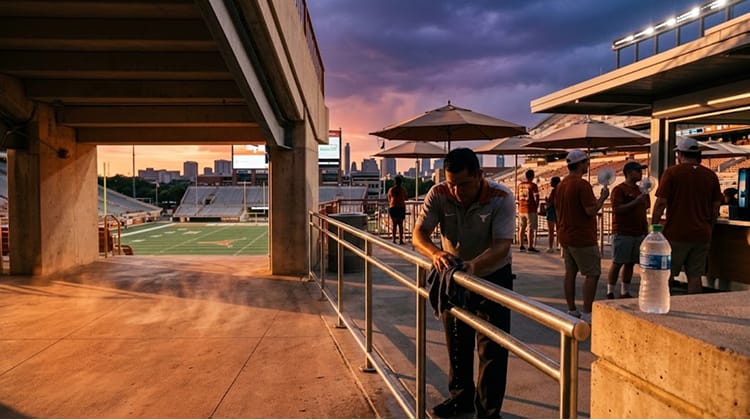
The most extreme temperatures are expected during the afternoon, but the heat will remain elevated when the game begins. One current forecast projects temperatures around 95 degrees at kickoff with a “feels like” temperature near 102 degrees. Another forecast places conditions closer to 99 degrees with a heat index around 100. Austin kickoff weather forecast
The University of Texas’ own weather service has classified Saturday as a period of elevated to dangerous afternoon and evening heat stress across the Austin and Interstate 35 corridor. The same outlook calls for little or no rainfall, meaning there is little expectation that a storm or cooler air mass will provide relief. UT Austin Weather
That creates a different environment from a typical September night game.
The sun will eventually disappear, but the concrete, seats and surrounding structures around DKR will have absorbed heat throughout the afternoon. More than 100,000 people are also expected to occupy the stadium and surrounding campus areas, adding another layer to the overall game-day environment.
Texas has played in Austin for decades. Ohio State has traveled to difficult environments before. Neither fact makes the weather irrelevant.
The question is how long the heat remains a factor once the game becomes physically demanding.
Texas Already Learned From The Texas State Opener
Texas’ first game provided an unusually useful preview of what extreme conditions can do around DKR.
The Longhorns beat Texas State 59-7, producing 516 total yards and scoring on eight of nine drives. Arch Manning threw for 305 yards and four touchdowns, Ryan Wingo caught seven passes for 121 yards, and Cam Coleman scored twice in his Texas debut.
But the story outside the field was different.
The 2:30 p.m. kickoff placed fans directly into the hottest portion of the day. FOX 7 reported a 102-degree temperature and a 105-degree heat index, while Austin-Travis County EMS confirmed 13 transports from the stadium area. FOX 7 Austin heat coverage
That experience led Texas to emphasize hydration and preparation for another difficult weather day.
The difference Saturday is that the game begins four hours later.
That should reduce the peak heat exposure, but it does not eliminate the accumulated effects of spending the afternoon around the stadium. Tailgating, College GameDay activities, campus events and the enormous crowd will begin long before kickoff.
For the players, the more relevant issue is what happens after 40 or 50 snaps.
A game played at 95 degrees feels different when both teams are fresh than it does when defensive linemen have already spent an hour chasing quarterbacks and running backs have absorbed repeated contact.
Ohio State Has To Travel Into The Environment
Ohio State’s challenge is not simply the temperature.
It is the combination of travel, an unfamiliar stadium environment and sustained physical stress.
The Buckeyes are traveling more than 1,000 miles from Columbus to Austin for their first road game of the season. They also enter the matchup after opening with a 56-3 victory over Ball State at Ohio Stadium.
That means Ohio State has not yet had to operate in a hostile road environment during the 2026 season.
The Buckeyes are also accustomed to playing in Ohio’s late-summer conditions, which can certainly become hot and humid. It would be wrong to suggest that Ohio State’s roster is incapable of handling high temperatures.
The issue is exposure.
Austin’s weather represents another variable the Buckeyes must manage while dealing with one of the best teams in the country.
Texas, meanwhile, gets to remain in its normal environment.
The Longhorns do not have to travel, change time zones or adjust their daily preparation around a road itinerary. They will practice in their own facility, sleep in their own beds and follow the same routines they have used throughout the preseason.
That is a small advantage before the football even begins.
Heat Matters More To The Defensive Line
If the weather becomes a genuine competitive factor, the defensive line could be where it first appears.
Defensive football requires repeated high-intensity efforts. Linemen sprint, collide, recover and repeat the process on nearly every possession. The heat does not make one player automatically better than another, but fatigue can make communication and technique deteriorate.

That matters for Texas because the Longhorns will need to pressure Ohio State quarterback Julian Sayin without allowing the Buckeyes to establish an easy rhythm.
Sayin opened the season by completing 21 of 25 passes for 320 yards and three touchdowns against Ball State. Jeremiah Smith caught eight passes for 151 yards and two touchdowns, giving Ohio State an immediate passing threat that Texas cannot afford to ignore.
Texas will therefore need defensive linemen to remain explosive deep into the game.
If fatigue arrives, pass-rush effectiveness can disappear quickly.
A tired edge rusher loses a fraction of a second off the snap. A defensive tackle gets less push through the middle. Linebackers arrive a step late. Coverage windows become larger.
Those small changes can completely alter a possession.
That is where Texas’ familiarity with the environment could become more meaningful.
Texas’ Depth Could Matter More Than The Temperature
The better way to describe the potential advantage is not simply “Texas is used to the heat.”
It is that Texas may be better positioned to manage the heat.
Steve Sarkisian has repeatedly emphasized roster depth during his tenure, and the 2026 roster gives Texas options at multiple positions. The Longhorns rotated players extensively in the season opener, while the defense forced three turnovers in the 59-7 victory over Texas State.
That depth becomes valuable if the game turns into a conditioning contest.
A coach does not want to keep a tired defensive lineman on the field simply because he is a starter. Rotating players can preserve intensity, particularly if the opponent’s offense is using tempo.
Ohio State has its own depth, of course.
The Buckeyes had 88 players participate in their opener, a reminder that Ryan Day has plenty of personnel available. The issue is not whether Ohio State can substitute. It is whether substitutions maintain the same level of execution against a Texas team playing in its home environment.
That is a much harder question.
The Heat Could Affect Offensive Tempo
Weather can also influence the offensive game plan.
Texas does not need to abandon its aggressive passing attack because of the temperature. Manning showed against Texas State that he can distribute the football quickly, connecting with eight different receivers during the opener.
But both teams could become more conscious of tempo if the heat remains severe.
Long offensive drives become physically expensive for defenses. Conversely, three-and-outs become particularly damaging because they force a defense back onto the field without giving it much recovery time.
That creates a strategic incentive to sustain drives.
For Texas, this could make running back usage especially important. Hollywood Smothers and Raleek Brown give the Longhorns different styles in the backfield, while Manning’s mobility creates another option for keeping the offense moving.
The objective would not necessarily be to run the ball every possession.
It would be to avoid repeatedly putting the defense into difficult situations.
A 12-play drive that ends in points does more than add to the scoreboard. It gives the opposing defense fewer opportunities to operate in the heat.
That becomes increasingly relevant late in the third quarter.
DKR’s Environment Could Become Part Of The Game
The stadium itself is another variable.
Texas expects one of the largest crowds in DKR history for the Ohio State game. Recent reporting indicates the attendance could surpass the previous stadium record of 105,215, set in 2024. Ohio State was allocated only 3,800 tickets for the matchup.
That means the Buckeyes will walk into an environment dominated by Texas supporters.
The heat will add to the atmosphere.
By kickoff, thousands of fans will have spent hours around campus. College GameDay will have been operating on the Forty Acres throughout the morning, and the stadium area will have been active long before the teams enter the field.
Texas’ home-field advantage therefore has multiple layers.
There is the crowd.
There is the familiarity.
There is the lack of travel.
And then there is the climate.
None of these factors guarantees a victory.
Together, however, they can increase the physical and mental burden on a visiting team.
Hydration Is A Competitive Issue And A Safety Issue
The heat should also be discussed responsibly.
This is not a situation where fans or players should be expected to simply “tough it out.” The City of Austin identifies extreme heat as one of the most dangerous weather hazards in Central Texas and recommends hydration, shade breaks, lightweight clothing and other measures to reduce the risk of heat illness. City of Austin heat-safety guidance
Texas has also prepared DKR with 19 hydration stations for Saturday’s game, giving fans access to water throughout the stadium. Fans are allowed to bring one sealed water bottle into the venue.
Those details matter because the same weather that could influence football can also create genuine health risks.
The Texas State opener demonstrated that point.
For the teams, hydration and cooling procedures are part of normal sports-science preparation. For the fans, the responsibility is different. Thousands of people will spend hours outdoors before kickoff, and some will consume alcohol while exposed to extreme heat.
The safest approach is also the simplest: hydrate early, seek shade when possible and recognize symptoms of heat exhaustion before they become more serious.
Ohio State’s Biggest Challenge May Come Late
The most interesting question is not whether Ohio State can play well in 95-degree conditions.
It almost certainly can.
The question is whether the heat changes the game during the final 20 minutes.
That is when fatigue becomes cumulative.
If Texas can keep the game close through the first half, maintain defensive rotations and continue producing first downs, the conditions could become more relevant in the fourth quarter.
Ohio State will also have a deep roster and an elite coaching staff, so there is no guarantee that Texas will benefit more from the conditions.
But Texas has an opportunity to make the environment matter.
That could mean using substitutions aggressively on defense, maintaining a physical running attack, forcing long drives and making Ohio State repeatedly execute in the heat.
The strategy is less about turning the weather into a gimmick and more about making the opponent work.
Texas Cannot Rely On The Weather
There is an obvious danger in overestimating the heat.
Texas still has to play Ohio State.
The Buckeyes are ranked No. 1, opened the season with a 56-3 win and have one of the deepest rosters in college football. Texas is ranked No. 4 and is coming off a 59-7 victory, but Saturday’s opponent is operating at an entirely different level.
The weather cannot fix protection problems.
It cannot prevent Jeremiah Smith from making contested catches.
It cannot guarantee that Texas’ defensive front reaches Sayin.
It cannot replace execution on third down.
And it cannot rescue the Longhorns if Ohio State wins the line of scrimmage.
The best version of Texas will use the environment as an additional advantage rather than treating it as the foundation of the game plan.
That distinction is important.
Saturday Could Show How Much Home Field Really Matters
Texas and Ohio State have met five times, and Ohio State leads the series 3-2. The last two meetings both ended in Buckeye victories, including the 14-7 result in the 2025 season opener and the 28-14 national championship victory on Jan. 10, 2025.
This time, the setting is different.
Texas gets the home stadium.
Texas gets the crowd.
Texas gets its own preparation routine.
And Texas gets an Austin evening that could still feel close to triple digits when the game begins.
That does not make the Longhorns the better team automatically.
It does give Sarkisian another variable he can use.
If Texas plays efficiently, rotates intelligently and keeps the game physically demanding, the heat could become more than a talking point. It could become part of the competitive equation.
The most important moment may come after halftime, when the weather, crowd noise and accumulated contact begin to test both teams.
If Texas is still fresh while Ohio State begins showing signs of fatigue, the Longhorns will have created the exact type of home-field advantage that cannot be measured in the preseason.
And if the game remains tight into the fourth quarter, nearly 100,000 people inside DKR will have one more reason to believe that Austin itself can help decide what happens next.