

Texas spent the first three quarters of Sept. 12 looking like a team that had lost control of its biggest game. By the end of the night, the Longhorns had produced one of the most remarkable comebacks in program history, defeated No. 1 Ohio State 24-23 and moved to the top of the college football rankings.
Now comes the less dramatic part of the schedule.
No. 1 Texas will host 2-0 UTSA at Darrell K Royal-Texas Memorial Stadium on Saturday, Sept. 19, at 7 p.m. CT on SEC Network+. The Roadrunners arrive after their own fourth-quarter comeback, defeating Texas State 31-26 on Sept. 12. (Texas-UTSA Game Center)
The timing creates an unusual challenge for Steve Sarkisian.
Texas is coming off the biggest regular-season win of his tenure, has moved to No. 1 for the first time during the regular season since October 2024, and now faces an opponent with nothing to lose and plenty of confidence. The Longhorns cannot control how the outside world reacts to the ranking, but they can control whether the program treats Saturday like another step in a long season or spends the week living inside the Ohio State celebration.
That is the real test of handling success.
Texas Has A New Position At The Top
The AP Top 25 released after Week 2 changed the context around Texas almost overnight.
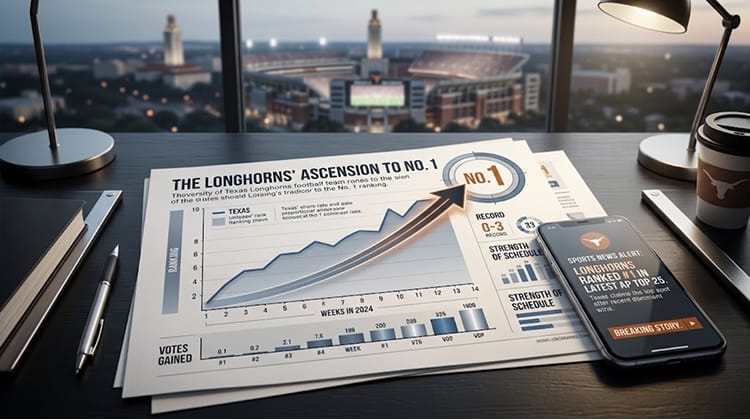
The Longhorns moved from No. 4 to No. 1 following the 24-23 victory over Ohio State. Georgia remained No. 2, Notre Dame stayed No. 3, Indiana moved to No. 4 and Miami climbed to No. 5. Ohio State dropped to No. 6 after beginning the season as the consensus No. 1. (AP Top 25 update)
For Texas, the ranking carries historical significance.
The Longhorns had not been No. 1 in the regular-season AP poll since October 2024. Their new position also represents the earliest point in a season that Texas has reached No. 1 since 1965.
But a ranking is a description of where the program sits at one moment. It does not provide protection against what happens the following Saturday.
That distinction matters against UTSA.
Texas is no longer chasing Ohio State’s position. It now occupies it.
Every opponent will have a different emotional relationship with the Longhorns because of that status. UTSA does not need to convince anyone that it belongs in the game. The Roadrunners simply need to play their style, take advantage of opportunities and force Texas to prove that the No. 1 ranking has not changed its preparation.
The Ohio State Comeback Created A Different Kind Of Pressure
Texas’ victory over Ohio State was not a routine top-five win.
The Longhorns trailed 23-3 entering the fourth quarter and eventually scored three touchdowns in the final period. Hollywood Smothers scored twice on one-yard runs, while Arch Manning connected with Ryan Wingo for a three-yard touchdown during the comeback. Smothers’ second touchdown tied the game with 25 seconds remaining, and Gianni Spetic’s extra point gave Texas the lead. (Texas’ Ohio State comeback)
The numbers behind the comeback are even more unusual.
Texas outgained Ohio State 239-132 in the second half and held the Buckeyes scoreless during the final 15 minutes. Manning completed 8 of 11 passes for 83 yards and a touchdown during the fourth quarter, while the Texas defense forced an interception from Julian Sayin.
It was the largest fourth-quarter comeback against an AP No. 1 team.
That kind of victory changes the atmosphere around a program.
Players receive more national attention. Coaches face more questions. Every practice becomes easier to scrutinize. Supporters expect another statement performance. And the next opponent gets to enter the game knowing that beating Texas would immediately become one of the biggest results of its season.
UTSA understands that dynamic.
UTSA Is Not Arriving In Austin At 0-2
The Roadrunners are 2-0, and the manner in which they reached that record makes them particularly relevant to this week’s discussion.
UTSA opened the season with a 45-16 victory over UTRGV before traveling to San Marcos to face Texas State on Sept. 12. The Roadrunners trailed 17-7 at halftime but outscored Texas State 24-9 in the second half and won 31-26 on Brandon High Jr.’s 25-yard touchdown run with 14 seconds remaining. (UTSA’s 31-26 comeback)
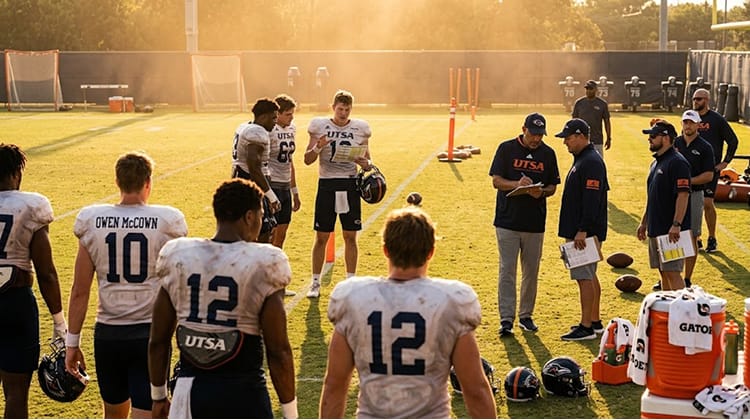
That result gave UTSA its 100th win in program history.
It also showed why the Roadrunners cannot be reduced to the role of an early-season opponent waiting to be overwhelmed.
UTSA converted two fourth downs on its final possession against Texas State. Quarterback Owen McCown contributed with both his arm and his legs during the drive, including a six-yard quarterback keeper that moved the ball to the UTSA 42-yard line.
Then the Roadrunners completed three consecutive passes before a defensive holding penalty against Texas State helped extend the drive.
Those details reveal something important about Jeff Traylor’s team.
UTSA is comfortable playing through difficult stretches.
That does not mean the Roadrunners will duplicate what Ohio State did against Texas. It means Texas should expect an opponent capable of responding if the Longhorns establish an early advantage.
Jeff Traylor Gives UTSA A Familiar Texas Connection
Saturday’s game also has a strong in-state component because UTSA’s head coach is Jeff Traylor.
Traylor has been at UTSA since 2020 and enters his seventh season as the Roadrunners’ head coach. The program credits him with 55 of its first 100 victories and identifies him as its winningest and longest-tenured head coach. UTSA entered 2026 with a 53-26 record under Traylor after six seasons, and the program has built itself into a consistent bowl participant during his tenure. (UTSA’s program history)
That history gives UTSA credibility before the opening kickoff.
Traylor also understands the Texas football landscape.
UTSA’s roster includes players with Texas recruiting backgrounds, while the Roadrunners have repeatedly competed against major programs from the state. The matchup therefore does not require UTSA to manufacture an emotional reason to compete.
The opportunity is already there.
A win over No. 1 Texas would become the biggest regular-season result in UTSA history.
That creates a very different motivational equation from what Texas experienced against Texas State two weeks ago.
Owen McCown Is The Quarterback Texas Cannot Overlook
The matchup also features a quarterback who has been building a significant résumé at UTSA.
Owen McCown entered 2026 as a preseason first-team All-American Conference selection and was placed on multiple national award watch lists, including the Manning Award, Maxwell Award, Davey O’Brien Award and Walter Camp Player of the Year. UTSA reported before the season that McCown had already accumulated 6,861 career passing yards, 59 touchdown passes and a .657 completion percentage. (Owen McCown’s UTSA profile)
More importantly, he has experience.
McCown has started each of UTSA’s last 27 games dating back to the 2023 Frisco Bowl, giving him a substantial amount of experience operating Traylor’s offense.
That matters because Texas’ defense is preparing for a quarterback who has already shown that he can stay composed when the game changes.
Against Texas State, McCown was involved in the final drive that turned a two-point deficit into a five-point victory.
Texas therefore cannot afford to assume that a strong opening quarter will settle the game.
The Longhorns need to make McCown consistently operate against a defense that has already demonstrated it can make adjustments.
Texas Needs To Clean Up What Ohio State Exposed
The 24-23 comeback should not erase the problems Texas had for three quarters.
Ohio State led 20-3 at halftime and 23-3 entering the fourth quarter. Texas’ offense struggled to sustain the same efficiency it showed in the season opener against Texas State, while Ohio State controlled the game for long stretches.
That gives Sarkisian a useful teaching tool for the UTSA game.
The coaching staff does not need to pretend the first three quarters did not happen because the fourth quarter produced a historic comeback.
In fact, the opposite approach may be more useful.
Texas can study the early problems while using the fourth quarter as evidence that the team is capable of correcting them during a game.
The offensive line will need to maintain its progress. Manning will need to make quicker decisions. The running game will have to stay efficient enough to prevent UTSA from concentrating entirely on the passing attack.
Defensively, Texas will need to avoid giving McCown opportunities to extend drives.
The Ohio State game showed that Texas can survive a poor start against elite competition.
The UTSA game should test whether Texas can prevent another poor start in the first place.
The Running Game Could Set The Tone
Hollywood Smothers enters the UTSA game after becoming one of the most important players in the Ohio State comeback.
He finished with 74 rushing yards and two touchdowns against the Buckeyes, including the two one-yard scores that changed the game. Texas also finished the game with 141 rushing yards against Ohio State, despite spending much of the night playing from behind. (Texas’ official game statistics)
That gives Texas a potentially useful foundation against UTSA.
The Longhorns do not need to replicate the comeback formula.
Ideally, they should avoid needing one.
A productive early rushing attack would allow Sarkisian to keep Manning out of obvious passing situations, control possession and make UTSA defend the entire field.
It would also give Texas an opportunity to rotate its running backs and maintain physicality over four quarters.
The goal against UTSA should be to establish control early rather than wait for adversity to force the offense into another dramatic response.
Texas’ No. 1 Ranking Changes The Opponent’s Mindset
There is also a psychological component to being No. 1.
Texas has now become the target.
That does not mean UTSA will be intimidated by the ranking. It means every opponent can point to Texas as the program it wants to measure itself against.
That creates a different responsibility for Sarkisian’s team.
The Longhorns have to learn how to play with expectations rather than chasing them.
For the past several weeks, the narrative surrounding Texas was about whether the team could live up to its preseason expectations. The Ohio State game answered part of that question.
Now the standard has changed.
A 10-point win over UTSA will be treated differently than a 10-point win would have been before the Ohio State game. A slow start will receive more attention. Every Manning throw will be examined. Every defensive breakdown will become part of the national discussion surrounding the No. 1 team.
That is the cost of reaching the top.
DKR Gives Texas Another Important Advantage
Texas will also have the benefit of returning to DKR.
The Ohio State victory drew 105,044 fans, the third-largest crowd in stadium history. Texas now hosts UTSA one week later at the same venue. The official schedule lists the game as a 7 p.m. CT kickoff on SEC Network+, and the contest is sold out. (Texas’ 2026 schedule)
That setting matters because the Longhorns have already demonstrated how powerful the home environment can become.
The Ohio State comeback happened in front of more than 105,000 fans, and Texas forced a turnover in the fourth quarter while the crowd remained fully engaged after the Buckeyes had controlled most of the evening.
UTSA will enter a very different atmosphere from the one it experienced at Texas State.
But the Roadrunners also have experience playing in Texas environments, and Traylor’s teams have consistently handled road games during his tenure.
The home crowd can provide energy.
It cannot execute a block or make a tackle.
Texas still has to produce the football.
The Schedule Makes UTSA More Important Than It Looks
The UTSA game also sits at a useful point in Texas’ schedule.
After Saturday, the Longhorns travel to Knoxville to face Tennessee on Sept. 26. That game is scheduled for an 11 a.m. CT kickoff and will air on ABC or ESPN. (Texas’ upcoming schedule)
That means UTSA represents the final home game before Texas begins SEC play on the road.
A strong performance would give Texas a chance to enter Tennessee week with momentum and fewer unresolved questions.
A messy performance would create a different type of week.
Sarkisian would have to address why Texas struggled against an opponent it was expected to control, while simultaneously preparing his team for one of the more demanding road environments in the SEC.
That makes Saturday valuable even beyond the win-loss record.
It is an opportunity to establish how the No. 1 team handles a different type of game.
Texas Does Not Need Another Miracle
The most important objective for Texas against UTSA is simple: avoid making the game dependent on another miracle.
The Ohio State comeback proved that the Longhorns possess resilience.
But resilience is most valuable when it serves as a backup rather than the primary strategy.
Texas now has the chance to show that it can start quickly, maintain discipline, control the line of scrimmage and finish an opponent without requiring a 21-point fourth quarter.
UTSA has already demonstrated that it can come from behind.
McCown has experience.
Traylor has built a winning program.
The Roadrunners are 2-0.
And Texas is no longer simply a highly ranked team looking for a breakthrough.
It is No. 1.
That means Saturday’s game is about more than avoiding an upset.
It is about learning how to carry the expectations that come with being at the top of the sport.
Texas has already shown it can respond when everything goes wrong.
Against UTSA, the next step is showing that it can handle success when everything starts going right.