

The Texas Longhorns have strengthened their position in the College Football Playoff race at an important point in the 2026 season. After defeating Missouri 34–20 on November 7, Steve Sarkisian’s team improved to 7–2 overall and 4–2 in SEC play. The selection committee rewarded that result by moving Texas from No. 7 to No. 6 in its second CFP rankings, released November 10.
The improvement carries more weight than a routine poll adjustment. Texas has recorded four victories over teams ranked in the Associated Press Top 25, a distinction no other program had matched when the committee published its latest rankings. With LSU, Arkansas and Texas A&M still on the schedule, the Longhorns have three opportunities to strengthen their postseason case before Selection Day.
The challenge is no longer simply getting back into the national conversation. Texas must demonstrate that its recent improvement can hold against difficult opponents and that its two October losses do not define the quality of its season.
Texas Moves Ahead After a Valuable Victory at Missouri
The 34–20 win over Missouri gave Texas another important result away from Austin. The game took place November 7 at Faurot Field in Columbia, where the Longhorns faced a Missouri team that entered the matchup ranked No. 19 in the CFP rankings and carrying a 6–2 record.
Texas did not control the game from the opening kickoff. Missouri scored 10 points in the first quarter, and the teams entered halftime tied at 10. The Tigers regained the lead in the third quarter, but Texas responded with two touchdowns before adding another score in the final period.
The Longhorns finished the game with 14 unanswered fourth-quarter points. That response was particularly important because it showed the offense could handle a competitive road environment and execute when the game remained undecided.
Arch Manning completed 28 of 38 passes for 297 yards, three touchdowns and no interceptions. His performance gave Texas a reliable passing foundation, while running back Raleek Brown supplied another dimension. Brown rushed for 85 yards and scored twice, including a receiving touchdown that gave Texas the lead for good with 5:03 remaining.
Freshman receiver Jermaine Bishop Jr. also caught a touchdown pass, while Derrek Cooper contributed a 24-yard scoring reception earlier in the game.
The victory improved Texas to 7–2 and added another ranked opponent to its list of wins. The official Texas Athletics game recap provides the complete scoring breakdown and individual performances.
The Committee Has Moved Texas to No. 6
The November 10 rankings provide a clearer picture of how the committee currently evaluates the Longhorns.
Texas opened the committee’s 2026 rankings at No. 7 on November 3. One week later, the team moved to No. 6, placing it immediately behind Notre Dame and ahead of Miami.
The latest top 10 looks like this:
| CFP Rank | Team | Record |
|---|---|---|
| 1 | Georgia | 8–1 |
| 2 | Utah | 9–0 |
| 3 | Alabama | 7–2 |
| 4 | UCLA | 9–0 |
| 5 | Notre Dame | 8–1 |
| 6 | Texas | 7–2 |
| 7 | Miami | 8–1 |
| 8 | Tennessee | 7–2 |
| 9 | Indiana | 8–1 |
| 10 | BYU | 7–2 |
The movement around Texas is significant. Miami dropped six positions after previously occupying the top spot, while Tennessee climbed five places to No. 8. Notre Dame made an even larger jump, moving from No. 11 to No. 5 after its latest victory.
Texas did not make the largest move, but its position is important because the committee continues to place the Longhorns among the strongest teams in the country despite their two losses.
The official College Football Playoff rankings also show that Alabama, another two-loss SEC program, occupies the No. 3 position. That placement demonstrates that the committee is willing to rank teams with multiple defeats highly when their overall profiles justify it.
For Texas, the next objective is to keep producing results that support its current position.
Four Ranked Victories Give Texas a Valuable Advantage
The strongest part of Texas’ playoff argument is the quality of its wins.
The Longhorns have defeated Ohio State, Tennessee, Ole Miss and Missouri, all of which were ranked in the AP Top 25 when Texas faced them. The victory over Ohio State was particularly important because the Buckeyes entered the September 12 matchup as the No. 1 team in the country.
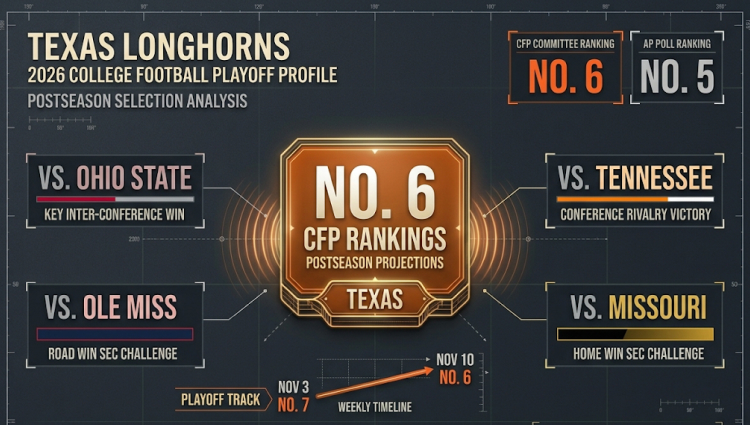
Texas won that game 24–23, establishing an early result that remains valuable in the committee’s evaluation. The Longhorns then defeated Tennessee 20–17 on September 26 at Neyland Stadium, adding a difficult SEC road victory to their record.
The October schedule became more complicated after consecutive losses to Oklahoma and Florida, but Texas responded by defeating Ole Miss 34–27 on October 24. The victory over Missouri completed the four-win collection against ranked AP opponents.
That group of results gives Texas a stronger argument than a team whose record is built primarily on victories against unranked opposition.
It also creates an important distinction between the Longhorns’ overall record and the quality of their competition. A 7–2 team with four ranked victories can have a more compelling profile than another program with the same record but fewer meaningful wins.
The committee’s November 10 release specifically identifies strength of schedule as one of its evaluation principles. It also considers head-to-head results, performances against common opponents and other relevant circumstances.
Texas has benefited from the first of those considerations, but it must continue producing strong results to maintain that advantage.
Arch Manning’s Improvement Is Strengthening the Offensive Case
Texas’ recent progress is closely connected to Arch Manning’s improved performances.
The quarterback has become more consistent during the three-game winning streak, giving Sarkisian a more dependable offensive foundation. His latest performance against Missouri was particularly encouraging because he completed nearly 74% of his attempts, threw three touchdowns and avoided an interception.
Through nine games, Manning has completed 168 of 254 passes for 2,024 yards and 18 touchdowns. His completion rate stands at 66.14%, while his seven interceptions remain an area that opponents will attempt to exploit.
The recent sequence offers a clearer picture of his development. Against Ole Miss, Manning helped Texas secure a 34–27 win. He followed that with a 31–3 victory over Mississippi State, completing 16 of 20 passes for 220 yards and three touchdowns. Against Missouri, he produced another three-touchdown performance.
Those games have helped restore confidence in an offense that struggled during the Oklahoma and Florida defeats.
The improvement also gives Texas more options. Brown has become a useful contributor as both a runner and receiver, while younger targets such as Bishop and Cooper have shown that they can contribute in important situations.
The Longhorns cannot assume that Manning will produce at the same level every week. LSU, Arkansas and Texas A&M will present different defensive challenges. However, if he maintains his current decision-making and completion rate, Texas will have a better chance of winning the close games that often determine playoff positioning.

Defensive Consistency Will Matter Against the Remaining Schedule
Texas’ defense has also played an important role in the team’s recovery.
The Longhorns are allowing 17.44 points per game through nine contests, according to the team’s official cumulative statistics. Opponents are averaging approximately 280 yards of total offense per game, compared with Texas’ 363 yards.
Those numbers reflect a team that has been more effective at controlling games than its two October losses might suggest.
The defense held Mississippi State to just three points on October 31 and limited Missouri to 20 points. Against the Tigers, Texas also benefited from a fourth quarter in which the offense maintained possession and built a two-score advantage.
Colin Simmons remains one of the most important players in this unit. His ability to pressure opposing quarterbacks can change the rhythm of a game, particularly against teams that rely on their passing attacks. The Longhorns need that pressure to remain consistent as they enter the most important stretch of the regular season.
The challenge will be managing injuries and maintaining depth. Texas has dealt with important absences along the offensive and defensive lines, as well as at other positions. The committee can consider relevant circumstances involving key player availability, but the team still has to perform with the players available.
Against LSU, the defense will need to limit explosive plays, win important third downs and avoid allowing the home crowd to influence the game’s momentum.
LSU Is the Next Major Test of Texas’ Playoff Position
The Longhorns travel to Baton Rouge on Saturday, November 14, to face LSU at Tiger Stadium. Kickoff is scheduled for 6:30 p.m. Central Time, with ABC carrying the game nationally.
LSU enters the matchup at 6–3 and ranked No. 21 in the November 10 CFP standings. The Tigers fell seven positions after losing 31–13 to Alabama on November 7.
Although LSU is coming off a defeat, the matchup remains important for both programs. Texas needs another strong road performance to support its No. 6 position, while the Tigers have an opportunity to improve their standing by beating a team ranked inside the CFP’s top six.
The matchup presents several questions for Sarkisian. Texas must protect Manning against LSU’s pass rush, establish enough running production to keep the defense balanced and avoid the penalties that have disrupted the offense at different points this season.
The Longhorns also need to manage the environment. Tiger Stadium is one of the most challenging road venues in college football, and communication becomes especially important when the crowd is loud.
A victory would improve Texas to 8–2 and provide another meaningful SEC result. It would also strengthen the argument that the Longhorns have recovered from their October setbacks and can compete consistently against highly ranked opponents.
A loss would not automatically eliminate Texas from playoff contention, but it would place additional pressure on the final two games.
Arkansas and Texas A&M Could Determine the Final Outcome
The schedule does not become easier after LSU.
Texas returns to Austin on November 21 to host Arkansas at Darrell K Royal–Texas Memorial Stadium. The game is scheduled for 2:30 p.m. CT and will air on ABC or ESPN.
The Razorbacks represent another SEC challenge, and the Longhorns will need to avoid treating the home matchup as an opportunity to relax after the LSU road trip.
The regular season then ends with the Lone Star Showdown against Texas A&M on November 27. Texas travels to Kyle Field in College Station for a 6:30 p.m. CT kickoff on ABC.
That rivalry game could carry significant postseason consequences. A win would give Texas another strong conference result and allow the Longhorns to finish the regular season with momentum. A loss could complicate the team’s position, particularly if other contenders continue winning.
The final stretch also gives the committee additional evidence to compare Texas with teams such as Miami, Tennessee, Indiana, BYU and Kentucky.
The Longhorns do not control those programs’ results. They do control their own performance, and winning the remaining schedule would make their playoff argument considerably stronger.
The complete Texas 2026 football schedule confirms the dates, venues and broadcast information for the final three games.
What No. 6 Means Under the 12-Team Playoff Format
The 2026–27 College Football Playoff will feature 12 teams. The field includes the four highest-ranked conference champions from the ACC, Big Ten, Big 12 and SEC, the highest-ranked team from the Group of Six conferences, and seven at-large selections.
The four highest-ranked teams among the playoff seeds receive first-round byes. The remaining eight teams play first-round games at campus sites hosted by the higher seeds.
Texas’ No. 6 position currently places the Longhorns in a strong position for an at-large selection. However, the final bracket is determined by the committee’s rankings and the playoff’s seeding rules, not simply by copying the weekly top 12.
The distinction matters because conference champions and automatic bids can affect the final seed order. Texas still has work to do before its postseason destination becomes clear.
The committee will release its third ranking on November 17, following its next meetings on November 16 and 17. That update will include the results of the LSU game only if the schedule or release timing changes; as currently scheduled, Texas will play LSU on November 14, giving the committee a new result to consider.
The final rankings and official playoff bracket are scheduled for December 6, following conference championship weekend. The CFP’s official 2026 bracket information explains the selection structure and postseason schedule.
Texas Has Earned Its Position, but the Job Is Not Finished
Moving to No. 6 is an important achievement for a Texas team that faced serious questions after losing to Oklahoma and Florida. Three consecutive victories have changed the tone around the program, and the Missouri win provided another example of the Longhorns responding under pressure.
The team’s four victories over AP Top 25 opponents give it a strong foundation. Manning’s improved passing production, Brown’s versatility and the defense’s ability to limit scoring have also helped Texas rebuild its postseason case.
However, the committee’s next decisions will depend on what happens during the final three games. LSU offers an immediate road challenge, Arkansas provides a home opportunity, and Texas A&M represents a rivalry matchup with major SEC implications.
Sarkisian’s team has moved into the top six, but that position is not a guarantee of playoff qualification. Texas must continue winning and show that its recent improvement is sustainable.
The Longhorns have put themselves in a serious position to compete for a national championship. Now they must finish the season with the consistency that their ranking demands.