The Texas Longhorns have a problem that goes beyond Arch Manning’s interceptions or the frustration surrounding Steve Sarkisian’s play-calling. Their offense is struggling to keep drives alive, and the numbers have become difficult to ignore. According to an October 15 report from Burnt Orange Nation, Texas has recorded a 48.1% three-and-out rate in SEC play, the highest mark in the conference. The Longhorns have also converted just 6 of 26 third-down opportunities across their last two games, a 23.1% success rate that puts their offensive problems into sharp focus.
The timing is significant. Texas enters its October 17 home game against Florida after a painful 27–24 loss to Oklahoma in the Red River Rivalry. The defeat dropped the Longhorns from No. 1 to No. 7 in the national rankings and exposed weaknesses that had already appeared during their narrow win over Tennessee. Texas still has the talent to compete with leading SEC teams, but that talent cannot consistently influence games if possessions end before the offense establishes a rhythm.
Sarkisian now faces a practical challenge: find a way to make Texas’ offense more dependable before another difficult stretch of the schedule arrives. The solution will require more than asking Manning to make better throws. Texas must improve its early-down execution, create manageable third downs, run the football with greater consistency and reduce the mistakes that repeatedly put its offense behind schedule.
Texas’ Three-and-Out Numbers Reveal a Bigger Offensive Problem
A three-and-out occurs when an offense fails to earn a first down during its initial three plays and must usually punt. One stalled possession can happen to any team. A rate approaching half of a team’s possessions, however, signals a persistent problem with sustaining drives.
Texas’ reported 48.1% rate in SEC play is especially concerning because the Longhorns entered the season with high expectations for their offense. Manning has experienced productive stretches, and the roster features talented receivers capable of making difficult catches and turning routine completions into substantial gains. Yet individual playmakers cannot compensate for an offense that repeatedly struggles to reach the line to gain.
The issue also affects the defense. When the offense returns the ball quickly, Texas’ defenders receive less time to recover and prepare for the next series. Short possessions can shift field position, increase the number of defensive snaps and leave the team with fewer opportunities to control the pace of a game.
Texas’ recent results illustrate the danger. The Longhorns defeated Tennessee 20–17 on September 26, but their offense had difficulty sustaining momentum during much of the contest. Against Oklahoma on October 10, those difficulties became more costly. The Sooners won 27–24 on Tate Sandell’s 47-yard field goal as time expired, turning Texas’ offensive inconsistency into one of the defining stories of the rivalry.
The three-and-out rate does not explain every problem on its own. Turnovers, penalties, missed blocks and special-teams mistakes also contributed to the Oklahoma loss. Still, the statistic identifies a recurring weakness that Sarkisian cannot afford to treat as an isolated bad afternoon.
Third-Down Conversions Show How Often Texas Falls Behind Schedule
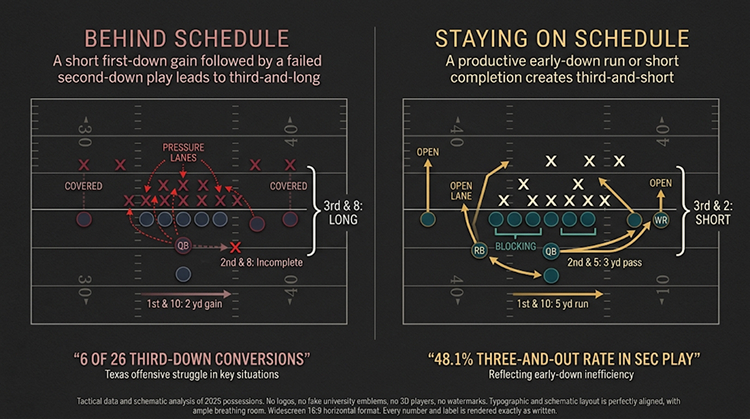
The Longhorns’ third-down performance provides another measure of the same problem. Converting 6 of 26 attempts over two games means Texas extended its drives on fewer than one in four third downs. That leaves little room for mistakes on first or second down.
Third-down difficulty is often the final symptom of a possession that went wrong earlier. A short run followed by an incomplete pass can turn a manageable second down into third-and-long. A penalty can erase a successful play. A missed assignment can force Manning to scramble or throw the ball away instead of allowing the offense to move the chains.
The distance required for a first down matters. Third-and-two gives an offense several realistic options, including a run, quick pass or quarterback keeper. Third-and-eight demands a more difficult conversion, often requiring protection long enough for a receiver to reach the necessary depth. Defenses can respond with pressure packages and coverage combinations that limit the quarterback’s choices.
Texas must therefore look beyond the conversion percentage itself. The coaching staff needs to determine how often the offense faces third-and-long, which formations produce the best results and whether the play calls fit the situation. Better third-down execution begins with more productive first and second downs.
There is also a question of predictability. If Texas repeatedly finds itself in obvious passing situations, opposing defenses can concentrate on pressuring Manning and contesting routes near the sticks. A more balanced offense would make those defensive decisions harder, particularly if the Longhorns can establish a credible running game early.
The Running Game Must Give Arch Manning More Manageable Situations
Texas cannot solve every third-down problem through the passing game. The running attack needs to contribute more consistently, both to gain yardage directly and to keep defenses from anticipating a pass on nearly every important down.
The Oklahoma game highlighted the challenge. Texas finished with 260 passing yards from Manning, three touchdown passes and two interceptions, but the offense struggled to maintain control when it needed to extend possessions. The two interceptions were costly, yet focusing exclusively on those throws would miss the broader question of why Texas repeatedly faced difficult situations.
The offensive line is central to that assessment. Center Connor Robertson and tackle Melvin Siani were among the players discussed in recent analysis of Texas’ stalled drives. Interior blocking, communication on defensive movement and protection against pressure all influence whether the offense can stay on schedule. When a running play gains little or a protection breakdown forces an early throw, the next down becomes more difficult.
The answer does not necessarily require Texas to abandon its preferred offensive identity. Sarkisian can use quicker runs, misdirection, screens and carefully chosen play-action concepts to create more favorable matchups. The key is to make defenses respect several possibilities rather than allowing them to focus on Manning’s dropback.
Freshman running back Derrek Cooper is another potential part of the conversation. Recent coverage of Texas’ playoff outlook has pointed to the possibility of giving Cooper a greater role as the team searches for offensive answers. That does not guarantee an immediate breakthrough, but a productive rotation could help Texas test different combinations and find a more reliable way to generate early-down yardage.
A stronger running game would also help protect the quarterback from unnecessary pressure. If Texas can create second-and-short situations, Manning would have more flexibility to throw, hand off or use play-action. That variety could improve both the quality of individual plays and the offense’s overall rhythm.
Steve Sarkisian’s Play-Calling Is Under Pressure
Sarkisian is responsible for more than the design of individual plays. As head coach, he must identify why the offense is failing and determine whether the current approach gives his players the best chance to succeed.
After the Oklahoma loss, Sarkisian acknowledged responsibility for the offense’s struggles while indicating that he would continue calling plays. That decision places the focus on execution and adjustments: Texas needs to show that its current structure can produce better results against the next opponent.
The distinction between a bad play call and poor execution matters. A receiver may fail to gain separation even when a concept creates the intended matchup. A quarterback may miss a read. A blocker may lose leverage against a defender. But when similar failures recur across multiple games, the coaching staff must examine whether the scheme, personnel groupings and situational decisions need to change.
Texas should pay particular attention to how it opens drives. Early play selection can establish whether the offense is willing to attack the defense horizontally, test the perimeter, use the running backs and create straightforward completions. If the first two plays repeatedly leave Manning facing third-and-long, the offense has already surrendered much of its flexibility.
The same principle applies in the red zone and on third down. Situational play-calling should reflect what the offense has executed well, not just what the playbook makes possible. Sarkisian has high-level talent available, but the next step is turning that talent into a repeatable series of first downs.
Florida Presents an Immediate Test for the Longhorns
Texas hosts Florida at Darrell K Royal–Texas Memorial Stadium on Saturday, October 17. The game gives the Longhorns a chance to respond quickly, but it also puts their offensive issues under a brighter spotlight. Texas cannot assume that home-field advantage will resolve the problems that appeared against Tennessee and Oklahoma.
The first priority should be improving early-down efficiency. Texas needs to avoid negative plays, limit penalties and gain enough yardage on first and second down to keep the full playbook available. Even a modest improvement in those areas could reduce the number of third-and-long situations and give Manning more realistic conversion opportunities.
The second priority is protecting possession. The interceptions against Oklahoma demonstrated how quickly a close game can turn on a mistake. Texas must balance aggression with sound decisions, particularly when a punt or field-goal attempt would be preferable to forcing a low-percentage throw. The quarterback should remain confident, but the offense must recognize when preserving the ball is the smarter decision.
The third priority is finishing drives. Sustaining a possession is valuable, but it only becomes a decisive advantage when Texas turns those opportunities into points. The Longhorns need more consistent production from their rushing attack, cleaner execution near the goal line and fewer self-inflicted setbacks.
Texas does not need to transform its offense overnight. It needs visible progress in the areas that have repeatedly undermined it. If the Longhorns convert more third downs, reduce three-and-outs and keep their defense from returning to the field after short possessions, the improvement will be measurable even before the final score.
Texas Needs Evidence of Progress Before the Ole Miss Game
The Florida matchup is also part of a larger test. Texas is scheduled to host No. 9 Ole Miss on October 24, giving the Longhorns another major SEC contest just one week later. A more effective performance against Florida would provide evidence that the coaching staff has addressed the issues revealed by the Oklahoma defeat.
The most useful measures will be straightforward: the number of three-and-outs, third-down conversions, yards gained on early downs, penalties that create long-yardage situations and turnovers. Those figures will help show whether Texas is sustaining possessions or simply relying on isolated explosive plays.
The 48.1% three-and-out rate and 6-of-26 third-down record are warning signs, not a final verdict on the season. Texas remains a talented team with opportunities to improve its position. But rankings and roster potential will not fix the offense. Better decisions, stronger blocking, a more dependable running game and more efficient play-calling must show up on the field.
For Sarkisian, Florida is the next opportunity to turn those adjustments into results. The Longhorns do not need every possession to become a scoring drive. They do need to stop giving away so many possessions before the offense has a chance to function. If Texas can keep drives alive on Saturday, it will take a meaningful first step toward answering the questions raised by the Oklahoma loss.