

Texas football has reached a defining point in its 2026 season. After climbing to No. 1 in the national rankings earlier this year, the Longhorns have fallen to No. 19 in the latest Associated Press Top 25, released October 19. Two consecutive 27–24 defeats, first against Oklahoma on October 10 and then against Florida on October 17, have transformed the conversation around head coach Steve Sarkisian’s team from championship potential to postseason survival. Houston Chronicle’s AP Top 25 report
Texas is now 4–2 overall and 1–2 in Southeastern Conference play, according to the latest rankings coverage. Its position is still recoverable, but the margin for error has narrowed considerably. The Longhorns must address offensive inconsistency, improve their execution in critical situations, and prepare for a difficult home matchup against No. 7 Ole Miss on October 24.
The latest ranking is more than a change in national perception. It reflects a team that has struggled to protect leads, finish games, and maintain the level of performance expected from a program that entered the season with College Football Playoff ambitions.
From No. 1 to No. 19: Texas Has Lost Its Margin for Error
Texas appeared to be among the leading national championship contenders after its early-season success, including a 24–23 victory over Ohio State on September 12. That win strengthened the Longhorns’ standing and helped propel them to the top of the rankings.
The situation changed dramatically in October. Oklahoma defeated Texas 27–24 in the Red River rivalry game, and Florida produced the same final score one week later at Darrell K Royal–Texas Memorial Stadium in Austin. The consecutive losses dropped Texas from No. 7 to No. 19 in the October 19 AP poll, a decline of 12 places.
The fall also placed Texas behind several SEC competitors, including Alabama at No. 13 and LSU at No. 18. Ole Miss sits at No. 7, making the upcoming matchup particularly significant for a Texas team that needs a strong conference result to rebuild its national standing. See the latest AP rankings coverage
Rankings alone do not determine playoff qualification. The selection committee evaluates a team’s full body of work, including wins and losses, schedule strength, conference results, and performances against quality opponents. Texas still has opportunities to improve its résumé, but another defeat would make its route considerably more difficult.
The Longhorns also face a broader challenge: their recent results have raised questions about whether the team can consistently perform at the level required to compete with the strongest programs in the country.
The Florida Loss Revealed Problems Texas Cannot Ignore
The October 17 game against Florida illustrated how quickly Texas can lose control of a contest. The Longhorns built a 17–3 advantage in the first half, using a 32-yard touchdown run by Raleek Brown and a 63-yard punt-return touchdown by Ryan Niblett to establish early momentum.
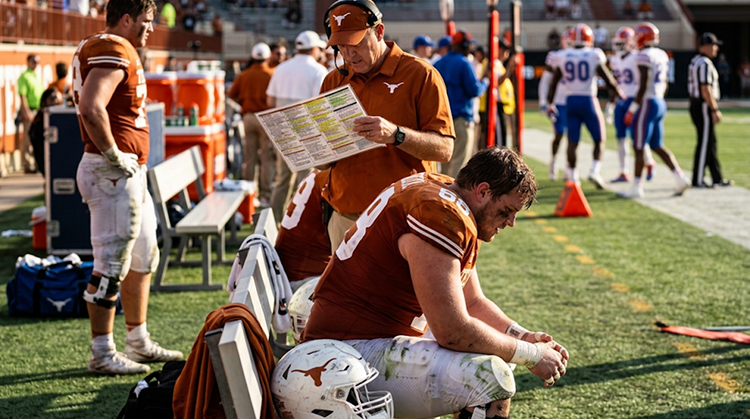
Florida responded with a sustained comeback. The Gators scored 24 unanswered points, turning a 14-point deficit into a 27–17 lead late in the fourth quarter. Freshman quarterback Tramell Jones Jr., making his first career start, threw for 155 yards and two touchdowns. Running back Jadan Baugh added 91 rushing yards and scored the go-ahead touchdown on an 11-yard run.
Texas briefly revived its chances when Arch Manning connected with Cam Coleman for a nine-yard touchdown with 4:21 remaining. The Longhorns then had another opportunity to regain possession and pursue a tying score. Instead, Florida’s defense forced a Manning fumble, recovered by the Gators with 1:58 remaining.
The final statistics exposed the scale of Texas’ offensive difficulties. The Longhorns managed 272 total yards, including 173 passing yards and just 99 rushing yards. They converted only two of 10 third-down attempts, while Florida controlled possession for 38 minutes and 11 seconds. Texas held the ball for just 21 minutes and 49 seconds.
Those numbers matter because they reveal more than one late mistake. Texas struggled to sustain drives, keep its defense rested, and produce reliable offense after its early lead disappeared. Official Texas Athletics game report and statistics
A playoff contender must be able to respond when its initial game plan stops working. Against Florida, Texas failed to maintain offensive rhythm for long stretches and could not recover after the Gators took control.
Arch Manning Must Become More Consistent Under Pressure
Manning remains central to Texas’ postseason prospects. His performance against Florida included 14 completions on 20 attempts for 173 yards and one touchdown. He also lost the fumble that effectively ended the Longhorns’ final comeback opportunity.
His previous outing against Oklahoma presented a different set of problems. Manning threw for 260 yards and three touchdowns but also recorded two interceptions in another 27–24 defeat. Taken together, the losses have placed his decision-making and performance under pressure at the center of the discussion surrounding Texas.
The quarterback’s overall season statistics provide a more complete picture than either game alone. Through six games, Manning has completed 106 of 166 passes for 1,295 yards, with 11 touchdowns and five interceptions, according to his published 2026 game log. Those numbers show that the offense can produce meaningful passing output, but recent turnovers and inconsistent results have limited the value of that production. Arch Manning’s 2026 game log
Manning does not bear responsibility for every problem. Texas’ offensive line has struggled to provide consistent protection, and the running game has not reliably helped the offense control the pace. Play-calling and execution on third downs also deserve attention.
However, Texas needs its quarterback to make sound decisions when defenses increase pressure and scoring opportunities become scarce. Against Florida, the Longhorns had a chance to tie or potentially win the game late. The fumble removed that opportunity.
Sarkisian has indicated that the program will evaluate its performance broadly after the defeat. The most productive response would be to establish clearer offensive priorities, improve protection, and create situations in which Manning can distribute the ball without being forced into unnecessary risks.

Steve Sarkisian Faces Questions About the Entire Offense
The two-game losing streak has intensified scrutiny of Sarkisian’s offensive system. Texas has struggled to sustain drives, and the Florida game exposed how difficult it has become for the Longhorns to maintain control after opponents adjust.
Third-down execution is an immediate concern. Converting only two of 10 opportunities against Florida repeatedly forced Texas off the field and prevented the offense from helping its defense recover. The possession imbalance also gave the Gators more opportunities to dictate the game’s tempo.
The running game requires attention as well. Brown’s 32-yard touchdown demonstrated the potential for explosive plays, but Texas finished with only 99 rushing yards against Florida. One successful run cannot compensate for repeated difficulties gaining yards on early downs.
Sarkisian and offensive line coach Kyle Flood must find a more dependable balance between passing and running. Better protection, quicker decisions, and more manageable third-down situations could reduce pressure on Manning while making the offense less predictable.
Texas also needs to respond more effectively when an opponent builds momentum. Florida erased the Longhorns’ lead through sustained drives and efficient red-zone execution. Texas’ offense failed to answer for much of the second half, leaving the defense on the field for extended periods.
The challenge is not necessarily to abandon the offensive system. It is to make the existing structure produce more consistent results. The coaching staff has limited time before Ole Miss arrives, so the adjustments must be practical enough to implement during one week of preparation.
The College Football Playoff Path Is Narrower, Not Closed
Falling to No. 19 creates a difficult position for Texas, but the ranking does not automatically eliminate the Longhorns from playoff consideration. The remaining schedule offers opportunities to collect important wins, particularly in SEC competition.
The immediate obstacle is Ole Miss, which entered the October 19 AP poll at No. 7. Texas will host the Rebels at Darrell K Royal–Texas Memorial Stadium on Saturday, October 24, with kickoff scheduled for 6:30 p.m. Central time. The game gives Texas an opportunity to improve its standing against a highly ranked conference opponent. Texas Athletics’ schedule and game information
A victory would not erase the Oklahoma and Florida defeats, but it would provide meaningful evidence that Texas can respond to adversity. It would also improve the team’s conference position and give the selection committee a stronger result to consider later in the season.
A third consecutive loss, however, would deepen the problem. Texas would have three defeats, including two at home, and would need a much stronger finish to restore confidence in its postseason case. The Longhorns would also have less room for another setback in their remaining SEC schedule.
The path depends on more than winning the next game. Texas must demonstrate that its recent failures are correctable rather than persistent. A convincing performance against Ole Miss would be more valuable than a narrow escape that leaves the same offensive weaknesses unresolved.
The Defense Must Help Texas Regain Control
The Longhorns’ defensive performance against Florida also deserves scrutiny. After building an early lead, Texas allowed the Gators to score 24 unanswered points. Florida’s ability to sustain possessions made it difficult for the Longhorns to regain momentum.
The defense was not solely responsible for the loss. Texas’ offensive struggles shortened its opportunities to respond and left little margin for defensive mistakes. Still, allowing an opponent to tu