

Arch Manning entered the 2026 college football season carrying expectations that extended far beyond Austin. The Texas Longhorns quarterback was widely discussed as a potential early first-round selection in the 2027 NFL Draft, but inconsistent performances have complicated that outlook. On October 15, ESPN draft analyst Mel Kiper Jr. ranked Manning No. 24 overall and sixth among quarterbacks on his latest draft big board. With Texas preparing to host Florida on October 17, Manning has an immediate opportunity to answer questions about his development and help restore confidence in his NFL potential.
The ranking arrives after a frustrating 27–24 loss to Oklahoma on October 10. Manning threw for 260 yards and three touchdowns in the Red River Rivalry, but two fourth-quarter interceptions helped turn a competitive game into a damaging defeat. One interception was returned for a touchdown, while the other gave Oklahoma another opportunity to secure the victory with a late field goal. Texas fell from No. 1 to No. 7 in the Associated Press poll, adding more scrutiny to a season that began with national championship ambitions.
Manning’s draft position is not a final judgment on his career. It reflects the concerns scouts and analysts have about his current performance, alongside the physical ability that made him one of the most closely watched prospects in college football. The Florida game offers a chance to show progress, but the larger challenge is proving that he can deliver consistent decisions and efficient production against SEC competition.
Why Mel Kiper Jr.’s Latest Ranking Matters
Kiper’s October 15 evaluation placed Manning 24th overall and sixth among quarterbacks in the 2027 NFL Draft class. That position is a notable change from the top-five selection projections that followed Manning into the season. It also places him behind several quarterbacks who have gained ground through their early-season performances, including Oklahoma State’s Drew Mestemaker and Notre Dame’s CJ Carr.
A draft big board is an assessment of prospects at a particular moment, not a prediction of exactly where every player will be selected. Manning has several months of college football remaining before the 2027 draft, scheduled for April 29 through May 1 in Washington, D.C. Strong performances could change the discussion, while further inconsistency could reinforce the concerns behind his current ranking.
The ranking matters because quarterback evaluations carry unusually high stakes. NFL teams must assess more than arm strength, athletic ability or recruiting pedigree. They look for evidence that a quarterback can process defensive coverage, make decisions under pressure, protect possession and repeat successful performances against different opponents.
Manning still has time to improve those areas. However, his reputation alone cannot guarantee a premium draft position. The next stage of his evaluation depends on what he produces on the field and how consistently he does it.
Arch Manning’s 2026 Statistics Tell a Mixed Story
Through Texas’ first five games, Manning had completed 92 of 146 passes for 1,122 yards, 10 touchdowns and five interceptions. His completion rate stood at 63%, with an average of 224.4 passing yards per game. Those figures show that he has produced meaningful scoring output, but the turnovers and uneven performances have kept his season from matching the expectations surrounding him.
His opening performance against Texas State demonstrated the upside. Manning completed 20 of 27 passes for 305 yards and four touchdowns in Texas’ 59–7 victory on September 5. The following week against Ohio State, he completed 23 of 37 attempts for 195 yards, one touchdown and one interception in a narrow 24–23 win.
The contrast between those games illustrates the challenge facing scouts. Manning has demonstrated that he can generate explosive production, but the standard for a high NFL selection is sustained performance rather than occasional statistical peaks.
His September 26 game against Tennessee offered another example. Manning completed 14 of 19 passes for 201 yards, but Texas needed a late defensive stand to preserve its 20–17 victory. Against Oklahoma, he produced three touchdown passes yet made two fourth-quarter mistakes that carried significant consequences.
Those results should be evaluated together. A quarterback can make productive throws throughout a game and still struggle with decisions in critical situations. Conversely, a poor finish does not erase every positive play that came before it. The central question for Texas is whether Manning can reduce costly mistakes while maintaining the aggression that makes the passing offense dangerous.
The Oklahoma Loss Exposed the Importance of Decision-Making
The Oklahoma defeat was particularly damaging because Texas had opportunities to win. Manning’s two interceptions in the fourth quarter shifted the momentum at a time when each possession carried substantial weight. The first became a defensive touchdown for Oklahoma, and the second helped set up the Sooners’ winning field goal.
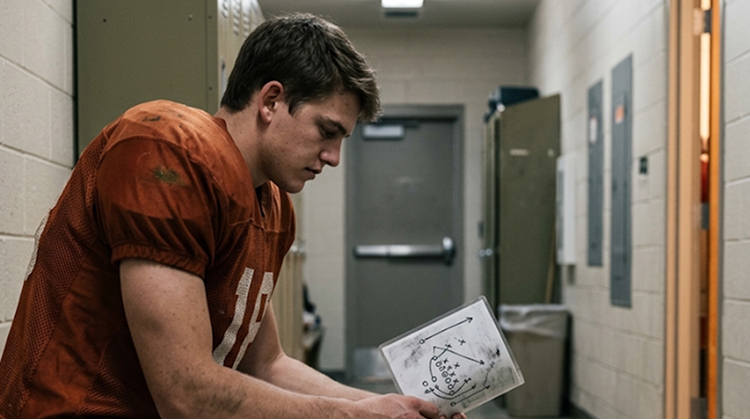
These were not simply entries in a statistical column. They changed the scoreboard and reduced Texas’ margin for error. NFL evaluators pay close attention to that distinction because professional defenses are equipped to punish inaccurate throws, late reads and decisions made under pressure.
Manning’s response should not be to abandon aggressive passing. Texas needs its quarterback to challenge defenses and take advantage of favorable matchups. The objective is to recognize when a throw is available, when a receiver is adequately covered and when preserving possession is the better choice.
Protection and play design also influence those decisions. If the offensive line struggles to maintain its blocks or the offense repeatedly faces third-and-long, Manning has less time and fewer straightforward options. Texas’ coaching staff must therefore improve the conditions around its quarterback while expecting him to execute more consistently.
That broader context is relevant to the draft debate. Evaluating a quarterback requires separating individual responsibility from problems involving blocking, play-calling, receiver separation and the overall offensive structure. Manning deserves scrutiny for his interceptions, but his performance should not be assessed as if he operates independently of the rest of the team.
Florida Offers an Immediate Opportunity to Improve His Evaluation
Texas hosts Florida at Darrell K Royal–Texas Memorial Stadium on Saturday, October 17. The matchup arrives at a useful moment for Manning because it gives him an opportunity to respond to the Oklahoma defeat before the Longhorns enter another demanding portion of their schedule.
Florida’s recent defensive performances create an opportunity for Texas to test different ways of attacking through the air. The Gators surrendered 45 points to Missouri on October 3 and 38 points to South Carolina on October 10. Those results do not guarantee that Texas will find the same openings, but they give the Longhorns reason to examine how Florida handles pressure, route combinations and sustained possessions.
For Manning, the most valuable outcome would be a controlled performance that combines accuracy with sound decisions. He does not need to chase a huge passing total on every drive. Moving the chains, taking advantage of open receivers and avoiding unnecessary risks would provide stronger evidence of development than a high yardage figure accompanied by costly turnovers.
Texas can also help by establishing the run and creating manageable down-and-distance situations. A balanced offense would make it harder for Florida to focus exclusively on Manning’s passing reads. Quick completions and well-timed play-action concepts could give him opportunities to build confidence without forcing difficult throws into crowded coverage.
The receiving group will be important, too. Texas needs its wideouts to create separation, secure catchable passes and convert opportunities into first downs. When the offense operates as a unit, Manning has a better chance of demonstrating the decision-making and accuracy that NFL evaluators want to see.
What NFL Scouts Need to See From Manning
A strong performance against Florida would be useful, but the details matter more than a single headline statistic. Several areas deserve particular attention as Manning continues his 2026 season.
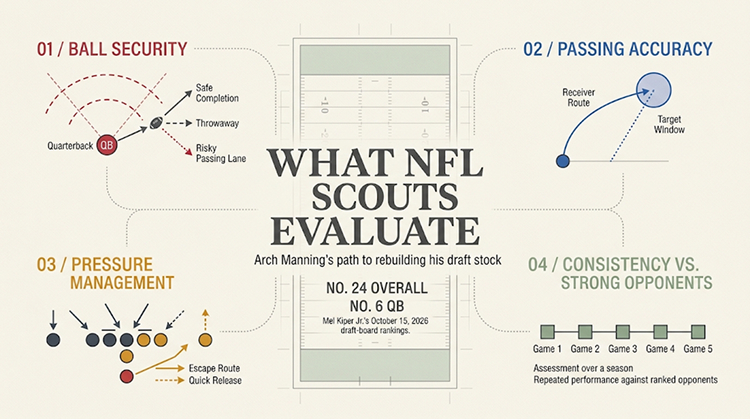
Ball security must improve. Five interceptions through five games have become a central part of the discussion around his draft position. Manning needs to demonstrate that he can recognize danger, work through progressions and avoid turning difficult situations into immediate scoring opportunities for opponents.
Accuracy must remain consistent. His 63% completion rate provides a baseline, but completion percentage alone cannot show whether throws arrive on time or give receivers a chance to gain additional yards. Evaluators will look at placement, timing and whether Manning can complete passes against tight coverage.
Pressure management must become more dependable. The quarterback needs to identify defensive pressure, adjust when appropriate and understand when a play has broken down. Better protection from the offensive line would help, but Manning must also show that he can respond when defenses disrupt the original design.
Production must hold up against strong opponents. Texas has important SEC games remaining, including its October 24 matchup with Ole Miss. Consistent performances across multiple opponents would give scouts a stronger basis for evaluating Manning than one successful afternoon against Florida.
These standards are relevant to every quarterback prospect, but Manning receives additional attention because of his family background and the expectations attached to his name. His uncle Peyton Manning and uncle Eli Manning enjoyed long NFL careers, creating comparisons that can overshadow the normal development process for a college quarterback.
Steve Sarkisian has pushed back against what he considers unfair expectations tied to Manning’s surname. That defense does not eliminate the need for improvement. Instead, it reinforces the distinction between a player’s reputation and the evidence available to evaluate his performance.
Steve Sarkisian Must Help Texas Create Better Conditions
Manning’s draft prospects are connected to the broader health of the Texas offense. Sarkisian remains responsible for building a system that gives his quarterback manageable situations, uses the roster effectively and adapts when opposing defenses expose weaknesses.
Texas’ recent offensive struggles have included stalled possessions, third-down difficulties and inconsistent execution. Those issues can place Manning in predictable passing situations, allowing defenses to increase pressure and reduce the number of easy completions available. Improving early-down production would help Texas avoid those situations and give the quarterback more options.
The coaching staff also needs to maintain a clear balance between aggression and discipline. Manning should be encouraged to attack openings, but the offense must avoid situations in which every drive depends on a difficult throw. Reliable rushing production, effective blocking and well-timed play calls can reduce that burden.
For additional context on the team’s broader challenge, TexasFootballInfo’s analysis of Texas’ offensive struggles against Florida examines the changes Sarkisian needs to make after the Oklahoma loss.
The Florida matchup is therefore a test for both the quarterback and his head coach. If Texas creates better opportunities and Manning responds with more efficient execution, the team can make progress in two areas at once. If the same problems continue, criticism will extend beyond the quarterback to the offensive system as a whole.
Manning’s Draft Stock Will Depend on What Happens Next
Kiper’s ranking gives Manning a clear reference point entering the Florida game: No. 24 overall and sixth among quarterbacks on the October 15 big board. It also highlights how much can change during a college season when expectations are high and performances are inconsistent.
One game will not determine Manning’s NFL future. A productive outing against Florida could begin to rebuild confidence, but scouts will need to see the same decision-making, accuracy and composure in subsequent games. A strong finish to the season would provide more persuasive evidence than a single rebound performance.
Texas also has larger team objectives to consider. At 4–1 entering the Florida matchup, the Longhorns remain positioned to pursue meaningful goals in the SEC and the College Football Playoff race. Better quarterback play would help, but improvement across the offense is necessary if Texas hopes to compete consistently against ranked opponents.
For Manning, the immediate task is straightforward: protect the football, take what the defense gives him and turn promising possessions into points. His physical tools and past production remain part of his evaluation. The next phase depends on whether he can make those qualities more consistent.
Saturday’s game gives him the next opportunity to demonstrate that progress. The draft ranking has changed, but the season is still unfolding—and Manning has time to shape the evaluation with his performance.