
Mississippi State’s most important offensive player will not return this season, giving the Texas Longhorns a significant new variable to consider before their October 31 matchup in Austin. On October 27, Mississippi State confirmed that quarterback Kamario Taylor would miss the remainder of the 2026 season because of a foot injury requiring surgery. The announcement changed the preparation for head coach Steve Sarkisian, defensive coordinator Will Muschamp, and a Texas defense looking to build on its recent victory over Ole Miss.
Taylor’s absence matters because the sophomore had become one of the Southeastern Conference’s most productive quarterbacks. Through six games, he completed 65.4% of his passes for 1,460 yards, 17 touchdowns, and four interceptions. His 17 touchdown passes tied for the SEC lead at the time of the announcement, according to Reuters’ report on Taylor’s injury.
Mississippi State now faces a quarterback transition with its season still in progress. Freshman Parker “Billy” Puckett and experienced transfer AJ Swann are the leading options to replace Taylor, creating a preparation challenge for the Bulldogs and an opportunity for Texas. The Longhorns cannot assume the change guarantees a victory, but they can use it to shape a defensive plan that tests Mississippi State’s ability to execute without its established starter.
Kamario Taylor’s Injury Changes Mississippi State’s Offensive Outlook
Taylor’s season developed quickly. He helped Mississippi State open the year 4–0, with victories over Minnesota, South Carolina, and Missouri establishing the Bulldogs as a team capable of competing against quality opposition. His passing production gave the offense a reliable source of explosive plays, while his mobility added another dimension to the playbook.
The injury first became a problem during Mississippi State’s September 26 victory over Missouri. Taylor subsequently attempted to play through the issue against Alabama on October 3, missed the October 17 game against LSU, and returned against Oklahoma on October 24. He lasted only part of the first quarter before leaving the 23–15 loss.
The university’s October 27 announcement confirmed that surgery would end his season, although the program expects him to make a full recovery. The decision removes uncertainty about his availability against Texas and for the Bulldogs’ remaining games.
Taylor’s production also illustrates what Mississippi State must replace. His 1,460 passing yards and 17 touchdown passes represented more than a statistical contribution. He had established a rhythm with the receiving group and given offensive coordinator Jeff Lebby a quarterback who could threaten defenses through both passing and movement.
Without him, Mississippi State must establish a new offensive identity in a short period. The coaching staff could preserve familiar concepts while reducing the complexity of the quarterback’s responsibilities, emphasizing shorter throws, quicker decisions, and a more deliberate approach to ball security.
That adjustment would be especially important against a Texas defense capable of turning mistakes into momentum. The Longhorns should prepare to attack the Bulldogs’ replacement quarterback without assuming that Mississippi State will abandon its established offensive system.
Billy Puckett and AJ Swann Give Texas Two Different Quarterback Profiles
The most immediate question for Mississippi State is who will take the first snap against Texas at Darrell K Royal–Texas Memorial Stadium.
Puckett has already gained meaningful experience in Taylor’s absence. Against LSU on October 17, he completed 16 of 26 passes for 121 yards and threw one interception in a 31–0 defeat. Against Oklahoma on October 24, he improved to 17 completions on 24 attempts for 158 yards, recording his first career touchdown pass while also throwing an interception.
Across those two games, Puckett completed 33 of 50 passes for 279 yards, one touchdown, and two interceptions. He has shown that he can operate the offense, but the results also demonstrate the difficulty of producing consistently when opponents can concentrate their attention on a quarterback who lacks Taylor’s established record of success.
Puckett’s mobility could influence Texas’ defensive plan. The Longhorns must account for quarterback runs, movement outside the pocket, and potential scramble opportunities rather than treating the play as finished when the first passing option disappears. Disciplined edge play and coordinated linebacker assignments will matter if Puckett starts.
Swann presents a different challenge. The fifth-year quarterback has previous starting experience at Vanderbilt and Appalachian State, bringing a larger body of college football experience than Puckett. His background gives Mississippi State another option if Lebby wants a quarterback with greater familiarity with the demands of starting against an SEC opponent.
However, Swann’s experience does not automatically make him the better choice. The coaching staff must determine which quarterback is executing the offense most effectively during practice and which one gives the team its best chance to protect the football and sustain drives.
For Texas, the distinction affects preparation. Puckett’s mobility would require particular attention to containment and second-reaction plays, while Swann’s experience could lead Mississippi State to emphasize a more conventional pocket-passing approach. The Longhorns should prepare for both possibilities until the Bulldogs make their decision.
Will Muschamp Can Test Mississippi State’s Passing Protection
Texas has a strong reason to approach this matchup with confidence in its defense. Before the Mississippi State game, the Longhorns were reported to have the SEC’s top total defense in conference games, according to On3’s coverage of Taylor’s season-ending injury.
That distinction is relevant because conference play provides a more direct comparison of how teams perform against SEC opposition. Texas will still need to execute against Mississippi State’s specific scheme, but its defensive production suggests it has the personnel to make life difficult for a quarterback entering a new role.
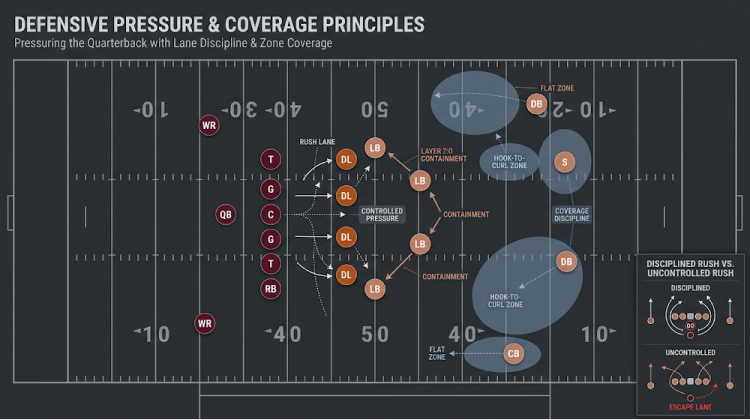
Muschamp’s priority should be to create pressure without sacrificing coverage discipline. An inexperienced quarterback may struggle when forced to progress beyond his first read, but an overly aggressive pass rush can create openings for screens, draws, and quick throws.
Texas can use different defensive looks to make the Bulldogs identify pressure before the snap. Late movement from linebackers and defensive backs could force the quarterback to reconsider protection assignments or alter his read. The goal should be to create uncertainty while maintaining sound tackling and coverage responsibilities.
The Longhorns must also avoid giving Mississippi State easy conversions. A defense can dominate early downs and still allow an offense to remain competitive if penalties, missed tackles, or coverage breakdowns extend drives. Against a team adjusting to a new quarterback, forcing third-and-long situations should be a priority.
Texas’ recent injury situation adds another consideration. Edge defender Colin Simmons was unavailable against Ole Miss, and his status for the Mississippi State game must be evaluated using the latest team updates. If Texas remains without one of its most dangerous pass rushers, the rest of the defensive front will need to generate pressure collectively.
The matchup is therefore about more than the identity of Mississippi State’s quarterback. Texas must execute its assignments, win at the line of scrimmage, and prevent the Bulldogs from turning short completions into sustained possessions.
Mississippi State May Lean More Heavily on Its Running Game
A quarterback change often affects how an offense distributes its responsibilities. Mississippi State has reason to consider a more prominent role for its rushing attack as it adjusts to life without Taylor.
Running back Fluff Bothwell has already shown that he can produce significant yardage. He returned to action against Oklahoma and rushed for 111 yards, providing the Bulldogs with a productive option despite the defeat. His performance gives Lebby a possible foundation for reducing pressure on the replacement quarterback.
A more balanced offense could help Mississippi State keep the playbook manageable. Running the football can create manageable passing situations, slow down a defense’s pass rush, and give a new starter opportunities to complete straightforward throws. Play-action could then provide chances for downfield gains when Texas begins committing additional defenders to the run.
The Longhorns cannot respond by loading the box on every early down. Doing so would invite Mississippi State to exploit isolated receivers or use play-action against a thinner secondary. Texas needs to identify formations, watch for personnel changes, and make the Bulldogs earn each first down.
Stopping Bothwell early would be particularly valuable. If Mississippi State cannot generate consistent rushing production, the offense may be forced into more obvious passing situations. That would give Muschamp greater freedom to use pressure packages and challenge the quarterback to make accurate decisions under stress.
The reverse is also true: if the Bulldogs establish the run, they could keep the game close by controlling the clock and limiting the number of possessions. Texas must therefore treat Bothwell as a central part of the matchup rather than focusing exclusively on Taylor’s replacement.
Arch Manning and the Texas Offense Must Avoid Giving the Bulldogs a Way Back
The quarterback news offers Texas a defensive opportunity, but the Longhorns still need a complete performance on the other side of the ball.
Texas entered the week at 5–2 overall and 3–2 in SEC play after beating No. 7 Ole Miss 34–27 on October 24. Arch Manning threw for 212 yards and one touchdown in that victory, while also recording two interceptions. Running back Raleek Brown supplied a major boost with 157 rushing yards, and Ryan Wingo led the receiving group with seven catches for 111 yards.
Those numbers illustrate both the Longhorns’ strengths and the areas that require attention. Brown’s production showed that Texas can move the ball effectively on the ground, while Wingo gave Manning a reliable downfield option. But turnovers and inconsistent stretches of execution can keep opponents in games even when Texas holds the advantage.
Against Mississippi State, the Longhorns should aim to build on the rushing success displayed against Ole Miss. A productive ground game can control possession, reduce pressure on Manning, and prevent the defense from having to return to the field after short offensive series.
Manning also needs to protect the football. Mississippi State may be dealing with its own quarterback transition, but the Bulldogs remain capable of creating turnovers or capitalizing on a short field. Texas should not treat the matchup as an opportunity to force unnecessary throws simply because its opponent has lost its starter.
The offensive line remains another key factor. Texas will be without left tackle Trevor Goosby for the rest of the season after his knee injury against Ole Miss, forcing the staff to continue evaluating its options at the position. The Longhorns’ approach to protecting Manning will matter against a Mississippi State defense seeking opportunities to disrupt the offense.
For a closer look at that personnel issue, see our related coverage of Trevor Goosby’s season-ending injury.
What Texas Must Do to Turn the Quarterback Change Into an Advantage
Mississippi State’s quarterback situation creates a favorable opening for Texas, but the Longhorns must convert that opening into specific advantages on the field.
First, Texas needs to win early downs. Limiting Bothwell and forcing Mississippi State into obvious passing situations would make it harder for the replacement quarterback to rely on the running game and quick, low-risk throws.
Second, the Longhorns must keep their rush lanes disciplined. Puckett has demonstrated mobility, and an uncontrolled pass rush could give him opportunities to extend plays or pick up first downs with his legs. Pressure is most effective when the defensive front maintains its assignments and closes the available escape routes.
Third, Texas needs to capitalize on mistakes. Mississippi State’s recent results included a 31–0 loss to LSU and a 23–15 defeat to Oklahoma. The Bulldogs have struggled to produce consistently without Taylor, but Texas still has to turn stalled drives, sacks, and turnovers into points rather than settling for field position alone.
Finally, the Longhorns must sustain their own offensive execution. A strong defensive performance will mean less if turnovers, penalties, or protection failures repeatedly give Mississippi State extra opportunities.
The game is scheduled for Saturday, October 31, at 6:30 p.m. CT at Darrell K Royal–Texas Memorial Stadium in Austin. The official Texas Athletics game center lists the matchup as a conference game and confirms the kickoff time.
Taylor’s season-ending injury changes the preparation for both teams. Mississippi State must choose between two quarterbacks with different strengths, while Texas has an opportunity to challenge an offense that has lost its most productive passer. If the Longhorns control the running game, maintain pressure without losing discipline, and protect the football, they will be better positioned to take advantage of the Bulldogs’ offensive reset.