Michael Fasusi’s absence became one of the biggest offensive-line storylines surrounding the 2026 Red River Rivalry, and the matchup immediately showed why. Oklahoma officially ruled out its starting left tackle before the Oct. 10 game against Texas after Fasusi had already missed several weeks with a shoulder injury suffered in the season opener against UTEP. The Sooners turned to Ryan Fodje at left tackle, leaving him with the responsibility of dealing with Texas edge rusher Colin Simmons. Simmons had already produced 7.5 sacks through four games, including a record-setting 5.5-sack performance against Tennessee.
The result was more complicated than a simple protection disaster. Oklahoma did give up three sacks in the 27-24 victory, and Simmons recorded two of them while forcing a fumble on the game’s opening defensive possession. Yet the Sooners still found enough answers to protect John Mateer during the critical moments, while Oklahoma’s defense and special teams helped secure the upset. The performance showed exactly why Fasusi’s status mattered, but it also demonstrated that Oklahoma could survive without its starting tackle when the rest of the game plan compensated for the weakness.
Fasusi’s Absence Was A Major Offensive-Line Problem
Fasusi was already an important part of Oklahoma’s offensive-line plans before the season began.
The sophomore tackle emerged as one of the Sooners’ most promising linemen during his freshman season. He allowed just four sacks on 395 pass-blocking snaps in 2025, according to On3, and entered 2026 as a key piece of an offensive line that needed to become more consistent.
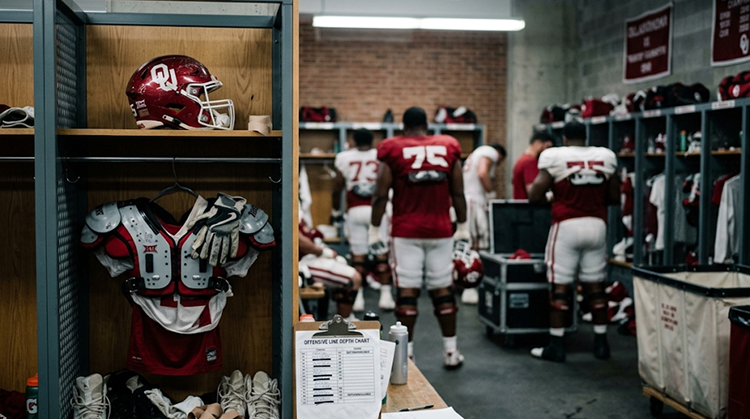
His shoulder injury against UTEP changed those plans almost immediately.
Fasusi played in Oklahoma’s opener but did not return to the lineup afterward. He suited up for the Michigan and New Mexico games without playing, then remained unavailable for the SEC opener against Georgia. By the time Oklahoma reached the Red River Rivalry, the Sooners had already spent several weeks adjusting their offensive-line combinations.
That matters because offensive-line continuity is especially valuable against a defensive front like Texas’.
A unit can compensate for one inexperienced player if the surrounding four linemen know exactly how they will slide, communicate and respond to pressure. Repeated injuries make that much harder.
Oklahoma therefore entered the Texas game with a problem that extended beyond one missing starter.
Ryan Fodje Had To Handle The Left Side
With Fasusi unavailable, Ryan Fodje became the most important replacement on the offensive line.
Fodje had been moved from his usual position at right guard to left tackle after Fasusi’s injury. That created another domino effect because Oklahoma also had to manage other injuries along the line. Against Michigan, the Sooners had Fodje at left tackle and freshman Noah Best at right guard, illustrating how much the unit had been forced to change.
That kind of reshuffling is particularly dangerous against an elite pass rusher.
Simmons does not need an entire game of favorable matchups to change an offense.
One missed assignment can produce a sack.
One sack can create second-and-long.
One second-and-long situation can turn into third-and-long.
And against a defense as aggressive as Texas, third-and-long is where the pass rush becomes even more dangerous.
Oklahoma knew that entering the game.
Simmons Immediately Tested Oklahoma’s Replacement Plan
The warning came on the opening possession.
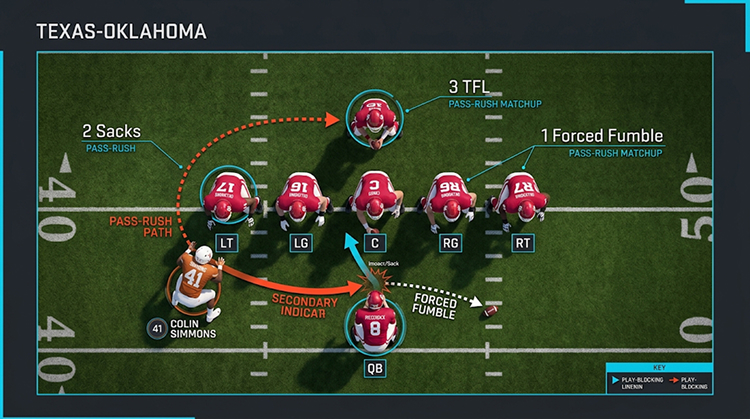
Oklahoma faced third-and-6 from its own 39-yard line when Simmons beat the protection, sacked Mateer and forced a fumble. Ryan Fodje recovered the loose ball, preventing the turnover, but the play demonstrated exactly why the Fasusi question had become such a major storyline.
Simmons was already coming off one of the most dominant defensive games in Texas history.
Against Tennessee on Sept. 26, he recorded 5.5 sacks, 9 tackles, six solo stops and a forced fumble. Through the first five games of the season, his sack total reached 9.5, including two against Oklahoma.
The opening series therefore delivered a direct message.
Texas was going to test Oklahoma’s protection.
The Sooners needed to make sure one matchup did not determine the game.
Oklahoma Could Not Let Simmons Become The Entire Game Plan
The best way to neutralize a dominant pass rusher is rarely to ask one offensive tackle to win every snap.
Oklahoma needed to alter the conditions around the matchup.
That could mean quicker throws, movement at the snap, running the ball away from Simmons, using tight ends or running backs to provide additional protection and preventing Texas from creating obvious passing situations.
Oklahoma’s offensive preparation reportedly emphasized exactly that challenge. Former Sooners center Gabe Ikard and linebacker Teddy Lehman identified the need to help Fodje and E’Marion Harris against Simmons while also emphasizing that the Sooners could not allow him to wreck the game.
That approach became particularly important because Oklahoma’s rushing attack had struggled entering Red River.
The Sooners averaged only about 99 rushing yards per game before the rivalry matchup, giving opposing defenses another reason to attack John Mateer through the air.
If the running game could not create enough balance, Simmons and the rest of Texas’ front would have even more opportunities.
The Fasusi Question Was Bigger Than One Position
Fasusi’s absence affected more than left tackle.
Offensive-line injuries force coaches to think about the entire structure of the unit.
If Fodje moves to left tackle, someone else has to take his normal position. If another player moves, a different combination has to be established. That can affect communication, protection calls and the timing of run-blocking assignments.
Oklahoma also entered the Texas game without Fred Hinton, while left guard Eddy Pierre-Louis was listed doubtful before eventually being unavailable. The final availability report left the Sooners without Fasusi, Hinton and Pierre-Louis along the offensive line.
That was a significant amount of disruption against one of the nation’s most aggressive defensive fronts.
It also explains why Oklahoma’s protection plan had to be broader than simply replacing Fasusi.
Simmons Still Produced Even Without A Full Breakdown
The most revealing part of the matchup is that Simmons did exactly what Texas needed him to do without completely taking over the game.
He finished with four total tackles, three tackles for loss, two sacks and a forced fumble.
Those numbers would be impressive in almost any game.
They were especially significant because Simmons had already produced 5.5 sacks against Tennessee.
Oklahoma therefore entered the game knowing it could not eliminate Simmons completely. The goal was to keep his impact from becoming overwhelming.
That distinction proved important.
The Sooners allowed three total sacks, but Mateer still completed 18 of 26 passes for 155 yards without an interception. Oklahoma also ran for 83 yards, with Lloyd Avant producing 72 yards and a touchdown.
The offense was hardly dominant.
It was simply efficient enough in the moments that mattered.
Mateer’s Mobility Helped Oklahoma Survive
John Mateer’s ability to move outside the pocket also became valuable.
The quarterback did take three sacks, but he remained difficult to completely contain because Oklahoma could use his mobility to change the geometry of the pass rush.
That became particularly important on late downs.
A defense can create pressure with four rushers, but if the quarterback can escape the pocket or extend a play, the advantage of that pressure can disappear.
Texas still held Oklahoma to 238 total yards and just 155 passing yards. The Longhorn defense recorded nine tackles for loss, with Simmons and Rasheem Biles leading the way.
Yet Oklahoma did something Texas struggled to do.
It avoided turnovers.
Mateer finished without an interception or lost fumble, while Texas committed two turnovers through Manning’s interceptions.
That difference ultimately mattered more than the individual protection battle.
Oklahoma’s Offensive Line Survived The Matchup
The final numbers tell an interesting story.
Oklahoma surrendered three sacks and averaged only 2.7 yards per rushing attempt, but the Sooners still generated enough offense to stay within one score throughout the afternoon.
More importantly, they avoided the catastrophic offensive-line breakdown that could have allowed Texas to control the game.
Simmons had his early sack and forced fumble.
He added another sack later.
But Oklahoma continued to operate.
That was a significant achievement given the personnel situation.
It also gives Brent Venables and offensive line coach Bill Bedenbaugh something to build around while Fasusi works toward a return.
The Running Game Gave Oklahoma A Necessary Escape Route
The most important development for Oklahoma may have been Lloyd Avant’s performance.
Avant carried the ball 10 times for 72 yards and scored Oklahoma’s first offensive touchdown of the game. His 42-yard run was the longest rushing play of the afternoon for either team.
That run mattered because it prevented Texas from treating every Oklahoma possession as a passing situation.
A struggling offensive line is easier to attack when the defense knows the quarterback must throw.
A productive run can force defensive ends to hesitate.
Even one or two successful runs can change the protection equation.
Oklahoma did not run the ball particularly well overall, but Avant provided enough production to keep the Longhorn defense from completely ignoring the ground game.
The Bigger Concern Is What Happens Against Kentucky
The Fasusi question does not disappear because Oklahoma beat Texas.
In fact, the victory may make the next decision more complicated.
If Fasusi is healthy enough to return, Oklahoma has to determine whether he immediately returns to left tackle or whether the coaching staff prefers the combination that helped beat Texas.
Fasusi was projected to return around Week 7 in one current injury projection, which lines up with Oklahoma’s Oct. 17 game against Kentucky. That projection is not an official medical timetable, so his actual availability remains dependent on the team’s injury reporting.
The Kentucky game could therefore become an important evaluation point.
Oklahoma now knows that its reshuffled line can survive against Texas.
But surviving one afternoon is different from building a reliable offensive line for the remainder of an SEC schedule.
Fasusi’s Return Could Still Change Oklahoma’s Ceiling
The Sooners should welcome Fasusi back if he is medically ready.
His return would give Oklahoma a proven option at left tackle and could allow the coaching staff to stop moving pieces around the line.
That stability could help the running game as much as the passing game.
It could also allow Fodje to return to a more natural position, reducing the number of players affected by a single injury.
The long-term goal should not be simply protecting John Mateer against one opponent.
Oklahoma needs a line capable of handling the remaining SEC schedule.
That requires continuity.
The Red River Game Showed Why Simmons Remains A Problem
Even though Oklahoma won, the game reinforced Texas’ advantage in the pass rush.
Simmons finished with two sacks and a forced fumble, and Texas generated three sacks overall. Mateer was repeatedly forced to operate under pressure even though Oklahoma avoided the turnovers that could have ended the game.
The lesson for Oklahoma is straightforward.
Fasusi’s absence can be survived.
It cannot be ignored.
Against a pass rusher of Simmons’ caliber, every protection weakness becomes more dangerous.
The Sooners found a way to keep that danger from becoming decisive at the Cotton Bowl.
They may need an even better solution later in the season.
Oklahoma Won The Battle That Mattered Most
The irony of the Fasusi-Simmons matchup is that Simmons technically won several individual battles while Oklahoma won the game.
The Texas star forced the opening fumble, registered two sacks and repeatedly created pressure.
But Oklahoma protected its most important possession late in the game.
After Texas tied the score at 24-24 with 6:32 remaining, Mateer led a final drive that moved the Sooners into field-goal range. Isaiah Sategna made a crucial 20-yard reception, and Tate Sandell eventually drilled a 47-yard field goal as time expired.
That sequence illustrates the real value of offensive-line performance.
It does not require perfection.
It requires enough stability to execute when the game is on the line.
Fasusi’s Status Will Still Matter For Oklahoma’s Future
Michael Fasusi’s shoulder injury did not prevent Oklahoma from beating Texas.
But it did expose the level of pressure placed on the Sooners’ offensive line when the best left tackle is unavailable.
Ryan Fodje deserves credit for stepping into the role and helping Oklahoma survive one of the toughest pass-rush matchups in college football. The rest of the line also deserves credit for keeping Mateer upright enough to make the late throws that mattered.
Still, Colin Simmons proved the original concern was justified.
He recorded two sacks and forced a fumble despite facing an Oklahoma line that had spent weeks adjusting to injuries.
Oklahoma’s 27-24 victory therefore should not be interpreted as proof that Fasusi is unnecessary.
It is better understood as evidence that the Sooners found a temporary answer.
If Fasusi returns healthy, Oklahoma could gain the continuity it lacked during the first part of the season. If he remains unavailable, the Sooners will need the same level of creativity, discipline and quarterback movement that helped them survive Texas.
The Red River Rivalry showed that Oklahoma can win without its starting left tackle.
The rest of the season will determine whether it can keep doing it.