
Steve Sarkisian has spent much of the 2026 season defending Texas’ offense, but the 27-24 loss to Oklahoma has made that defense harder to sustain. The Longhorns entered the Red River Rivalry as the No. 1 team in the country and left the Cotton Bowl with their first loss, a No. 7 ranking and a much larger question surrounding the offense: can Sarkisian’s play-calling get Texas where it needs to go? The coach has already made his position clear. He does not intend to give up offensive play-calling, saying after the loss that there was “not a chance” he would step away from that responsibility.
That decision puts more pressure on Sarkisian because the Oklahoma game exposed problems that have been visible for several weeks. Texas produced only 41 yards after halftime, went through multiple three-and-outs and repeatedly struggled to maintain offensive rhythm despite having enough talent to create explosive plays. The Longhorns ultimately lost a game in which their defense held Oklahoma’s offense to one touchdown before the Sooners’ late winning drive.
The issue is therefore bigger than Arch Manning’s two interceptions. The quarterback made critical mistakes, especially late, but Texas also spent large portions of the game failing to put him in favorable situations.
The Oklahoma Loss Exposed A Familiar Offensive Pattern
Texas did not suddenly develop an offensive problem at the Cotton Bowl.
The Oklahoma game amplified one.
Through the first four games, Texas had already struggled to produce the kind of offensive consistency expected from a roster with elite talent at quarterback and wide receiver. The Longhorns had survived because their defense repeatedly created a margin for error.
Against Oklahoma, that margin finally disappeared.
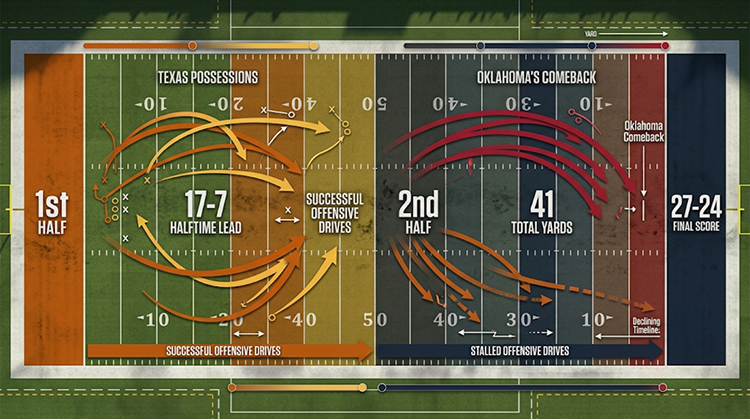
Texas scored 17 points through the first three quarters before adding a touchdown in the fourth, but the offense managed just 41 yards after halftime. The Longhorns also had seven three-and-outs during the game, according to postgame statistical analysis, while their inability to sustain drives allowed Oklahoma to remain within striking distance.
That is where the play-calling question becomes legitimate.
Sarkisian has the responsibility to determine how Texas uses its personnel, how quickly the offense adjusts when a defense takes away the first option and how aggressively the team attacks critical downs.
Against Oklahoma, too many possessions ended without enough evidence that the offense had found a reliable rhythm.
Sarkisian Is Still Calling The Plays
Sarkisian’s decision to retain play-calling duties is important because Texas does not have an offensive coordinator currently handling that responsibility.
The head coach has made the offense his direct responsibility, and he has rejected the idea that Oklahoma’s loss should force him to surrender those duties. That means the solution will have to come from Sarkisian changing the way the offense is structured, called or adjusted rather than simply handing the responsibility to another coach.
There is a reasonable argument for keeping the arrangement.
Sarkisian is one of the most experienced offensive minds on the Texas staff. He recruited many of the players now forming the offense and has spent years developing the system. A midseason change could create its own problems, especially with Texas entering another SEC game immediately after the Red River loss.
But the opposite argument is becoming harder to dismiss.
If the head coach is also responsible for every offensive decision, then he must accept a larger share of responsibility when the unit repeatedly fails to generate production.
Sarkisian did exactly that after the Oklahoma loss.
He acknowledged that the offensive issues ultimately begin with him because his job is to put players in positions to succeed.
That admission makes the next few games particularly important.
Texas Has Too Much Talent To Look This Limited
The talent question makes the offensive struggles more difficult to explain.
Texas has Ryan Wingo, Cam Coleman, Emmett Mosley V and freshman Jermaine Bishop Jr. at receiver. Manning entered the season with enormous expectations at quarterback. The Longhorns also have a deep running back rotation that includes Hollywood Smothers and Raleek Brown.
The problem has been turning that talent into consistent production.
Against Oklahoma, Manning completed 16 of 19 passes for 260 yards and three touchdowns. He connected with Cam Coleman for a 41-yard touchdown on the opening possession and hit Ryan Wingo for a 34-yard score in the second quarter. Later, he found Bishop for a 15-yard touchdown that temporarily put Texas ahead 24-17.
Those plays show the offense has explosive potential.
They also raise a difficult question.
Why did Texas struggle to produce anything similar for long stretches?
The answer cannot simply be that Oklahoma’s defense was good. It was. But Texas has now produced similar offensive stretches against multiple opponents, making the issue increasingly structural rather than opponent-specific.
The Second Half Was The Biggest Warning
Texas entered halftime with a 17-7 lead.
The Longhorns then failed to build on it.
Oklahoma scored 17 fourth-quarter points and eventually won on Tate Sandell’s 47-yard field goal with 19 seconds remaining. The Sooners’ comeback included Peyton Bowen’s 42-yard interception return for a touchdown and Lloyd Avant’s two-yard rushing touchdown.
Texas’ offensive response was inconsistent throughout the second half.
That matters because good play-calling is not simply about drawing up successful plays. It is also about recognizing how the defense is changing and adjusting before the game gets away.
Oklahoma’s defense had already demonstrated that it could pressure Manning and restrict Texas’ rushing game. Texas needed a response that forced the Sooners to defend more areas of the field.
Instead, the Longhorns repeatedly struggled to stay ahead of the chains.
That put Manning in situations where one mistake could change the game.
Eventually, it did.
Manning’s Interceptions Cannot Be Ignored
Sarkisian has strongly defended Manning since the loss, arguing that the quarterback receives an unusual level of scrutiny because of the Manning family name. Manning finished the game with 260 yards and three touchdowns, and through five games he has 1,122 passing yards, 10 touchdowns and five interceptions.
That defense is understandable.
It is also possible to defend Manning while acknowledging that his two fourth-quarter interceptions were decisive.
The first became a 42-yard pick-six for Bowen and tied the game at 24. The second came with 19 seconds left and gave Oklahoma possession at the Texas 39-yard line. Sandell then kicked the winning field goal.
Manning has to improve his decision-making.
But Texas also has to make sure the quarterback is not being asked to rescue the offense on every important possession.
Sarkisian’s own postgame comments pointed in that direction. He said Texas cannot keep putting all the pressure on Manning and emphasized that the team has to help him play better.
That is fundamentally a coaching issue.
The Running Game Has To Become Part Of The Answer
Texas’ offensive problem also cannot be solved entirely through the passing game.
The Longhorns need a running attack that forces defenses to respect the line of scrimmage. Without that threat, opposing defenses can dedicate more resources to Manning and the receivers.
Texas entered the Oklahoma game already searching for more consistency on the ground. The Longhorns have rotated backs throughout the season, with Hollywood Smothers and Raleek Brown providing different skill sets.
The coaching challenge is determining how those backs fit into the larger offensive plan.
A successful rushing attack does not necessarily require 200 yards.
It requires enough efficiency to create favorable down-and-distance situations and prevent defenses from assuming Texas must throw.
That was especially important against Oklahoma.
The Sooners’ defense was good enough to make Texas pay when the offense became predictable.
The 10-Personnel Package Now Needs To Become More Than A Wrinkle
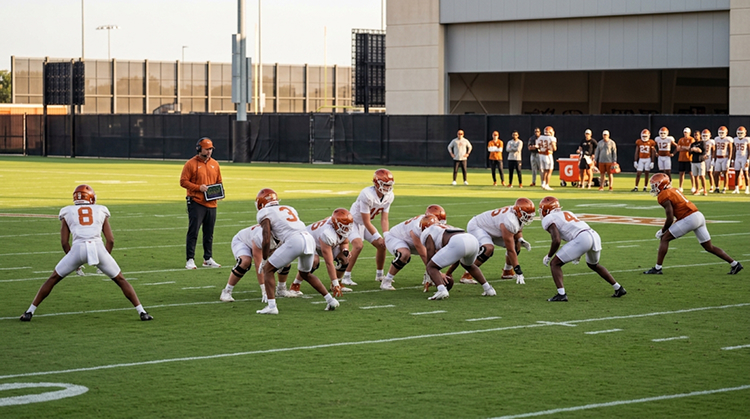
Texas had just introduced a four-receiver 10-personnel package before Red River, designed in part to get Jermaine Bishop Jr. onto the field alongside Wingo, Coleman and Mosley.
Bishop eventually caught a 15-yard touchdown against Oklahoma, showing the value of having another explosive receiver available.
That development should matter going forward.
The formation can give Manning four receiving options and create more space for the quarterback. It also forces defenses to determine how many defensive backs they want on the field and where they are willing to create one-on-one matchups.
But Sarkisian cannot allow the package to become predictable.
The point should be to create different plays from the same personnel rather than simply lining up four receivers and throwing.
The Oklahoma game showed why that distinction matters.
Texas needs formations that make defenses hesitate before the snap and then punish the choice after it.
The Offensive Line Is Part Of The Play-Calling Problem
Play-calling cannot be separated from protection.
Texas’ offensive line has experienced enough inconsistency this season to affect what Sarkisian can realistically call. Long-developing passing concepts are harder to use when protection is unreliable, while predictable quick-game concepts can allow defenses to sit on routes.
That creates a difficult balance.
Sarkisian needs to call plays that give Manning enough time to work through progressions while also protecting him from unnecessary pressure.
He also needs to use motion, formations and route combinations to make defensive pressure more difficult to predict.
The Oklahoma game showed what happens when those pieces fail to connect.
Manning has enough arm talent to make difficult throws, but repeatedly asking him to manufacture offense in difficult situations is a poor long-term strategy.
Special Teams Made The Offensive Problem Worse
Texas’ special-teams failures also increased the pressure on Sarkisian’s offense.
Oklahoma blocked a Texas punt and recovered it in the end zone for a touchdown. That mistake erased Texas’ early momentum and helped keep the Sooners alive in a game where their offense was struggling.
Texas also had other special-teams issues during the afternoon, meaning the offense was forced to operate with less margin for error.
That is important because a strong offense can sometimes overcome one special-teams mistake.
A struggling offense usually cannot.
The result was a game in which every stalled possession became more damaging.
Sarkisian is not responsible for every individual special-teams mistake, but as head coach he has to find a way to make the entire team more reliable.
Florida Gives Sarkisian An Immediate Test
There is no extended recovery period for Texas.
The Longhorns return to DKR-Texas Memorial Stadium on Saturday, Oct. 17, to face Florida at 11 a.m. CT on ABC. The game is Texas’ next SEC contest and the first opportunity to see whether Sarkisian’s offensive response to Oklahoma produces measurable improvement.
That makes Florida more than a routine rebound game.
It is a diagnostic test.
Texas needs to show improvement in several areas:
- Fewer three-and-outs.
- Better rushing efficiency.
- More consistent early-down production.
- Better third-down execution.
- More disciplined quarterback decision-making.
- Greater use of Texas’ receiver depth.
- Better answers when defenses change pressure or coverage.
The goal should not be to erase the Oklahoma loss with one spectacular performance.
The goal should be to prove that the problems exposed in Dallas can actually be corrected.
Sarkisian Does Not Need To Abandon His System
The answer may not require Texas to completely change its offensive identity.
Sarkisian has had success building offenses around quarterback development, spacing, motion and explosive passing plays. The talent on this roster still fits that structure.
The problem is execution and consistency.
Texas needs more reliable ways to get to favorable situations.
That could mean using more 10 personnel. It could mean giving the running backs a clearer role. It could mean more motion before the snap. It could mean simplifying some reads for Manning while creating more opportunities for the receivers after the catch.
The key is that Sarkisian has to identify what Texas does best and build the weekly plan around it.
Against Oklahoma, Texas sometimes appeared to be waiting for its offense to start working rather than forcing the game to move in its preferred direction.
That cannot continue.
The Florida Game Could Define The Next Phase Of The Season
Texas is still 4-1 and remains firmly in the College Football Playoff conversation, but the margin for error is smaller after losing to Oklahoma.
The Longhorns also fell from No. 1 to No. 7 in the AP Top 25 after the defeat.
That ranking change matters less than what it represents.
Texas is no longer being evaluated as an undefeated favorite.
Now the program is being evaluated on whether it can respond.
Sarkisian has chosen to keep calling plays. He has defended Manning. He has resisted immediate staff changes. Those decisions mean the next several games will serve as a direct test of his approach.
Florida is first.
Ole Miss, Mississippi State, Missouri and LSU follow before Texas reaches its November stretch, with Texas A&M waiting at the end of the regular season.
There is plenty of time to repair the offense.
But there is much less time to keep producing the same problems without consequences.
Sarkisian Now Has To Make The Offense Match The Talent
The Oklahoma loss did not prove that Steve Sarkisian cannot build a championship offense.
It did prove that Texas cannot continue relying on its defense to compensate for offensive inconsistency.
The Longhorns have enough talent to produce more than isolated explosive plays. They have multiple high-level receivers, a talented quarterback, capable running backs and a coaching staff with extensive experience.
Sarkisian now has to connect those pieces.
His decision to keep calling the plays puts the responsibility directly on him. That is not necessarily a problem if Texas responds with better sequencing, stronger situational football and a more consistent offensive identity.
If the same problems appear against Florida, the play-calling debate will become much louder.
If Texas responds with a complete offensive performance, the Oklahoma loss can become what Sarkisian wants it to be: a painful lesson rather than the beginning of a larger decline.
For now, the question is no longer whether Texas has enough offensive talent.
It is whether Sarkisian can consistently put that talent in position to win.