
Texas enters the 2026 season with one of the most talented defensive rosters in the SEC, but the biggest question may not be whether the Longhorns have enough star power. It may be whether the back end can communicate, tackle and make the right decisions quickly enough for Will Muschamp’s new defensive system to function at its highest level.
That puts the spotlight directly on the safety room.
Senior Jelani McDonald, senior Derek Williams Jr. and junior Kobe Black have emerged as three of the most important pieces in a safety group that Texas believes is deeper and more versatile than it was a year ago. Jonah Williams has also separated himself as a meaningful contributor, giving the Longhorns four players capable of competing for significant snaps.
The timing could hardly be more significant.
Texas opens the season Saturday, September 5, against Texas State at Darrell K Royal-Texas Memorial Stadium before hosting No. 1 Ohio State on September 12. The Bobcats bring an aggressive passing attack led by quarterback Brad Jackson and receivers Beau Sparks and Chris Dawn Jr., giving Texas an immediate opportunity to test its rebuilt secondary.
For Muschamp, that makes the opener more than a chance to install his defense in a live game.
It is the first opportunity to see whether Texas’ safety structure can become the communication center of a defense built to attack.
McDonald Brings The Experience Texas Needs
Among the three primary names in this story, McDonald is the most established.
The Waco, Texas, product enters his senior season after starting all 13 games in 2025. He recorded 80 tackles, four tackles for loss, three interceptions, three pass breakups and one fumble recovery, giving Texas a productive veteran capable of affecting the game in several ways.
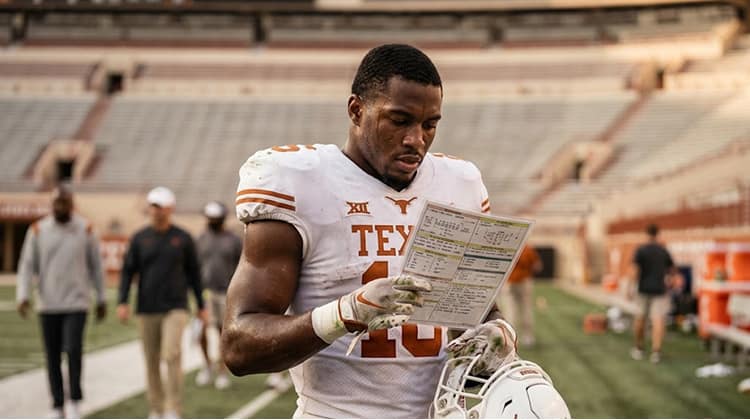
More importantly, McDonald has accumulated more than 1,200 career defensive snaps, according to recent reporting from Burnt Orange Nation. That experience matters because Muschamp’s system places significant responsibility on the secondary to recognize formations, communicate adjustments and react decisively after the snap.
McDonald also has an unusual developmental background. He was originally recruited as a quarterback before moving into the defensive backfield, giving him a different perspective on offensive formations and quarterback tendencies.
That background could become particularly useful against Texas State.
G.J. Kinne’s offense is built around tempo, spacing and creating conflicts for defenders. A safety who can recognize formations before the snap and anticipate where the quarterback wants to attack can prevent a simple offensive concept from turning into an explosive play.
That is where McDonald’s value goes beyond his tackle statistics.
Texas needs someone in the back end who can stabilize the communication.
The Longhorns have enough pass-rushing talent to create pressure. Colin Simmons, Lance Jackson and the rest of the defensive front should give Muschamp opportunities to attack opposing quarterbacks. But pressure only matters if the secondary holds up long enough for it to arrive.
McDonald could be the player responsible for making that possible.
Fans following the Texas defense in 2026 should therefore pay attention to where McDonald lines up, how often he rotates and how frequently he is involved in pre-snap communication. His role could tell us a great deal about how Muschamp wants to construct his defense.
Derek Williams Represents The Physical Element
If McDonald provides experience, Derek Williams brings another ingredient Texas desperately needs from the safety position: physicality.
Williams enters the 2026 season as a senior after dealing with a difficult stretch that included a knee injury and uncertainty about his future in Austin. He has since revitalized his position under passing game coordinator and safeties coach Blake Gideon and has emerged as one of the leading candidates for a starting role.
Recent depth-chart projections have placed Williams alongside McDonald as one of the expected starters, although there has been some disagreement over which safety would occupy free versus strong safety. That flexibility itself is important.
The latest projection from On Texas Football lists McDonald and Williams as the primary two starters, while another recent projection lists McDonald at strong safety and Williams at free safety.
That uncertainty should not necessarily be interpreted as a problem.
It may actually reflect the versatility Texas wants.
Muschamp has a history of using aggressive defensive structures that require defensive backs to support the run while still protecting against explosive passes. A safety cannot simply be a deep defender waiting for the quarterback to throw.
He has to diagnose.
He has to tackle.
And he has to trust the players around him.
Williams’ physical approach could become particularly important against Texas State because Kinne’s offense is designed to create space horizontally before attacking vertically. If the first defender misses, the play can quickly become a 20- or 30-yard gain.
That makes safety tackling a priority.
| Safety | 2026 Role | Primary Value |
|---|---|---|
| Jelani McDonald | Veteran starter | Experience, communication and coverage instincts |
| Derek Williams Jr. | Veteran starter candidate | Physicality, versatility and range |
| Kobe Black | Rotational/starter candidate | Instincts, tackling and position flexibility |
| Jonah Williams | Key depth/rotation | Size, athleticism and developmental upside |
Williams also gives Texas something valuable heading into SEC play: experience against high-level competition.
The Longhorns cannot afford to enter September still trying to determine whether their safeties can handle the speed of SEC offenses. The Texas State game provides the first controlled environment to find out how quickly the unit can communicate and adjust.
Kobe Black Could Be The Wild Card
Kobe Black might be the most intriguing piece of the group.
The former elite cornerback recruit is now transitioning to safety, a position that can allow Texas to take advantage of his instincts and physical ability while giving him more opportunities to influence the game near the box. Recent reporting has specifically highlighted Black’s tackling and instincts as reasons he is pushing for meaningful playing time.
The move makes sense from a roster-building perspective.
Texas already has established options at cornerback, including Kade Phillips and Bo Mascoe, while the safety room needs players capable of covering ground and handling multiple assignments.
Black has the physical profile to help solve that problem.
The Texas roster lists Black at 6-foot-2 and 202 pounds, with the junior entering his third season in Austin. He is also from Waco, meaning the Longhorns have another Texas-raised defensive back with a significant understanding of the program and its expectations.
His transition could give Muschamp additional flexibility.
Black can potentially play closer to the line of scrimmage, cover tight ends and slot-oriented threats, or operate deeper depending on the defensive call. That versatility is valuable in a system that wants to disguise intentions before the snap.
The biggest question is how quickly the position change becomes instinctive.
Safety is not simply a deeper version of cornerback.
The player has to see more of the field, understand the responsibilities of the other defensive backs and recognize when an offensive formation changes the assignment.
If Black can make that transition quickly, Texas gains another player capable of moving around the secondary without revealing its intentions.
That could become a major advantage against quarterbacks who rely on pre-snap reads.
Muschamp’s Defense Puts Pressure On The Safeties
The safety discussion cannot be separated from Muschamp.
Texas brought Muschamp back into the program for the 2026 season, and recent reporting has described his defensive philosophy as aggressive, physical and heavily focused on pressure. The Houston Chronicle reported that Muschamp intends to bring an “in-your-face” mentality to a defense that already performed strongly during preseason scrimmages.
That creates a simple equation.
The more aggressively Texas attacks, the more responsibility the safeties carry.
If the Longhorns blitz a linebacker, rotate a safety toward the line or use a defensive front designed to create one-on-one pressure opportunities, somebody in the secondary has to cover the space created by that aggression.
McDonald, Williams and Black therefore become the final layer of protection.
That is why the safety position could have an outsized influence on Texas’ 2026 defensive ceiling.
The front seven may create the headlines. Simmons could produce sacks. Rasheem Biles could dominate the middle. The defensive line could overwhelm offensive fronts.
But if the safeties make mistakes behind them, explosive plays can erase everything the front seven accomplishes.
Muschamp’s system demands trust.
That trust starts with communication.
Texas State Is An Immediate Stress Test
The season opener against Texas State is a particularly useful test because the Bobcats are not built simply to run the clock and survive.
Kinne’s offense is designed around pace and space, and Texas State returns significant receiving production. Beau Sparks and Chris Dawn Jr. both provide legitimate vertical threats, while Brad Jackson gives the Bobcats a quarterback capable of distributing the ball quickly.
Texas is currently a heavy favorite, but the game can still reveal weaknesses.
The most important sequence may not be a spectacular interception.
It could be a third-and-seven conversion in which the safety communicates the coverage correctly, forces the quarterback to hold the ball and allows Simmons or another Texas pass rusher to arrive.
That is how the secondary and defensive front work together.
The same is true on running plays.
If Texas State forces McDonald, Williams or Black to make open-field tackles and they consistently finish those plays, Muschamp gains confidence in using more aggressive calls later in the season.
If missed tackles create explosive gains, the coaching staff will have evidence that the defense needs adjustment.
Either outcome provides valuable information.
Ohio State Will Make The Safety Question Bigger
The timing of Texas’ schedule makes this evaluation even more important.
Ohio State comes to Austin on September 12, only seven days after Texas State. The Buckeyes enter the season ranked No. 1 in the Associated Press preseason poll and feature quarterback Julian Sayin, making the matchup one of the most significant games of the early college football season.
That game will require the Texas secondary to operate at an entirely different level.
Against Texas State, Muschamp can learn.
Against Ohio State, mistakes become much more expensive.
The Buckeyes will test whether Texas can disguise coverage without losing discipline. They will test whether the safeties can communicate against motion. They will test whether Texas can support the run without exposing itself to explosive passes.
That makes the first Saturday of the season a diagnostic exercise.
The second Saturday is the examination.
The Four-Man Room May Matter More Than The Three-Man Headline
Although McDonald, Williams and Black represent the central trio, Texas’ depth at safety could ultimately become one of the unit’s biggest advantages.
Jonah Williams has generated significant attention during preseason work, while Xavier Filsaime, Jordon Johnson-Rubell and others provide additional options. Recent projections have consistently identified multiple players capable of competing for snaps rather than one obvious starter and a large drop-off behind him.
That matters over a 12-game regular season.
Texas will face Tennessee, Oklahoma, Florida, Ole Miss, Missouri, LSU and Texas A&M in addition to Ohio State. The schedule will create situations where the Longhorns need fresh defensive backs late in games and late in the season.
Depth also allows Muschamp to change personnel without fundamentally changing the defense.
A three-safety package could provide one answer against certain offensive formations. A more traditional structure could work against another opponent. Black’s ability to move between positions could give Texas another option when injuries or matchups demand it.
The objective is not simply to identify two starters.
It is to build a safety room capable of surviving an SEC season.
Why This Group Could Define Texas’ Defensive Ceiling
Texas already has enough defensive talent to create enormous expectations.
The front seven features proven players and elite prospects. The Longhorns have a new defensive coordinator with an aggressive identity. The roster has significant depth across the unit.
But the safety position connects everything.
McDonald brings experience and communication.
Williams brings physicality and veteran reliability.
Black brings versatility and the potential to become one of the defense’s most interesting matchup pieces.
Jonah Williams adds another athletic option behind them.
If those players consistently make the correct decisions, Muschamp can be aggressive.
He can send pressure.
He can rotate coverage.
He can bring safeties closer to the line.
He can disguise the defense until the quarterback has to make a post-snap decision.
That is where Texas’ defensive ceiling becomes interesting.
The Longhorns do not need their safeties to produce five interceptions each.
They need them to make the defense function as one connected unit.
That starts Saturday against Texas State.
By the time Ohio State arrives in Austin seven days later, Texas should have a much clearer answer about whether McDonald, Williams, Black and the rest of the safety room can support the aggressive identity Muschamp wants to establish.
If the answer is yes, the Longhorns could have something far more valuable than three talented defensive backs.
They could have the communication hub of a championship-level defense.