exas entered the final stretch of fall camp with one of the most talented rosters in college football and legitimate expectations of competing for the SEC championship. Then, on Monday, August 17, the Longhorns lost an important piece of their offensive line when left tackle Trevor Goosby suffered a left-knee injury during practice. An MRI confirmed a bone bruise, according to ESPN reporting cited by Reuters, but his recovery timeline remains uncertain. At 6-foot-7 and 325 pounds, Goosby is far more than another starter: he was a first-team All-SEC selection in 2025 and started all 13 games at left tackle while protecting Arch Manning.
The timing makes the situation particularly important. Texas opens the 2026 season against Texas State on September 5 before hosting No. 1 Ohio State on September 12 at 6:30 p.m. CT. That second game will be one of the most significant early tests of Steve Sarkisian’s program, and the Longhorns now have to determine whether their offensive line can absorb a potential change at its most important protection position.
Goosby’s injury does not automatically change Texas’ championship outlook. But it does expose the exact kind of depth and adaptability that a championship contender needs to possess.
Why Trevor Goosby Matters So Much
The easiest way to understand the magnitude of the injury is to look at what Goosby accomplished in 2025.
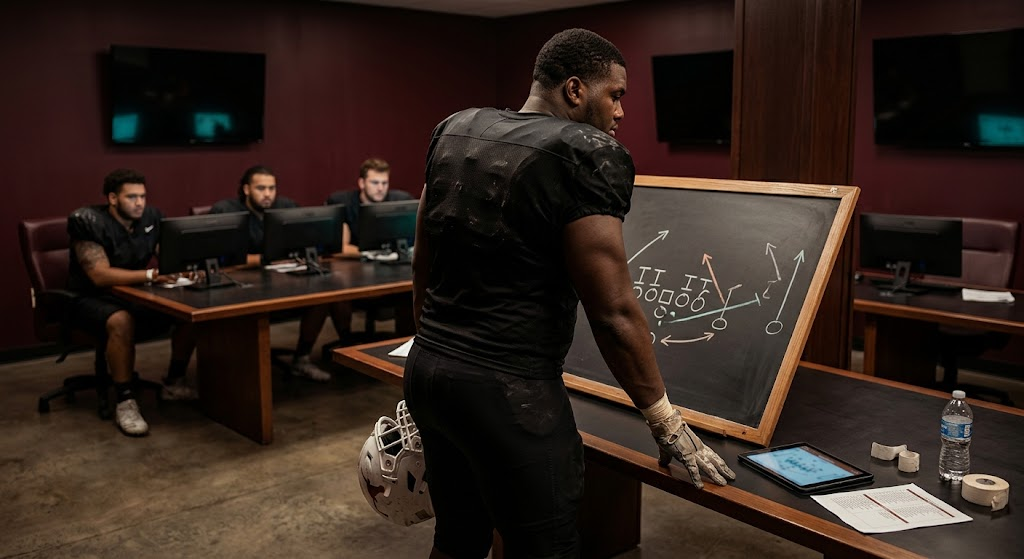
The Melissa, Texas, product started every game at left tackle during his first full season as a starter. Texas’ official roster credits him with 30 career games and 15 starts entering 2026, while his 2025 season included first-team All-SEC recognition from the conference’s coaches. He also earned preseason first-team All-America and first-team All-SEC recognition from Phil Steele heading into this season.
That résumé explains why his status matters more than a routine camp injury.
Left tackle is the position responsible for protecting a right-handed quarterback’s blind side. For Texas, that means Goosby has been an important part of the protection structure surrounding Manning, whose development is central to Sarkisian’s championship ambitions.
Goosby’s 2025 performance also showed that he was not simply surviving at the position. He became one of the more reliable offensive linemen on the roster and earned first-team All-SEC honors after helping Texas produce a 10-win season and reach the Citrus Bowl. Texas’ official postseason recognition noted that he protected Manning throughout the season and delivered particularly strong performances late in the schedule.
The question now is not whether Texas has talented offensive linemen.
It does.
The question is whether those players can be rearranged without weakening the entire unit.
The Timing Creates A Different Kind Of Problem
The most difficult part of Goosby’s injury is the calendar.
Texas has less than three weeks before the season opener and less than four weeks before Ohio State arrives in Austin. The Longhorns cannot spend the next month waiting for perfect clarity before making contingency plans.
Reuters reported August 18 that Goosby’s MRI confirmed a bone bruise and that the recovery timeline had not yet been established. That leaves Texas in a difficult middle ground: the injury is considerably more encouraging than a major structural knee injury, but the team still cannot assume Goosby will be ready for the opening weeks of the season.
That uncertainty forces offensive line coach Kyle Flood and Sarkisian to prepare two plans simultaneously.
One plan assumes Goosby returns quickly.
The other must prepare for him to miss meaningful time.
That is particularly important because Ohio State is not an opponent against whom Texas can afford communication errors and protection breakdowns.
The Buckeyes will provide the first major stress test of the Longhorns’ offensive structure. Texas and Ohio State are scheduled to meet at DKR-Texas Memorial Stadium on September 12, with ESPN’s College GameDay also coming to Austin.
A new left tackle would therefore be learning his responsibilities against one of the most difficult defensive environments on the schedule.
Melvin Siani Could Become The Immediate Answer
The most logical replacement option emerging from current reporting is Wake Forest transfer Melvin Siani.
Siani had been working at right tackle, but the Goosby injury could force Texas to move him across the formation. Reuters reported that Siani is a candidate to shift to left tackle, with Sarkisian having previously praised his toughness and run-blocking ability.
That would create a domino effect rather than a simple one-for-one replacement.
If Siani moves left, Texas needs another player at right tackle.
That could mean another reshuffling of the starting five, potentially moving a player who had spent the offseason preparing for one position into another role just weeks before the opener.
The advantage is that Siani is not entering the program without experience. His transfer background gives Texas an older player who has already dealt with college football environments outside Austin.
The disadvantage is continuity.
Offensive line play depends heavily on the relationships between adjacent players. Tackles must communicate with guards. Guards must coordinate with the center. Protection calls have to be understood across the entire group.
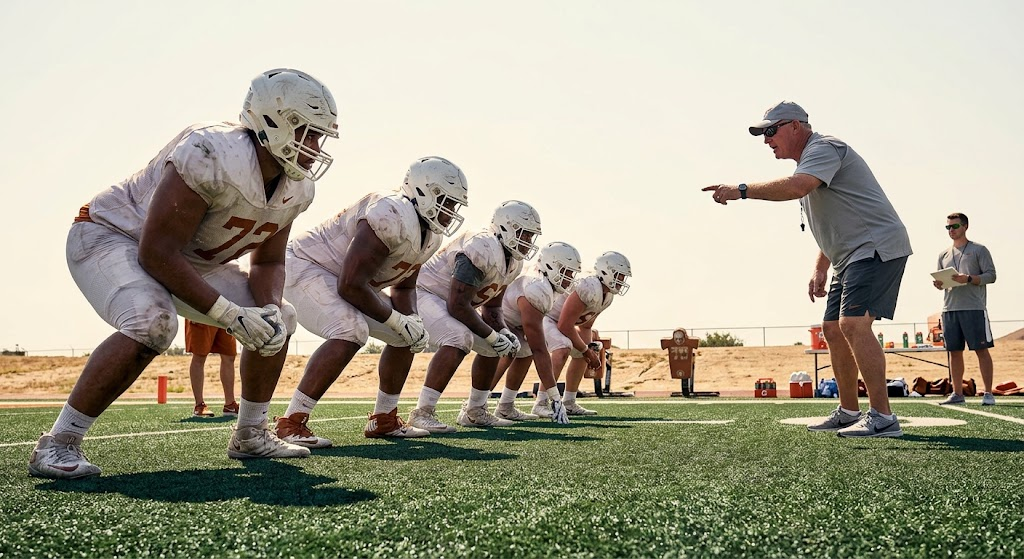
Changing one position can therefore affect five players.
Texas Already Has Experience To Lean On
The situation is serious, but it is not a complete reset.
Texas has several experienced offensive linemen capable of helping stabilize the unit.
Cole Hutson is back after returning to the team with a fifth year of eligibility, while Connor Robertson remains an important piece at center. Brandon Baker has also been moved from right tackle to right guard, according to recent reporting, while Siani had been working at right tackle. Laurence Seymore has been projected at left guard but has also dealt with a minor limitation during camp.
That makes the Goosby situation more complicated but also demonstrates why Texas spent the offseason building depth.
| Player | Current 2026 Role/Projection | Why He Matters |
|---|---|---|
| Trevor Goosby | Left tackle | 2025 first-team All-SEC starter |
| Melvin Siani | Right tackle / possible LT option | Transfer with starting experience |
| Brandon Baker | Right guard | Former tackle providing versatility |
| Connor Robertson | Center | Continuity in the middle |
| Cole Hutson | Interior offensive line | Experienced returner |
| Laurence Seymore | Left guard | Veteran presence on the interior |
The challenge for Flood is finding the combination that creates the strongest five-man unit rather than simply identifying the best individual replacements.
That distinction could determine whether the injury becomes a temporary inconvenience or a structural problem.
The Bigger Concern Is Protecting Arch Manning
Every offensive-line discussion eventually returns to Manning because Texas’ 2026 championship case is built around the quarterback.
Manning enters his second season as Texas’ primary starter after completing 227 of 370 passes for 2,942 yards and 24 touchdowns during the 2025 regular season, according to Texas Athletics.
Those numbers establish the baseline.
The next step is giving him enough protection to operate Sarkisian’s offense against elite defenses.
Manning has the arm talent to attack every level of the field. He also has a deeper receiving corps featuring players such as Ryan Wingo, Cam Coleman and Emmett Mosley.
But those weapons only matter if Manning has time to use them.
An unstable offensive line can force a quarterback into faster decisions, eliminate deeper route concepts and make an offense more predictable.
That is exactly what Texas cannot afford against Ohio State or the SEC defenses waiting later in the schedule.
The Longhorns’ 2026 schedule includes Tennessee, Oklahoma, Florida, Ole Miss, Mississippi State, Missouri, LSU, Arkansas and Texas A&M in addition to the early nonconference tests.
That is why this injury has implications far beyond September 12.
The Ohio State Game Is The Immediate Measuring Stick
Texas does not have to prove its entire season in the Ohio State game.
But the matchup will provide an unusually clear answer about whether the offensive line is ready for the level of competition expected later.
Ohio State defeated Texas 28-14 in the 2025 regular-season opener, while the Longhorns had defeated the Buckeyes in the previous College Football Playoff semifinal. The 2026 matchup will therefore be the third consecutive season in which the programs meet. Texas Athletics has confirmed that Ohio State leads the all-time series 3-2.
That history adds another layer to the protection question.
Ohio State knows what it is facing.
Texas knows what is coming.
And the Buckeyes will have no reason to hide their intention to pressure Manning if they believe a reshuffled offensive line presents an opportunity.
For Flood, the objective is therefore not merely to identify Goosby’s replacement.
It is to make sure the replacement can communicate, recognize pressure and function within the existing protection system.
Continuity Could Matter More Than Individual Talent
The temptation after an injury like this is to ask which player is the “best” replacement.
That may be the wrong question.
The better question is: Which five players function best together?
Offensive line performance is unusually dependent on collective timing. A talented tackle who is unfamiliar with the guard beside him can create problems that do not appear on individual scouting reports.
Texas has the advantage of having multiple players capable of playing different positions.
That flexibility can be a strength.
It can also become a weakness if the coaching staff keeps moving players around without giving them enough repetitions together.
The next few weeks will therefore be as much about repetition as talent.
Siani needs snaps at left tackle if he is going to be the contingency option.
Baker needs continued work at guard if that is where the staff believes he fits best.
The interior group needs to establish communication.
And Manning needs to develop trust with whichever five players eventually line up in front of him.
This is where Texas’ 2026 offensive line becomes one of the most important stories of fall camp.
The SEC Will Make The Problem Bigger
Even if Texas finds a stable solution before Ohio State, the SEC schedule will eventually expose any weakness.
The Longhorns travel to Tennessee on September 26, face Oklahoma in the Red River Rivalry on October 10, then play Florida, Ole Miss, Mississippi State, Missouri, LSU, Arkansas and Texas A&M. The Tennessee game arrives only two weeks after Ohio State and represents the beginning of the conference portion of Texas’ season.
That sequence means the offensive line cannot simply survive the opening month.
It has to develop.
A championship offensive line has to become more reliable as the season progresses.
That places additional importance on Goosby’s recovery.
If he returns quickly, Texas can restore the structure it planned during the offseason.
If he misses several weeks, the Longhorns will need the reshuffled group to develop quickly enough that the team does not lose offensive efficiency during the most difficult part of the schedule.
Sarkisian Has To Balance Patience And Preparation
Steve Sarkisian’s response will be just as important as Flood’s.
The coaching staff cannot rush Goosby back simply because Ohio State is approaching. A bone bruise can vary in recovery time, and the long-term health of a player with NFL potential should matter more than one September game.
At the same time, Texas cannot operate as if Goosby is guaranteed to return.
The correct approach is to prepare the backup plan as though it could become the primary plan.
That means giving Siani and the other candidates meaningful repetitions.
It means evaluating combinations instead of individual players.
And it means determining which lineup gives Manning the highest level of protection against different defensive fronts.
The situation is also a test of Sarkisian’s broader roster-building philosophy.
Elite programs cannot depend on every starter remaining healthy.
They have to create enough depth that one injury does not destroy the structure.
This Could Reveal How Far Texas Has Really Come
The Goosby injury is unfortunate, but it may provide one of the clearest tests of Texas’ roster construction before the season even begins.
A program aspiring to compete for championships has to be capable of absorbing adversity.
Texas has spent several seasons building toward that standard. The Longhorns have posted three consecutive 10-win seasons, reached the College Football Playoff semifinal twice and made an SEC Championship Game appearance during that stretch.
The next step is different.
Texas now has to demonstrate that its depth can withstand the type of disruption that separates talented teams from championship teams.
Goosby’s injury gives the Longhorns that test earlier than expected.
The immediate objective is simple: protect Manning, preserve offensive continuity and establish the strongest possible five-man combination before September 12.
If Goosby returns quickly, the story may eventually become little more than a stressful week in August.
If he misses significant time, however, the work done over the next three weeks could influence the trajectory of the entire season.
For Texas, the offensive line was supposed to be a foundation.
Now it has to prove it can remain one even when one of its most important pieces is temporarily removed.