

Arch Manning could not have started the 2026 season much better.
The Texas quarterback completed 20 of 27 passes for 305 yards and four touchdowns in a 59-7 victory over Texas State on Sept. 5 at Darrell K Royal-Texas Memorial Stadium. He connected with eight different receivers, threw two touchdowns to transfer Cam Coleman and left the game midway through the third quarter with Texas leading 42-7.
But the performance matters for a reason that has little to do with Texas State.
One week later, Manning gets another opportunity against the team that delivered one of the most difficult moments of his career.
No. 1 Ohio State defeated Texas 14-7 in Columbus on Aug. 30, 2025, limiting Manning to 17 completions on 30 attempts for 170 yards, one touchdown and one interception. It was his first start against the Buckeyes and the beginning of a season in which Texas ultimately finished 10-3 and missed the College Football Playoff.
The rematch arrives Sept. 12 at 6:30 p.m. CT in Austin.
This time, Manning enters the matchup with a full season of starting experience, a dramatically deeper collection of offensive weapons and the confidence generated by one of the strongest opening performances of his career.
The 305-yard opener does not guarantee that Texas will beat Ohio State.
It does change what the Buckeyes have to prepare for.
Manning’s Opener Changed The Conversation
The most important number from Manning’s first game was not 305.
It was 20-of-27.
The completion percentage showed a quarterback operating efficiently rather than simply accumulating statistics against an overmatched opponent. Manning consistently found different receivers, distributed the football and kept the Texas offense moving.
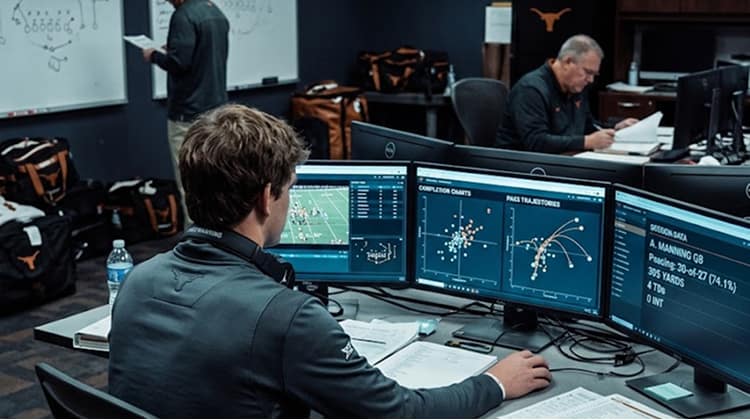
His four touchdown passes tied a career high, a mark he had reached twice during the 2025 season. He also demonstrated greater comfort operating under pressure and outside the pocket, according to ESPN’s analysis of his performance.
There was one obvious blemish.
Manning threw an interception late in the first half while attempting to force a pass into triple coverage in the Texas State end zone. Against Ohio State, that type of decision could have a much greater cost.
That is why the Texas State performance should be viewed as evidence of progress rather than proof that every problem has disappeared.
Still, the overall picture was significantly different from the one Ohio State saw a year ago.
Manning looked more decisive.
He looked more comfortable.
And, perhaps most importantly, Texas has more ways to punish a defense that tries to take away its primary options.
The Texas quarterback outlook heading into this matchup is therefore very different from the situation that existed before the 2025 meeting.
The 2025 Game Exposed Manning’s Biggest Weaknesses
Ohio State’s defensive performance last season provides the blueprint Texas has to overcome.
Manning completed 17 of 30 passes for 170 yards, one touchdown and one interception in the 14-7 loss. The Buckeyes consistently made the quarterback work for completions and prevented Texas from generating enough explosive plays to control the game.
The problem was larger than the box score.
Texas struggled to maintain offensive rhythm, and Ohio State’s defense created enough pressure to keep Manning from settling into the type of game Texas wanted to play.
That experience is important because Manning is no longer approaching Ohio State as an inexperienced quarterback trying to survive his first major start.
He now has a full season of SEC football behind him.
He has started against Alabama, Oklahoma, Georgia, Texas A&M and Michigan.
He finished the 2025 season with a 10-3 record as Texas’ starter and was named Citrus Bowl MVP after throwing and running for touchdowns in the Longhorns’ 41-27 victory over Michigan.
That experience changes the rematch.
Ohio State can still create problems.
But Texas no longer has to wonder how Manning will respond when the opponent is bigger, faster and more disciplined than the teams he sees most weeks.
The Eight-Receiver Performance Matters Against Ohio State
Manning’s ability to spread the ball around may be the most important development from the Texas State game.
He connected with eight different receivers.
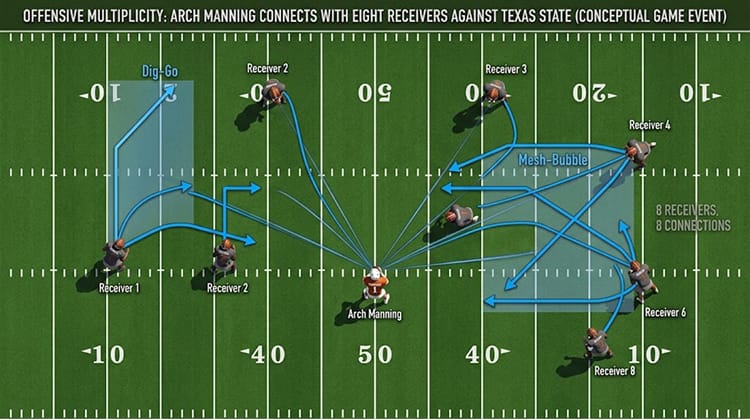
Ryan Wingo led Texas with seven receptions for 121 yards and a touchdown. Coleman added three catches for 70 yards and two scores. Hollywood Smothers also contributed as a receiver while producing 70 rushing yards.
That creates a difficult problem for Ohio State.
The Buckeyes cannot simply build their defensive plan around stopping Wingo.
If they give Wingo additional safety help, Coleman can attack the resulting matchup. If they commit defenders to the outside, Texas can work underneath with its tight ends, running backs and slot receivers.
Coleman’s arrival is particularly important because he gives Manning another receiver capable of winning vertically.
The former Auburn standout immediately demonstrated that chemistry in his Texas debut.
That means the Ohio State defense has to prepare for a Texas offense with more legitimate answers than the one Manning had available in 2025.
The Buckeyes still have elite defensive talent.
But the burden on them is different.
They have to defend an offense that can distribute the ball without becoming predictable.
Cam Coleman Could Change Manning’s Deep Passing Game
The Coleman addition may prove to be one of the most important differences between this Texas offense and last year’s group.
Coleman caught two touchdown passes against Texas State, including a 20-yard scoring reception. He also showed the ability to stretch the field vertically, giving Manning another target capable of turning a single coverage opportunity into a major play.
That matters because Ohio State’s defensive approach against Manning will almost certainly involve forcing him to make difficult decisions before the snap.
If the Buckeyes bring pressure, Manning needs a receiver who can win quickly.
If they sit back in coverage, Texas needs somebody who can create separation downfield.
Coleman gives Sarkisian both possibilities.
Wingo gives Texas proven production on the other side.
And Manning demonstrated against Texas State that he is comfortable using both.
That combination could force Ohio State defensive coordinator Matt Patricia to make difficult coverage decisions throughout the game.
It also creates a direct connection between the transfer-portal strategy and Manning’s development.
Texas did not simply add Coleman to improve its depth chart.
The Longhorns added him because a quarterback competing for a national championship needs multiple receivers capable of changing a game.
The Texas football roster now gives Manning a collection of weapons that looks considerably different from the group Ohio State faced in 2025.
Manning Has To Handle Pressure Differently
The biggest question Saturday may not be whether Manning can throw for 300 yards.
It will be whether he can remain efficient when Ohio State takes away his first option.
That is where the Texas State film becomes particularly interesting.
ESPN’s postgame analysis showed Manning completing all four of his passes when blitzed for 46 yards. He was also 4-of-4 for 52 yards and three first downs when pressured, while completing three of three passes for 48 yards and three first downs when throwing outside the pocket.
Those numbers are much more relevant to Ohio State than his overall yardage total.
The Buckeyes will not be impressed by Texas piling up yards against Texas State.
They will be interested in whether Manning can recognize pressure, move the defense with his eyes, deliver accurately under pressure and avoid turning difficult situations into turnovers.
That was one of the biggest differences between the two teams in last year’s meeting.
Manning has now had an entire season to develop those skills.
The Texas State opener suggests that development is visible.
Ohio State will provide the first real opportunity to determine how far it has gone.
Ohio State Has Its Own Quarterback Problem For Texas
The rematch is not simply Manning versus Ohio State’s defense.
Texas has to deal with Julian Sayin.
The Ohio State quarterback opened the season by throwing for 320 yards and three touchdowns in a 56-3 victory over Ball State. Jeremiah Smith was particularly dominant, catching eight passes for 151 yards and two touchdowns in the first half alone.
That creates an important parallel.
Manning threw for 305 yards and four touchdowns.
Sayin threw for 320 yards and three touchdowns.
Texas defeated Texas State 59-7.
Ohio State defeated Ball State 56-3.
Neither quarterback has yet faced a defense comparable to the one waiting on Sept. 12.
That makes the rematch fascinating because the opening-week statistics are almost irrelevant once the game begins.
Manning will have to prove that his improved mechanics and decision-making translate against Ohio State.
Sayin will have to prove that he can operate efficiently when Texas’ pass rush and secondary begin creating uncomfortable situations.
The first quarterback to consistently win those downs could determine the game.
Texas’ Offensive Line Is Part Of Manning’s Story
There is a tendency to make the rematch entirely about Manning.
That would miss one of the most important variables.
Texas has to protect him.
The Longhorns are still working through a competition at left guard between Dylan Sikorski and sixth-year transfer Laurence Seymore. Against Texas State, the two players split the position, with Sikorski playing 33 snaps and Seymore 36. Neither allowed a pressure, although Sikorski graded better as a run blocker according to Pro Football Focus.
That competition becomes much more meaningful against Ohio State.
Sarkisian can live with rotation against Texas State.
Against the Buckeyes, Texas needs consistency.
Manning cannot spend the night dealing with immediate pressure in obvious passing situations. The offense also needs enough rushing efficiency to prevent Ohio State from knowing exactly when Manning will throw.
The quarterback’s development therefore depends partly on the five players in front of him.
If Texas protects well, Manning’s improved pocket movement and accuracy can become major advantages.
If Ohio State controls the line of scrimmage, Manning will have to create answers under pressure for four quarters.
The 305 Yards Matter, But The Decisions Matter More
The easiest way to evaluate Manning’s opener is to focus on the 305 yards and four touchdowns.
The more revealing evaluation is the way he produced them.
He completed 74.1 percent of his passes.
He used eight receivers.
He produced explosive plays.
He handled pressure effectively.
And he left the game before the end of the third quarter because Texas had built a 42-point advantage.
Those details provide a better picture of where Manning stands than the raw yardage total.
There was also the interception.
That matters because Ohio State will look for opportunities to punish exactly those decisions.
Manning admitted Monday that he remembers the 2025 Ohio State game clearly and acknowledged that there were not many good memories from that performance. He also said he hopes to have a good game in the rematch.
That response is important.
He does not need to erase the previous game.
He needs to demonstrate that the player who struggled in Columbus is no longer the player Texas is putting on the field.
Ohio State Will Force Texas To Play A Different Game
Texas State allowed Manning to operate with a significant margin for error.
Ohio State will not.
The Buckeyes entered the season ranked No. 1 and immediately backed up that ranking with a 56-3 victory over Ball State. Sayin looked efficient, Smith was dominant and Ohio State established itself as the team Texas must beat if the Longhorns want to make an early national statement.
The matchup is scheduled for 6:30 p.m. CT on Sept. 12 at a sold-out DKR-Texas Memorial Stadium in Austin. Ohio State currently leads the all-time series 3-2, including the 14-7 victory in 2025.
For Texas, that means the objective cannot simply be to replicate the Texas State offensive performance.
The Longhorns need to prove they can sustain drives against an elite defense.
They need Manning to convert third downs.
They need explosive plays without reckless decisions.
And they need the quarterback to remain aggressive without allowing Ohio State to turn that aggression into turnovers.
That balance could define the entire game.
The Rematch Is About How Much Manning Has Changed
There is an obvious storyline surrounding Manning and Ohio State.
He struggled against them last year.
Now he gets another chance.
But the more interesting story is what happened between those two games.
Manning became a full-season starter.
He experienced the SEC.
He led Texas to 10 wins.
He won a bowl game against Michigan.
He earned postseason recognition.
Texas added Coleman and Smothers through the transfer portal.
Wingo developed into an established receiving threat.
The offensive structure around Manning changed.
And the quarterback himself appears more comfortable operating within it.
That is why his 305-yard performance against Texas State matters.
It does not prove that Manning will beat Ohio State.
It proves that the version of Manning entering this rematch is substantially more experienced than the one who left Columbus with a 14-7 loss.
The Ohio State rematch preview is therefore less about revenge than it is about evidence.
Texas needs evidence that Manning’s development translates against the best opponent on the schedule.
If he protects the football, handles pressure, distributes the ball and creates explosive plays without forcing throws, Texas will have a legitimate opportunity to beat the No. 1 team in the country.
And if Manning can do that while leading the Longhorns to a victory, the 305-yard opener will be remembered as something more significant than a strong debut.
It will have been the first chapter of the answer to the question Texas has been carrying since Aug. 30, 2025:
How much better is Arch Manning now?