

Texas entered the 2026 season having made one of the most aggressive transfer-portal pushes of the Steve Sarkisian era. The Longhorns brought in 22 transfers, targeting proven production rather than simply adding depth. After one game, that strategy already has some compelling evidence behind it.
No. 5 Texas opened the season with a 59-7 demolition of Texas State on Sept. 5 at Darrell K Royal-Texas Memorial Stadium, and three of the most visible newcomers immediately became central figures. Cam Coleman caught two touchdown passes, Hollywood Smothers opened the game with a 45-yard run and Rasheem Biles forced a fumble before recording an interception.
That performance matters because the Longhorns did not build this transfer class simply to improve their roster on paper. Texas made these additions with a national championship objective and, in part, with the expectation that the new players would have to contribute immediately.
The first game provided exactly that.
Texas Bet On Immediate Production
The biggest difference between Texas’ 2026 transfer strategy and a conventional roster-building approach is the emphasis on players who had already demonstrated that they could produce at the highest levels of college football.
Cam Coleman arrived from Auburn. Rasheem Biles transferred from Pitt. Hollywood Smothers came from NC State. Raleek Brown arrived from Arizona State. The broader class also included additions along the offensive and defensive lines, at linebacker, in the secondary and on special teams. Texas Football’s breakdown of the portal class identified 16 incoming transfers in its January list, while later reporting put the total number of transfers brought into the program at 22.
The philosophy was straightforward: replace lost production with players who did not need several seasons to become comfortable with major college football.
That is particularly valuable for Texas because the 2026 roster was built around a quarterback with enormous expectations. Arch Manning entered the season with the pressure of leading a preseason top-five team, while the Longhorns were also preparing for a Sept. 12 meeting with No. 1 Ohio State.
The additions therefore had a very specific purpose.
They were supposed to make Manning’s job easier, give the defense more playmaking ability and make the roster deeper before Texas reached the most difficult portion of its schedule.
The Texas State opener offered the first indication that the plan is working.
Cam Coleman Gives Arch Manning Another Elite Target
Coleman may be the clearest example of why Texas attacked the portal so aggressively.
The former Auburn receiver did not need a long adjustment period. On his first scoring drive in burnt orange, Coleman caught a six-yard touchdown pass from Manning to give Texas a 7-0 lead. He added another touchdown on a 20-yard reception in the third quarter.

He finished with three catches for 70 yards and two touchdowns.
The numbers are impressive, but the larger value is what Coleman does to the structure of the Texas offense.
Ryan Wingo already gives Manning a proven outside target. Wingo produced seven receptions for 121 yards and a touchdown against Texas State. Emmett Mosley IV provides another option from the slot, while Texas has multiple tight ends and backs capable of contributing in the passing game.
Coleman adds another player defenses have to account for before the snap.
That distinction becomes especially important against elite opponents.
If a defense dedicates additional attention to Wingo, Coleman can punish the matchup. If safeties move toward Coleman, Manning has opportunities elsewhere. And if Texas creates favorable one-on-one situations, the quarterback now has a receiver capable of turning those opportunities into touchdowns.
That is precisely why Coleman was already receiving major preseason recognition. Texas Athletics reported that he was selected to the second team of the Walter Camp Preseason All-America Team, while he and Biles were both named first-team Preseason All-SEC selections by conference coaches.
For more context on how the Longhorns are building around Manning, the team’s 2026 quarterback outlook provides a useful starting point for following the offense as the season develops.
Rasheem Biles Gives The Defense A Different Identity
If Coleman represents the offensive side of Texas’ portal gamble, Biles is the defensive centerpiece.
The former Pitt linebacker arrived in Austin with major expectations. Walter Camp named him a first-team Preseason All-American, and SEC coaches selected him to the first team in their preseason voting.
Against Texas State, he immediately looked like the type of defensive player Texas expected him to be.
Biles forced the fumble that Graceson Littleton recovered and returned 59 yards for a touchdown. Later, Biles intercepted Texas State quarterback Brad Jackson. The interception became his fourth career pick and represented his second turnover-producing play of the afternoon.
That combination is significant.
Biles did not simply accumulate tackles. He changed possessions.
That is exactly what Texas needs from its defense under Will Muschamp.
The Longhorns have talented players throughout the front seven, including Colin Simmons and Justin Cryer, but a championship-caliber defense needs players who can turn pressure into possession-changing plays.
Biles demonstrated that potential immediately.
The Washington Post’s postgame report highlighted his ability to impact the game in multiple ways and quoted Sarkisian describing the fumble-forcing play as an elite effort. Biles himself described the play as a close-range tackle where he used a punch to knock the ball loose.
That is more than a good debut.
It is evidence that Texas may have added the type of defensive catalyst that can matter against elite SEC offenses.
The Three Transfers Solve Three Different Problems
The most encouraging part of Texas’ early return on its portal investment is that Coleman, Smothers and Biles are not redundant additions.
They solve different problems.
| Transfer | Previous School | Texas State Impact | Potential Value |
|---|---|---|---|
| Cam Coleman | Auburn | 3 receptions, 70 yards, 2 TD | Explosive outside receiver |
| Hollywood Smothers | NC State | 10 carries, 70 yards, 2 receiving TD | Big-play running back |
| Rasheem Biles | Pitt | Forced fumble, interception | Turnover-producing linebacker |
Coleman makes the passing game harder to defend.
Smothers gives the offense explosive rushing potential.
Biles gives the defense another player capable of creating turnovers.
That is why the transfer strategy already looks more significant than a simple statistical comparison.
Texas did not need these players to duplicate what returning starters were already doing. It needed them to expand the number of ways the team could win.
The opening game provided evidence of that expansion.
Sarkisian’s Portal Strategy Was Built For Games Like Ohio State
Texas State was always going to be a limited measuring stick.
The real test arrives Sept. 12, when No. 1 Ohio State visits Austin for a 6:30 p.m. CT matchup on ABC.
That game was part of the reason the Longhorns attacked the portal so aggressively in the first place.
Texas had already faced Ohio State twice in recent postseason history, losing the College Football Playoff semifinal at the end of the 2024 season and falling 14-7 in the 2025 season opener. The 2026 meeting gives Sarkisian’s roster a chance to show whether the personnel changes actually closed part of the gap.
Ohio State also opened the 2026 season in dominant fashion, defeating Ball State 56-3 behind quarterback Julian Sayin’s 320 passing yards and three touchdowns.
That makes the transfer discussion more relevant.
Coleman cannot simply be productive against Texas State. He has to create matchup problems against an Ohio State defense.
Smothers cannot just break one long run. He has to help Texas stay efficient when the Buckeyes attempt to pressure Manning.
Biles cannot simply make one highlight play. He has to help Texas handle an Ohio State offense that showed plenty of balance in its opener.
The portal gamble will ultimately be judged in those situations.
Texas’ Newcomers Also Change The Pressure On Returning Players
There is another effect of the transfer strategy that does not show up cleanly in the box score.
Competition improves the entire roster.
Texas entered the offseason after losing several experienced players, including running back Tre Wisner and wide receivers DeAndre Moore Jr. and Parker Livingstone. The program also allowed other highly regarded players to leave as Sarkisian and general manager Brandon Harris reshaped the roster around immediate production.
That approach creates pressure on returning players to hold their positions.
Wingo responded immediately with seven catches and 121 yards.
The offensive line had to compete with incoming players for roles.
The linebacker room added Biles alongside an established group.
The running back room gained Smothers and Brown.
The result is a roster where a player cannot rely solely on what he did the previous season.
That matters for a program trying to move from being a consistent national contender to becoming a team capable of winning the College Football Playoff.
Hollywood Smothers Changes The Pace Of The Running Game
Smothers made his presence felt before Texas had even completed its first offensive series.
On the opening play from scrimmage, the former NC State running back broke loose for a 45-yard gain. Three plays later, Manning found Coleman for the opening touchdown.
That sequence captured what Texas wanted from Smothers.
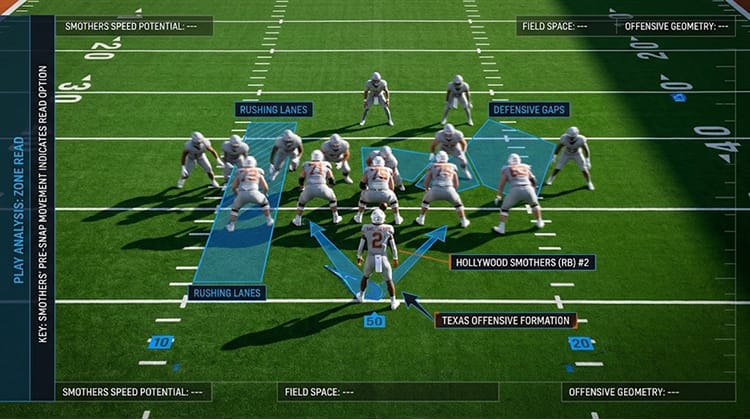
The running back is not simply another player who can carry the football. His acceleration creates the possibility of changing a possession with one play.
Smothers finished the opener with 10 carries for 70 yards while also catching two touchdown passes.
His previous production explains why Texas targeted him. At NC State in 2025, Smothers carried 160 times for 939 yards and six touchdowns, averaging 5.9 yards per carry. He also caught 37 passes for 189 yards and another touchdown.
That background gave Sarkisian a player who could contribute immediately rather than requiring Texas to manufacture a role from scratch.
The Longhorns also have Raleek Brown, who scored two rushing touchdowns against Texas State, giving the offense another explosive back. The result is a backfield where Texas can change styles without changing its overall offensive identity.
Smothers can provide the initial burst. Brown can attack space in different ways. Manning can keep the ball when defenses overcommit. The passing game can then punish opponents for loading the box.
Against Texas State, Texas finished with 516 total yards, including 360 through the air and 156 on the ground.
The rushing total was not overwhelming by itself.
The explosiveness was more important.
The First Game Validated The Philosophy, But Ohio State Will Decide The Argument
Texas scored on eight of its nine drives against Texas State and produced 516 yards of offense. Manning completed 20 of 27 passes for 305 yards and four touchdowns while connecting with eight different receivers.
That distribution is perhaps the strongest argument for the transfer strategy.
Coleman did not have to dominate because Wingo was already producing.
Smothers did not need 20 carries because Texas had other options.
Biles did not need double-digit tackles because his two turnover-producing plays changed the game.
The new additions made the roster broader.
That could become one of Texas’ most important characteristics as the schedule gets tougher.
The Longhorns will eventually face Tennessee, Oklahoma, Florida, Ole Miss, Missouri, LSU and Texas A&M. Those games will require different solutions. Some opponents will challenge the secondary. Others will test the offensive line. Some will force Texas to win through the passing game, while others will demand physicality in the trenches.
A roster built around multiple proven transfer additions gives Sarkisian more answers.
The Texas transfer class was assembled with that flexibility in mind, and the Texas State opener provided the first evidence that several of its most important pieces can contribute immediately.
The Gamble Is Paying Off, But The Real Return Comes Later
It would be premature to declare the 2026 transfer strategy a complete success after one game.
Texas State was overmatched, and the Longhorns were expected to win comfortably.
But the first evidence is difficult to ignore.
Cam Coleman scored twice in his Texas debut.
Hollywood Smothers produced a 45-yard run on the first play and finished with 70 rushing yards plus two receiving touchdowns.
Rasheem Biles forced a fumble and intercepted a pass.
Raleek Brown scored twice.
And the broader group of newcomers helped Texas produce the type of explosive, deep roster Sarkisian envisioned when he made the decision to reshape the team through the portal.
That is the real story behind the 59-7 score.
Texas did not simply add 22 players.
It added specific answers to specific roster questions.
Coleman gives Manning another premium weapon.
Smothers gives the running game another explosive dimension.
Biles gives Muschamp a turnover-producing linebacker.
The next step is considerably harder.
Ohio State will test whether those additions can produce against a team with championship-level talent of its own.
If Coleman can win against Buckeye defensive backs, if Smothers can keep Texas’ offense ahead of the chains and if Biles can continue creating disruption against an elite quarterback, then the portal gamble will begin looking less like a risky roster overhaul and more like the foundation of Texas’ 2026 championship push.