

For Texas, the 2026 season may ultimately be decided by a position group that rarely receives the same attention as Arch Manning, Ryan Wingo or Steve Sarkisian: the offensive line. Kyle Flood enters his fifth season on the Texas staff with one of the most important assignments of his tenure, trying to turn a talented but inconsistent unit into a reliable foundation for a team with SEC championship and College Football Playoff ambitions.
Flood’s situation is unusual because his résumé at Texas already contains substantial evidence of successful development. The Longhorns produced three NFL draft picks from the offensive line in 2025, including first-round selection Kelvin Banks Jr., while Flood’s previous groups helped Texas establish itself as one of the country’s more physical programs. Yet the 2025 season exposed significant problems, particularly along the interior, and Texas’ failure to reach the College Football Playoff has placed greater importance on getting the position right in 2026.
The challenge now is straightforward: Can Flood turn individual talent and experience into five players who consistently function as one unit against SEC defenses?
Why 2026 Is Different For Kyle Flood
Flood has been Texas’ offensive coordinator and offensive line coach since January 2021, making him one of the longest-tenured members of Sarkisian’s staff. His previous work provides a strong argument for patience. Texas’ 2024 offensive line, led by Banks, helped produce an offense that averaged 278.8 passing yards and 158.8 rushing yards per game while scoring 33 points per game.
That production makes the 2025 regression more significant.
The problem was not simply that Texas lost individual battles. The interior of the line became unsettled, forcing adjustments that affected both the running game and Arch Manning’s protection. Sports Illustrated’s recent evaluation described the 2025 interior as a major weakness before Texas stabilized the group by moving Cole Hutson to left guard and Connor Robertson to center.
That late-season improvement provides an important clue for 2026.
Flood does not necessarily need to reinvent the offensive line. He needs to establish continuity earlier.
That distinction is critical in college football. Offensive lines depend heavily on communication, chemistry and recognition. A center must understand how the guards are handling a stunt. Guards need to recognize when a defensive tackle is attempting to penetrate rather than occupy a gap. Tackles have to coordinate their sets with the quarterback’s timing.
Talent helps.
Experience helps.
But five talented players who do not communicate effectively can still produce an average offensive line.
The Returners Give Texas A Foundation
Texas enters 2026 with several players capable of providing that continuity.

Trevor Goosby and Connor Robertson are particularly important pieces, while Brandon Baker is expected to move inside, giving Flood another experienced option in the interior. The Longhorns also added Wake Forest transfer Melvin Siani, increasing the competition for meaningful snaps.
| Player | 2026 Role | Why It Matters |
|---|---|---|
| Trevor Goosby | Returning offensive lineman | Provides experience and tackle stability |
| Connor Robertson | Returning offensive lineman | Offers continuity after late-2025 improvement |
| Brandon Baker | Interior candidate | Adds size and experience inside |
| Melvin Siani | Transfer addition | Brings additional SEC-caliber competition |
| Laurence Seymore | Interior competition | Adds depth at guard |
The roster construction is important because Texas no longer appears to be entering the season with a completely unsettled group. Instead, Flood has multiple experienced pieces competing for the five starting positions. The official Texas roster lists Flood as both offensive coordinator and offensive line coach, reinforcing how closely his responsibilities are tied to the unit’s performance.
The next question is how quickly those pieces become a cohesive five-man front.
Brandon Baker’s Position Change Could Be A Major Factor
One of the more interesting developments in the offensive line is Brandon Baker’s expected move inside.
Baker arrived at Texas as a highly regarded offensive tackle and has developed significant experience on the outside. Moving him toward guard changes the equation because interior offensive line play requires a different combination of leverage, footwork and reaction time.
The potential benefit is obvious.
If Baker can successfully transition inside, Flood gains another experienced player capable of handling powerful defensive tackles while also creating a more athletic option in the running game.
The risk is equally clear.
Every position change introduces an adjustment period.
That makes fall camp particularly important. The goal is not merely to determine whether Baker can play guard. Flood has to determine whether the entire combination works better with Baker inside and another player occupying the tackle position.
This is why offensive line evaluation cannot be reduced to individual rankings.
The best five players on paper are not necessarily the best five players together.
Melvin Siani Adds A Transfer-Portal Solution
The addition of Melvin Siani gives Flood another way to address the problem.
Siani arrives from Wake Forest with the experience Texas wanted in the trenches. His presence also creates competition, which may be just as important as his eventual starting role.
Competition prevents assumptions.
A returning player cannot assume that last year’s snaps guarantee this year’s starting job. A transfer cannot assume that his previous production automatically translates to Texas. Younger linemen also have an opportunity to force themselves into the rotation.
That dynamic is valuable because SEC offensive lines need depth.
Texas will not play one elite defensive front throughout the season. It will face different styles, different blitz packages and different physical profiles. Injuries are also unavoidable over a long season.
The ability to rotate players without dramatically lowering the quality of protection can become a competitive advantage.
Recent analysis of the 2026 Texas offensive line has specifically pointed to the combination of returning contributors and portal additions as the reason the group could emerge as one of the SEC’s better units.
The Interior Could Determine Everything
The most important improvement may come inside.
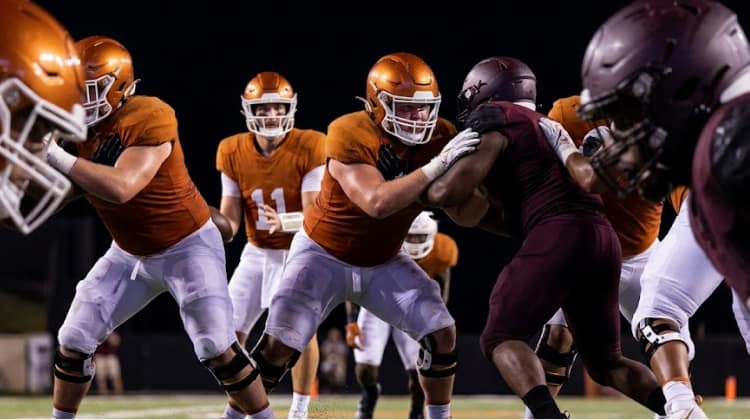
Texas’ tackle situation has more recognizable continuity, but interior play has been a recurring concern. That makes the guard and center positions particularly important for Manning’s development.
Manning does not need perfect protection on every snap. No quarterback receives that in the SEC.
He does need predictable protection.
If the interior collapses quickly, Manning’s ability to operate the offense becomes more complicated. His progressions shorten. The pocket disappears. Running plays become harder to execute. And Sarkisian loses some of the flexibility that makes his offense difficult to defend.
The importance of the interior also extends to the running game.
A team cannot consistently establish inside runs if its guards and center are losing leverage. That becomes especially problematic near the goal line, where the field is compressed and defensive fronts can attack the same gaps repeatedly.
Texas has spent the offseason emphasizing physicality, making the performance of the interior line one of the clearest indicators of whether that message has translated into actual football.
Recent reporting on Texas’ 2026 preparation has emphasized the importance of becoming more physical, particularly after the inconsistencies that affected the 2025 offense.
Arch Manning Changes The Standard
The emergence of Arch Manning raises the stakes for Flood.
Texas has spent years building toward a quarterback with Manning’s pedigree, and 2026 represents his first season entering the year as the unquestioned starter. That means the offensive line is no longer simply developing a unit for the future.
It is protecting the centerpiece of the current offense.
Manning’s skill set gives Sarkisian options that can reduce some pressure on the offensive line. His mobility can extend plays, while his ability to distribute the ball quickly can punish defensive pressure.
But those traits should complement strong protection rather than compensate for weak protection.
That is particularly true against elite SEC defenses.
If Texas wants to compete with Georgia, Alabama and other championship-level programs, Manning cannot spend the season consistently escaping pressure before making throws. Sarkisian needs to be able to call deeper concepts, manipulate safeties and establish a credible running threat.
That starts with time.
The Running Game Is The Other Half Of The Equation
The offensive line’s success cannot be judged only by sacks allowed.
Texas also needs to determine whether it can run the football when the defense knows a run is coming.
This is where Flood’s 2026 evaluation becomes more complicated.
A successful passing offense can hide some weaknesses in the running game against lesser opponents. But championship contenders eventually face defenses capable of forcing them into uncomfortable situations.
Third-and-2 is the classic example.
If Texas needs two yards and cannot reliably create them between the tackles, opponents can attack Manning with greater confidence. If the Longhorns can consistently gain those two yards, the entire playbook expands.
That also affects red-zone football.
The closer Texas gets to the goal line, the less useful open-field athleticism becomes. Blocking angles become more important. Individual leverage becomes more important. And the ability to move a defensive lineman backward becomes one of the most valuable skills on the field.
Sarkisian has already emphasized the need for Texas to become more physical, making the offensive line a central part of that broader identity.
Ohio State Will Provide The First Major Test
Texas does not have to wait long for an evaluation of its progress.
The Longhorns open the 2026 season against Texas State before hosting Ohio State on September 12. That second game provides an early opportunity to see whether the revamped offensive line can handle an elite opponent.
The Ohio State matchup is especially important because Texas will have little room for technical mistakes.
Against a lesser opponent, a missed assignment can sometimes be corrected by superior individual talent.
Against Ohio State, it can become a sack, tackle for loss or turnover.
That makes communication as important as physical strength.
Flood’s group will need to identify pressures, communicate protections and maintain blocks long enough for Manning to work through his progressions. The running game will also be tested because Ohio State can devote additional resources to stopping it if Texas cannot consistently create movement.
A strong performance would not automatically prove Texas has an elite offensive line.
A poor performance would not necessarily prove the opposite.
But the game will provide one of the first meaningful data points of the season.
SEC Play Will Reveal Whether The Improvement Is Real
The ultimate test will come later.
Texas can look excellent against one opponent and still struggle over the course of an SEC schedule. Depth, injuries and accumulated physical wear become increasingly important as the season progresses.
That is why Flood’s job is bigger than identifying five starters.
He needs a rotation.
He needs younger players ready to contribute.
He needs multiple combinations capable of surviving injuries.
And he needs those players to improve between September and November rather than simply maintaining their August level.
Texas’ current roster provides Flood with significant size and experience. The official roster lists multiple offensive linemen above 300 pounds, giving the Longhorns the physical profile expected from a major SEC program.
The next step is turning that physical profile into consistent production.
Flood’s NFL Track Record Sets The Bar
There is also a broader reason expectations remain high for Flood.
His Texas tenure has already produced NFL offensive linemen. Kelvin Banks became a first-round NFL Draft selection, while Cam Williams and Hayden Conner were also selected in the 2025 draft. Texas’ 2024 offense demonstrated what the position can look like when the unit is experienced and cohesive.
That history matters because Flood has already shown he can develop professional-level talent.
The 2026 challenge is different.
It is about developing a group capable of producing championship-level consistency.
That means fewer communication breakdowns.
Fewer negative plays.
Better short-yardage execution.
More reliable pass protection.
And greater physical control of the line of scrimmage.
Those are not glamorous statistics, but they are often the numbers that determine whether a talented roster becomes a championship roster.
The Five-Man Combination Could Define Texas’ Ceiling
Flood’s most important decision may ultimately be the simplest one: identifying the best five-man combination and keeping it together.
Texas has enough talent to create several possible combinations. The return of Goosby and Robertson provides continuity, Baker’s potential move inside offers flexibility, and Siani adds another experienced option. The depth behind them gives Flood additional insurance.
But the strongest lineup will be the one that communicates best under pressure.
That will become especially important once Texas reaches the heart of SEC play.
A championship offensive line does not have to dominate every opponent for 60 minutes. It needs to dominate the right moments.
Third-and-short.
Goal line.
Two-minute protection.
Fourth-quarter clock management.
A late drive against an elite defense.
Those are the situations where the difference between a good offensive line and an elite one becomes visible.
Texas Needs Flood’s Unit To Become A Strength
The pressure surrounding Kyle Flood is understandable, but the situation is not necessarily a referendum on whether he can coach offensive linemen.
His record already provides evidence that he can.
The 2026 season is instead about whether he can take a group with returning experience, transfer additions and positional flexibility and build the kind of cohesion Texas needs to compete for the SEC championship.
That is a different challenge from simply producing NFL prospects.
Texas already has the quarterback.
It has explosive receivers.
It has defensive talent.
It has a coaching staff built around championship expectations.
The offensive line has to connect those pieces.
If Flood’s unit protects Manning, establishes a dependable rushing attack and remains physically consistent through the SEC schedule, Texas’ offense could become considerably more difficult to defend.
If the interior problems return, the Longhorns could once again find themselves with elite skill-position talent that is forced to overcome weaknesses at the point of attack.
That is why 2026 represents such an important season for Kyle Flood.
The question is no longer whether Texas has talented offensive linemen.
The question is whether Flood can make them play like an elite offensive line when the games become most demanding.
For a Texas program trying to move from SEC contender to national championship favorite, that distinction could define the entire season.