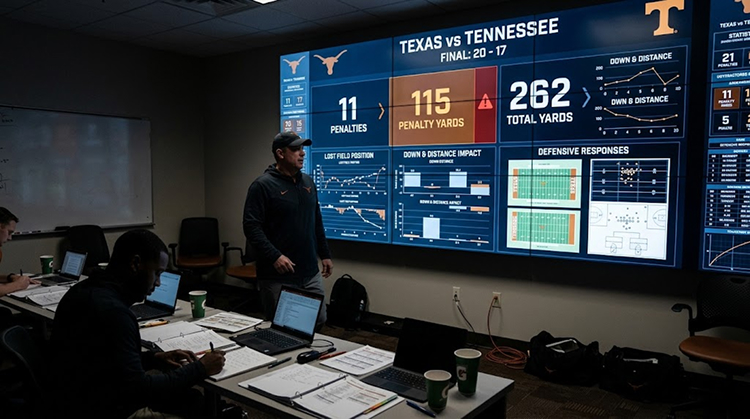
Texas enters the Red River Rivalry with a 4-0 record, the No. 1 ranking in the country and one of the strongest defenses in college football. Yet Steve Sarkisian knows there is still one problem capable of turning a dominant season into a much harder one: penalties. The Longhorns committed 11 penalties for 115 yards in their 20-17 victory over Tennessee on Sept. 26, and they enter Oklahoma week averaging 6.25 penalties and 62.5 penalty yards per game. Sarkisian used the bye week to put his players through game-like situations specifically designed to address the decisions that have created those flags.
Texas’ Record Has Hidden The Cost Of Its Penalties
Texas has managed to win every game despite repeatedly giving opponents opportunities through self-inflicted mistakes. That is an important distinction because the Longhorns’ record is excellent, but their margin for error has not always matched their national ranking.
The Tennessee game was the clearest example. Texas gained only 262 total yards, rushed for 61 yards and converted three of 12 third downs. Tennessee actually produced 22 first downs compared with Texas’ 14. Yet the Longhorn defense held the Volunteers to 221 total yards and the Longhorns escaped Knoxville with a three-point victory.
The problem is that Texas cannot assume its defense will always erase those mistakes.
Colin Simmons and the rest of the defensive front gave Sarkisian an enormous safety net against Tennessee, but even that performance could not completely eliminate the consequences of poor execution. Eleven penalties for 115 yards meant Texas repeatedly surrendered field position while also extending the possibility of Tennessee drives.
That is why the issue deserves more attention than the raw penalty count suggests.
The Tennessee Game Was A Warning
The numbers from Neyland Stadium provide a useful picture of how penalties can distort a close game. Texas was penalized 11 times compared with seven penalties for Tennessee, and the Longhorns lost 115 yards to flags. The Volunteers lost 55.
Texas still won because its defense created pressure at an extraordinary rate. Simmons tied the Texas single-game record with five sacks, while the Longhorn defense produced 10 sacks as a team. The defense also limited Tennessee to 70 rushing yards and 151 passing yards.
That formula will be difficult to reproduce every week.
Against Oklahoma, Texas may need the offense to do more of the work. The Sooners enter Red River at 2-2, and while their own season has been inconsistent, their defense has shown enough ability to create difficult down-and-distance situations.
Giving Oklahoma 10 or 15 free yards through a penalty can completely change the value of a defensive stop. A third-and-9 can become a first down. A punt can become a new possession. A promising Texas drive can suddenly begin 15 yards behind schedule.
Those are the hidden costs of penalties.
Sarkisian Is Treating The Problem As A Decision-Making Issue
Sarkisian’s comments during Red River week are significant because he did not describe the penalty issue simply as bad luck or aggressive football.
He pointed specifically to the decisions that lead to penalties.
During the bye week, Texas reportedly created intense, game-like situations designed to force players to experience the consequences of those decisions before returning to competition. Sarkisian said the staff wanted players to feel the effect of penalties during practice rather than simply hearing another warning about discipline.
That approach is important because Texas’ penalty problem has involved different types of mistakes.
Some penalties can come from technique. Others are created by players losing emotional control, making late decisions or failing to recognize the situation. Those problems require different corrections.
The coaching challenge is therefore bigger than telling players to “play smarter.”
Texas needs players to make the correct decision while tired, frustrated, excited and under pressure. That is precisely why Sarkisian emphasized game-like situations during the bye.
Texas Has Already Improved From Last Season
There is an important piece of context that prevents the current penalty problem from being overstated.
Texas’ numbers are better than they were last season.
Recent reporting has Texas averaging 6.25 penalties and 62.5 penalty yards per game through four games, compared with an SEC-worst 8.3 penalties and 69.7 penalty yards per game during the previous season.
That means Sarkisian’s program has made progress.
The problem is that progress is not the same as being good enough.
A team ranked No. 1 nationally is judged differently from a team trying to become competitive. Texas has championship expectations, and the margin between winning and losing becomes much smaller as the schedule gets harder.
The Longhorns also cannot assume that every future opponent will fail to capitalize on their mistakes.
Red River Is The Worst Possible Place To Lose Discipline
The Oklahoma game presents an unusually difficult environment for Texas because of the rivalry itself.
The Red River Rivalry is emotional by nature. Texas and Oklahoma play at the Cotton Bowl with the State Fair of Texas surrounding the stadium, and the game creates a level of noise, pressure and attention that is difficult to replicate during a normal conference game.
That environment makes discipline even more important.
Players will be surrounded by rival fans, former players, national television coverage and constant reminders of the history between the programs. A late hit, unnecessary celebration or retaliation after the whistle can quickly change the game.
Sarkisian does not need his players to remove emotion from the rivalry. He needs them to control how they respond to it.
That distinction could be one of the biggest themes of Saturday’s matchup.
Colin Simmons Has Already Learned The Lesson
Colin Simmons provides perhaps the clearest example of why emotional control matters.
His five-sack performance against Tennessee was one of the most dominant defensive displays in Texas football this season. But the celebration after one of his sacks resulted in an unsportsmanlike conduct penalty, creating an avoidable consequence immediately after an enormous defensive play.
Sarkisian subsequently addressed the behavior and made clear that the standard had to be higher.
The incident is relevant because Simmons is precisely the type of player Texas needs operating at maximum intensity. His aggression is an asset. His ability to create pressure changes games.
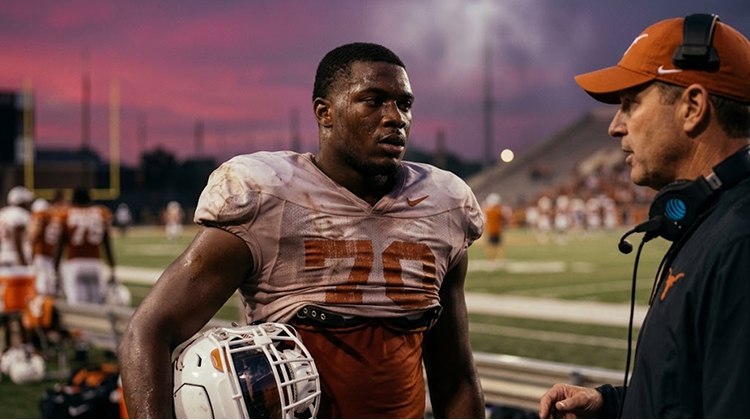
But the same emotional energy that helps him attack quarterbacks can become a problem if it crosses the line.
Texas needs Simmons playing with the same physical intensity while eliminating the penalties that can accompany it.
The Offense Cannot Afford More Lost Yardage
Texas’ offensive struggles make the penalty problem even more significant.
Through the first four games, the Longhorns have been searching for consistency in the running game and have had stretches in which the offense struggled to sustain drives. Against Tennessee, Texas averaged only 1.7 yards per rushing attempt and finished with 262 total yards.
That means offensive penalties can be particularly damaging.
An offense that is already struggling to create manageable third downs cannot afford first-and-20 situations. A false start, holding penalty or illegal formation can turn an ordinary possession into a difficult sequence.
It also puts more pressure on Arch Manning.
Manning has demonstrated the ability to produce explosive passing performances, including 305 yards and four touchdowns against Texas State. But asking a quarterback to repeatedly rescue drives after penalties is an inefficient way to build an offense.
Texas needs to make his job easier.
The Longhorns should be trying to create second-and-medium and third-and-manageable situations rather than repeatedly asking Manning to convert long-yardage downs.
Penalties Can Change Texas’ Play-Calling
There is also a strategic consequence that does not appear in a box score.
Penalties can shrink the offensive playbook.
When Texas falls behind schedule, Sarkisian has fewer opportunities to call the full range of plays he has available. Certain runs become less attractive. Play-action becomes harder to establish. Deep routes become more necessary, while Oklahoma can anticipate the passing situation.
That is exactly what a defense wants.
A penalty therefore affects more than the 10 or 15 yards printed next to it. It changes the next several plays.
If Texas begins a possession with a false start, for example, the offense may need two or three successful plays simply to return to its original down-and-distance situation. One mistake can therefore influence an entire series.
This is especially dangerous against an Oklahoma defense capable of creating pressure.
Texas’ Defense Cannot Keep Cleaning Up Every Mistake
The Longhorn defense has become the team’s most reliable source of stability.
Texas held Ohio State to 23 points in the season opener, defeated UTSA while creating defensive stops and then produced a dominant pressure performance against Tennessee. Simmons has become one of the country’s most disruptive pass rushers, while Texas has developed enough depth to create pressure from multiple positions.
But relying on the defense to repeatedly overcome offensive and special-teams mistakes is not sustainable.
A defense can force a punt after a penalty. It can create a turnover after a poor offensive possession. It can even dominate an opponent for most of a game.
Eventually, however, the number of extra opportunities becomes too large.
Texas should want its defense to decide games because it is the better unit, not because the offense has repeatedly put it in difficult situations.
Special Teams Makes The Problem Even Bigger
The penalty issue also intersects with another area Sarkisian had reason to address during the bye: special teams.
Texas struggled in that phase against Tennessee, including a 57-yard punt return touchdown allowed by Tennessee and several execution issues that created field-position problems. One block-in-the-back penalty was among the mistakes that compounded the situation.
Special teams mistakes can be particularly damaging because they often affect both field position and momentum.
A penalty after a punt return can erase valuable yardage. A mistake on a kickoff can give an opponent possession near midfield. A poor punt can force a defense to defend a short field.
Texas survived those problems against Tennessee because the defense repeatedly responded.
That should not become the plan.
Oklahoma Will Test Texas’ Discipline Differently
The Red River matchup creates a different type of challenge from Tennessee.
Texas will not be dealing with the same road environment it faced at Neyland Stadium, but the emotional pressure may be just as intense. The Cotton Bowl setting gives both fan bases an unusually direct presence, and the game is played with the rivalry’s history constantly in view.
Oklahoma also has plenty of motivation.
The Sooners are 2-2, while Texas is 4-0 and remains No. 1. That difference creates a natural pressure imbalance. Oklahoma can approach the game as an opportunity to disrupt Texas’ season, while the Longhorns enter knowing that a loss could immediately change the national conversation.
That is precisely why discipline matters.
Texas cannot control how Oklahoma plays. It can control whether its own mistakes give the Sooners opportunities.
The No. 1 Ranking Makes Every Penalty More Visible
The national perception of Texas has changed because the Longhorns are No. 1.
Every mistake is now analyzed differently.
When a team ranked outside the top 25 commits 11 penalties, it is usually described as a discipline problem. When the No. 1 team commits 11 penalties for 115 yards in a three-point victory, the same issue becomes part of the national argument over whether that team is actually the best in the country.
Texas cannot eliminate every mistake. No college football team can.
But the Longhorns can eliminate avoidable mistakes.
That is what makes Sarkisian’s emphasis so important. The goal is not perfection. The goal is to stop giving opponents opportunities that Texas does not need to give them.
The Bye Week Was Texas’ Chance To Reset
The timing of the bye week may have been ideal.
Texas had nine days between the Tennessee game and the start of Red River preparation, giving Sarkisian and his staff time to review the first four games without preparing for another opponent immediately.
The coaching staff could examine every penalty, identify patterns and recreate the situations that caused them.
Sarkisian said the team had two particularly intense practice days during the bye, using game-like situations to reinforce the consequences of poor decisions.
Now the coaching staff has to find out whether those lessons transfer to the Cotton Bowl.
Practice corrections only matter if players make better decisions under real pressure.
Texas Needs Fewer Mistakes More Than More Emotion
There is no reason for Texas to become less aggressive against Oklahoma.
The Longhorns should attack. Their defensive front should pressure John Mateer. Their receivers should challenge the Sooners’ secondary. Their running backs should run with physicality.
The objective is to preserve that aggression without allowing it to become undisciplined football.
That is the balance Sarkisian has been trying to establish.
Texas has enough talent to beat Oklahoma. It has enough defensive strength to control games. It has enough offensive weapons to create explosive plays.
What the Longhorns cannot afford is to repeatedly give those advantages away.
The Penalty Count Could Become A Red River Stat That Matters
The most important statistic Saturday may not be Arch Manning’s passing yards or Colin Simmons’ sack total.
It could be the number of penalties next to Texas’ name.
If Texas finishes with three or four penalties and avoids the major emotional mistakes that hurt it against Tennessee, Sarkisian will have evidence that the bye-week emphasis worked.
If Texas again reaches double digits, the issue will become much harder to dismiss.
The Longhorns have already shown that they can win despite their mistakes. They beat Tennessee 20-17 while committing 11 penalties for 115 yards. They have also remained undefeated and stayed atop the AP rankings.
But the next step for Texas is different.
A championship-level team cannot consistently depend on its defense to erase its own mistakes. Against Oklahoma, the Longhorns have an opportunity to show that the lessons from the first month have actually translated onto the field.
For Sarkisian, the objective is straightforward: keep the physical edge, keep the emotion and remove the unnecessary flags. If Texas can do that, its No. 1 ranking will look considerably more convincing after Red River.