Texas is heading into its first SEC game of the 2026 season with the No. 1 ranking, a 3-0 record and a defense that has already carried the team through its most important early-season moments.
But there is one developing question that could affect how Steve Sarkisian and defensive coordinator Will Muschamp approach the trip to Knoxville.
Colin Simmons left Texas’ 30-6 victory over UTSA on Sept. 19 and spent the second half on the sideline in street clothes while wearing a boot on his right foot. The junior edge rusher had recorded a sack of UTSA quarterback Owen McCown before leaving the game, and the exact moment of the injury was not initially clear.
Sarkisian subsequently downplayed the severity of the situation, saying the decision to remove Simmons was precautionary and that he expected him to be fine.
That distinction is critical.
There is currently no confirmation that Simmons will miss Texas’ Sept. 26 matchup with No. 14/13 Tennessee. But the fact that one of the Longhorns’ most important defensive players was wearing a walking boot one week before the SEC opener means Texas has to prepare for multiple possibilities.
The issue is less about replacing Simmons completely and more about determining how the defense would redistribute his responsibilities if his availability is limited.
Simmons Has Become A Central Piece Of Texas’ Defense
Simmons entered the season with enormous expectations as a preseason All-American and one of the most recognizable players on the Texas defense.
Through the opening three games, his statistical totals have not been overwhelming, but his impact extends beyond the box score. Before the UTSA game, Simmons had recorded 2.5 tackles for loss, one sack, one quarterback hit and four quarterback hurries during the first two games. He added another sack against UTSA before leaving.
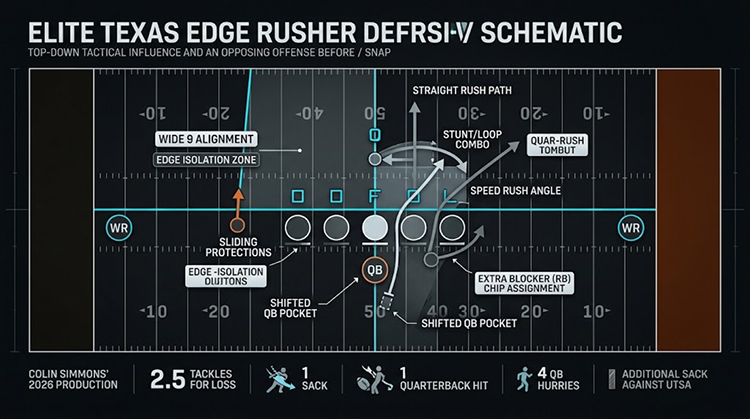
His value becomes clearer when considering the type of player Texas asks him to be.
Simmons is expected to threaten the quarterback from the edge, set the edge against the run and create situations in which opposing offenses have to account for him before the snap.
That versatility gives Muschamp flexibility.
Texas can move Simmons around the formation, use him as a traditional edge rusher, create pressure with simulated fronts or force an offense to change its protection rules because of where he lines up.
If Simmons is completely healthy against Tennessee, that flexibility remains intact.
If he is limited, Texas may have to simplify certain portions of its defensive plan or lean more heavily on other pass rushers.
That could matter significantly against Tennessee quarterback Faizon Brandon.
Steve Sarkisian Is Downplaying The Injury
The most important piece of information currently available comes directly from Sarkisian.
After the UTSA game, the Texas coach said he did not believe Simmons’ injury was serious and characterized the decision to remove him as precautionary.
“I don’t think Colin’s injury is serious,” Sarkisian said. “It was more precautionary to get him out. I think Colin will be fine.”
That statement should carry more weight than speculation based solely on the walking boot.
Texas has already demonstrated this season that protective measures do not automatically mean a player will miss the following game. Derrek Cooper Jr., for example, had worn a boot earlier in the season before returning to play against Ohio State.
At the same time, the Tennessee game represents a different level of competition.
Texas is entering conference play, and Tennessee has become one of the most significant tests on the schedule. The Longhorns therefore have every reason to be conservative with Simmons during the week if his recovery requires additional evaluation.
The first official SEC injury report should provide more clarity as game week progresses.
Until then, the appropriate reading is that Simmons’ status is uncertain but that Texas expects him to have a chance to play.
Tennessee Creates A Different Challenge For The Edge Rushers
The timing of Simmons’ injury matters because Tennessee is not simply another opponent on the schedule.
The Longhorns will travel to Neyland Stadium for an 11 a.m. CT kickoff on Sept. 26, with the game televised nationally by ABC. Tennessee is 3-0 and has moved to No. 14/13 in the latest national rankings.
That means Texas will be facing its first SEC opponent immediately after completing a nonconference schedule that included Texas State, Ohio State and UTSA.
The defensive game plan will also have to account for Tennessee’s freshman quarterback.
Faizon Brandon is a 6-foot-4, 225-pound true freshman from Greensboro, North Carolina, who was named Tennessee’s starting quarterback before the season. He has already earned SEC Freshman of the Week honors twice this season, including recognition following Tennessee’s games against Furman and Georgia Tech.
Brandon’s mobility changes the equation for an edge defender.
A pass rusher cannot simply attack the quarterback without maintaining awareness of the escape lane. If Simmons is available, Texas can use his athleticism while asking him to maintain discipline. If Simmons is limited, the Longhorns may need to be more deliberate about how aggressively their edge defenders attack.
That distinction could influence the entire pressure package.
Richard Wesley Gives Texas An Intriguing Option
One of the most interesting developments from the UTSA game was the additional playing time received by freshman Richard Wesley after Simmons left.
Wesley is a five-star recruit from California, and he finished the UTSA game with three solo tackles, including one tackle for loss. Sarkisian specifically praised Wesley’s ability to play the run while also pointing out his natural pass-rushing ability.
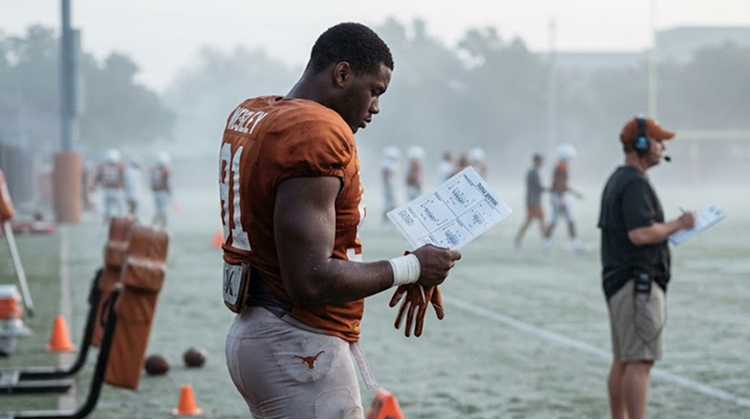
That gives Texas a potential answer if Simmons cannot handle his normal workload.
Wesley does not need to become Colin Simmons overnight.
Texas can instead change the distribution of snaps.
Simmons could potentially play a reduced number of high-leverage situations while Wesley receives additional early-down work. Texas could also rotate other defensive linemen and linebackers into packages designed to preserve the pressure threat without asking one player to replicate everything Simmons provides.
That approach would allow the Longhorns to protect Simmons while keeping Tennessee from knowing exactly where the pressure is coming from.
For a freshman like Wesley, the Tennessee game would also represent a significant jump in responsibility.
Neyland Stadium is a different environment from DKR, and SEC road football introduces communication challenges that do not appear in the statistics.
Texas’ Defense Has Already Shown It Can Carry The Team
The good news for Texas is that Simmons is part of a defensive unit that has developed considerable depth.
Against UTSA, the Longhorns held the Roadrunners to 142 total yards, including only 72 rushing yards and 70 passing yards. UTSA converted just 1 of 11 third downs, while Texas controlled possession for 36:51 and produced 27 first downs.
The defense also benefited from an early turnover when Rasheem Biles intercepted McCown on the opening play.
That performance was particularly important because Texas’ offense was inconsistent.
Arch Manning completed 16 of 32 passes for 161 yards and two touchdowns, while the Longhorns produced 228 rushing yards. Texas won 30-6 despite an offensive performance that did not resemble the explosive fourth-quarter finish against Ohio State.
That makes the defensive performance even more relevant.
Texas did not need Simmons for the entire second half against UTSA, and the defense continued to control the game.
The question is whether that depth will hold against Tennessee.
Rasheem Biles Could Become Even More Important
If Simmons’ workload changes, Rasheem Biles could become one of the players Texas relies on most heavily.
Biles has already emerged as a major piece of the defense early in the season. His opening-play interception against UTSA showed his ability to create immediate disruption, while his physical presence gives Texas another way to pressure an opposing offense without depending entirely on its edge rushers.
That versatility becomes valuable if Simmons is restricted.
Texas can generate pressure through the second level, bring defensive backs into pressure packages or use interior defenders to collapse the pocket.
The goal would not be to find one player who replaces Simmons.
It would be to make the defense less dependent on any single matchup.
That could actually make Texas more difficult for Tennessee to diagnose.
Hero Kanu And The Interior Could Matter More
Another potential adjustment involves the defensive interior.
Texas recorded 228 rushing yards offensively against UTSA, but the defensive front also helped limit the Roadrunners to 72 rushing yards. That performance gives Muschamp another foundation from which to build the Tennessee game plan.
If Simmons cannot play his normal number of snaps, the interior defensive line becomes even more important.
A strong interior rush can prevent the quarterback from simply stepping up when edge pressure arrives.
That is especially useful against a mobile quarterback like Brandon.
Texas could therefore emphasize interior disruption early in the game and use its edge rushers more selectively rather than asking them to win every passing situation.
Hero Kanu and the rest of the interior rotation will have an important role in that equation.
The better Texas plays inside, the less pressure there is on one edge defender to create the entire pass rush.
The Tennessee Game Will Reveal How Deep Texas Really Is
The Ohio State comeback showed Texas could overcome adversity.
The UTSA game showed the defense could dominate even when the offense was uneven.
Tennessee presents a different test because the Longhorns are now entering the portion of the schedule where depth becomes a weekly requirement.
Texas has already been managing multiple defensive personnel questions. Simmons left UTSA, Kobe Black did not play, and Justus Terry was also unavailable. Sarkisian said after the game that Texas was down several significant defensive players and hoped to begin getting some of them back.
That makes the next few days important.
The Longhorns do not need every player to return at once.
They need enough of their core defensive personnel available to maintain the identity that has helped them reach No. 1.
For Texas fans following the Texas defensive outlook, the Simmons situation is therefore about more than one injury. It is an early measure of whether the roster has the depth necessary to survive an SEC schedule.
Tennessee Will Test Texas’ Ability To Rush Without Losing Discipline
There is a tactical reason Simmons’ status matters beyond his individual talent.
Against Brandon, Texas cannot afford to turn every pass rush into a race to the quarterback.
A mobile quarterback can punish overaggressive edge play by escaping outside containment or scrambling through an open lane.
That means Texas may need to balance pressure with controlled rush lanes.
Simmons is particularly valuable in that type of game because his athleticism gives the defense more options. If he is limited, the Longhorns may prefer pressure concepts that create confusion without asking a backup edge defender to win a one-on-one matchup every snap.
That could mean more simulated pressures, more movement before the snap and greater reliance on interior penetration.
It also means Texas has to tackle well.
The easiest way for a quarterback to turn a well-designed defensive call into a big play is to escape the initial pressure and gain yards after the defense loses its structure.
The Longhorns have little margin for that against Tennessee.
Neyland Stadium Raises The Communication Challenge
Texas’ defensive adjustments will take place in one of college football’s loudest environments.
The game will be played at Neyland Stadium in Knoxville, with the official Texas schedule listing an 11 a.m. CT kickoff on ABC. Tennessee’s official game center lists the same contest at noon Eastern.
That environment places additional importance on communication.
A defense missing a key edge player may already be adjusting assignments and rotations. Doing so on the road against a fast Tennessee offense requires everyone to understand the call immediately.
Texas therefore needs to enter Knoxville with a plan that does not depend on improvisation.
If Simmons is cleared, the Longhorns can build around him.
If he is limited, the rotation must already be established.
If he cannot play, Wesley and the rest of the defensive front need to know exactly what their responsibilities are before the first snap.
That preparation can matter as much as the final injury designation.
Simmons’ Status Could Change The Plan Without Changing The Standard
The latest information does not indicate that Colin Simmons is expected to miss Tennessee.
Sarkisian has described the injury as precautionary and said he expects Simmons to be fine.
But Texas should prepare for every reasonable scenario.
The Longhorns have earned the No. 1 ranking by surviving Ohio State, controlling UTSA and building one of the nation’s more disruptive defensive groups.
The next step is proving that the defense can maintain that standard when one of its most important players is not at full strength.
If Simmons plays normally, Texas gains one of its most valuable pass-rushing weapons for the SEC opener.
If he is limited, the Longhorns can lean on Richard Wesley, Rasheem Biles, Hero Kanu and a deeper rotation.
If he cannot play, Texas will need its collective defensive structure to compensate.
That is the real significance of the injury heading into Sept. 26.
The question is not simply whether Colin Simmons will be on the field.
It is whether Texas has built enough defensive depth that one player’s availability does not determine the identity of the No. 1 team in the country.